 Wiga Tap Manufacturer
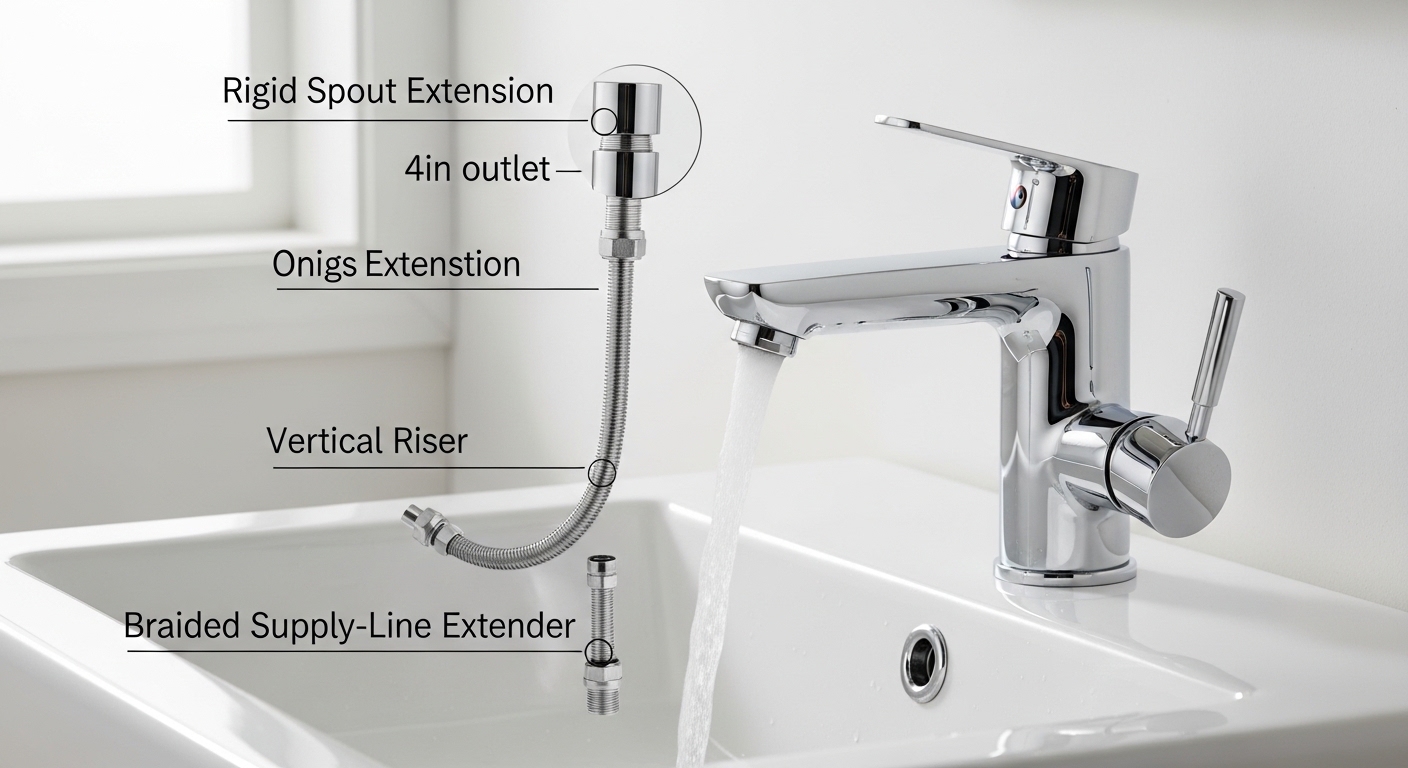
If your water splashes the back of the sink, your spout sits too low over a vessel bowl, or your supply lines just won’t reach the shutoff valve, a bathroom faucet extension pipe is usually the cheapest fix in plumbing. It’s a small part that solves a surprisingly annoying set of problems — awkward reach, wrong height, or a connection that’s an inch too short. But “extension pipe” actually covers three very different parts, and buying the wrong one is the #1 reason people return them. This guide sorts out exactly which type you need, how to size it, and how to install it without a leak.
What does a “faucet extension pipe” actually do — reach, height, or supply?
It does one of three jobs, and you need to know which before you buy. An extension pipe either (1) lengthens the spout so water reaches farther into the bowl, (2) raises the height of the spout for vessel or deep sinks, or (3) lengthens the supply line/tailpiece underneath so the faucet connects to a shutoff valve that’s too far away.
These are not interchangeable. A part that screws onto your aerator threads to push the stream forward will do nothing for a supply line that’s 4 inches short down at the wall. So the first question is always: where is the gap?
- Water lands too far back / splashes the faucet base? You want a spout reach extension — it threads onto the aerator outlet and angles the stream forward.
- Spout sits too low over a raised vessel bowl? You want a riser / height extension that sits between the faucet body and the spout, or a taller faucet altogether.
- Supply hoses won’t reach the shutoff valves? You want a supply-line extension (braided or PEX) or a longer faucet connector — this is the most common “extension” people actually need.
How do I know which size and thread I need before I buy?
Measure the gap and identify the thread — those two numbers are all that matter. Bathroom faucet outlets are almost always M22 male / M24 female at the aerator, while supply connections are usually G1/2″ (BSP), 3/8″ compression, or 1/2″ compression. Get the thread wrong and it simply won’t seat, no matter how good the part is.
Here’s the reliable way to check without guesswork. Unscrew your existing aerator by hand (or with a cloth-wrapped plier) and count the threads or match it against a known part. If you’ve ever measured an aerator before, a faucet aerator gauge makes this trivial — it tells you the exact diameter and whether the threads are internal or external in about 30 seconds, which is the same measurement you need for an outlet-style extension pipe.
For the supply side, look at the fitting on your faucet’s tailpiece and the shutoff valve. Most modern US bathroom faucets use a 3/8″ compression connection at the valve. If your extension needs to bridge to a different fitting entirely — say your faucet came with an unusual metric connector — that’s a job for a faucet hook up adapter rather than a plain extension, so identify that mismatch before ordering.
| Type of extension pipe | What it fixes | Typical thread/size | Price range | Install time |
|---|---|---|---|---|
| Spout reach extension (outlet) | Stream lands too far back; splashing | M22/M24, some G1/2″ | $8–$18 | 5 min |
| Aerator swivel/angle extender | Directs stream forward or down | M22/M24 | $10–$22 | 5 min |
| Height riser (under-spout) | Vessel/deep bowl, spout too low | G1/2″, brand-specific | $15–$40 | 15 min |
| Braided supply-line extension | Hoses don’t reach shutoff valve | 3/8″ comp × 3/8″ comp | $9–$20 | 10–15 min |
| Tap valve extender | Handle/valve buried behind tile | Brand cartridge-specific | $12–$30 | 20 min |
My bathroom faucet splashes everywhere — will an extension pipe stop it?
Often, yes — if the splashing is because the stream lands too close to the drain or hits a flat spot in the bowl. A short spout reach extension pushes the water outlet forward by 1–3 inches so the stream lands in the deeper part of the basin instead of ricocheting off the edge. It’s a $10 fix for a problem people assume needs a whole new faucet.
But be honest about the cause first. Splashing has three common sources, and only one of them is reach:
- Stream lands too far back or too shallow — an extension pipe or angled aerator fixes this.
- Water pressure is too high and the stream is a hard jet — swap to a lower-flow aerator (1.2 GPM) instead; an extension won’t help.
- The aerator is clogged and spraying sideways — clean or replace the aerator, no extension needed.
If your issue is actually weak, sputtering flow rather than splashing, that’s a different rabbit hole. A clogged aerator or a failing cartridge behaves a lot like low pressure, and the fix there is diagnostic, not an extension — our walkthrough on why a bathroom faucet loses water pressure covers how to tell the two apart before you spend money on the wrong part.
Do I need an extension pipe for a vessel sink, or a taller faucet?
For a raised vessel bowl, a taller faucet is almost always the better long-term answer — but a height riser extension is a legitimate, cheaper stopgap. The problem with vessel sinks is clearance: if the spout doesn’t clear the rim of the bowl by at least 2–3 inches, you can’t get your hands under it comfortably. A riser that seats between the faucet body and the spout buys you that clearance.
The catch is that risers are far more brand- and model-specific than outlet extenders. A universal M22 spout extender fits almost anything; an under-spout riser has to match your faucet’s internal thread and often its aesthetic. Before you buy a riser, confirm:
- The spout is genuinely removable (many single-piece cast spouts are not).
- The riser thread matches your faucet body (usually G1/2″).
- The added height won’t put the aerator so high the stream splashes on the way down.
If the spout won’t come off cleanly, or you’re already fighting the faucet, it’s usually smarter to buy a vessel-height faucet outright. A good one runs $60–$150 and solves the geometry permanently instead of stacking parts.
How do I install a supply-line extension without a leak?
Shut off the water, drain the line, hand-tighten the new fitting, then give it a quarter-turn with a wrench — and always use a fresh washer or thread tape on threaded (not compression) joints. Supply-line extensions are the most common “extension pipe” people buy, and they’re genuinely a 15-minute DIY job if you follow the sequence.
Here’s the reliable process:
- Close both shutoff valves under the sink (turn clockwise until they stop). Open the faucet to release pressure.
- Place a towel and small bowl under the connection — a little water will always come out.
- Unscrew the existing hose from the shutoff with an adjustable wrench, bracing the valve with a second wrench so you don’t twist it in the wall.
- Thread the extension on hand-tight first. For braided compression connectors, the rubber gasket does the sealing — do NOT use tape on those. For NPT/BSP threaded ends, wrap 3 turns of PTFE (plumber’s) tape clockwise.
- Snug with a wrench — about a quarter turn past hand-tight. Overtightening cracks the fitting or crushes the gasket, which causes the leak you were trying to avoid.
- Open the valves slowly and watch the joints for 60 seconds. A weeping joint usually just needs another eighth-turn.
The single biggest mistake is not bracing the shutoff valve while you turn the nut — twist an old valve hard enough and you can loosen it inside the wall, turning a $10 job into a real repair. Support the valve body every time.
What’s the difference between an extension pipe and a valve extender?
An extension pipe lengthens the water path (spout or supply line); a valve extender lengthens the handle-to-valve distance so the control reaches through a thicker wall or a rebuilt tile surface. They solve different problems and are not swappable.
You’d reach for a valve extender when a wall-mount or shower valve got buried deeper than the trim was designed for — after a re-tile, for example — and the handle stem no longer reaches the finished surface. That’s a cartridge-and-stem depth issue, not a flow-reach issue. If your handle “won’t reach the wall” or the trim plate stands off from the tile, the part you actually want is a tap valve extender, which is engineered to match specific cartridge splines — a plain pipe extension won’t do that job.
Are cheap extension pipes worth it, or will they corrode and leak?
Solid-brass and stainless extensions are worth the extra few dollars; thin zinc-alloy or plastic ones are where cheap goes wrong. The failure point on a bargain extension isn’t usually day one — it’s month eight, when a zinc body corrodes at the threads or a brittle plastic nut cracks under normal tightening. On a part that costs $8 versus $16, the upgrade is a rounding error.
When you’re shopping, look for these markers of a part that will last:
- Solid brass or 304 stainless body — magnet won’t stick to brass; stainless is corrosion-resistant.
- Braided stainless outer sleeve on supply hoses (not vinyl), rated for potable water.
- EPDM or silicone gaskets, not the cheap orange rubber that hardens and leaks.
- A stated pressure rating (look for something tested to at least 1.5 MPa / ~215 psi) and a listed standard like NSF/ANSI 61 for anything on the potable-water side.
- A real warranty — even a 1–5 year warranty tells you the maker expects it to survive.
One more practical note: if your extension project is part of fixing a leak or a worn faucet, don’t just extend around a failing part. A dripping handle or a splashy spout is often an internal cartridge or washer at end of life, and adding an extension won’t cure that. If you’re already under there, our guide to a leaking bathroom sink faucet handle helps you decide whether you need an extension, a new cartridge, or both.
FAQ
Can I use a kitchen faucet extension on a bathroom faucet?
Sometimes, but check the thread first. Many outlet-style extenders use the universal M22/M24 aerator thread that both kitchen and bathroom faucets share, so they’ll cross over. Supply-line extensions are also often interchangeable at 3/8″ compression. The mismatch usually happens with under-spout risers and pull-down kitchen hoses, which are model-specific — don’t assume those fit.
Will an extension pipe reduce my water pressure or flow?
A properly sized extension has a negligible effect — you won’t notice it. Any restriction comes from a narrow internal bore or a low-flow aerator on the end, not the length. If you see a real pressure drop after installing one, suspect a partially closed shutoff valve, a kinked braided hose, or debris caught at the connection rather than the extension itself.
What thread size are most bathroom faucet aerators and outlet extensions?
The most common is M22 male / M24 female (metric), which is the standard on the majority of North American and imported bathroom faucets. Some older or European fixtures use G1/2″. If you’re unsure, unscrew the existing aerator and match it, or measure across the threads — 22mm across male threads means M22.
Do I need plumber’s tape (PTFE) on an extension pipe?
Only on threaded pipe joints (NPT/BSP), not on compression or gasketed connections. Aerator-thread outlet extenders seal with a rubber washer and need no tape — adding it can actually prevent a proper seat. Braided supply hoses seal with their built-in gasket, so skip tape there too. When in doubt, if the joint has a rubber washer or cone, no tape; if it’s metal-on-metal threads, use 2–3 turns.
How much does it cost to have a plumber install one instead?
A plumber will typically charge a minimum service call of $75–$150 for a job this small, which is why most people DIY it — the part itself is under $20 and the work is 10–15 minutes. Paying a pro only makes sense if it’s bundled with other repairs. For a sense of going rates on faucet work, see our breakdown of what a plumber charges to install a bathroom faucet before you decide.
Can an extension pipe fix a spout that’s too short for a farmhouse or wide vessel sink?
For reach, yes — a spout reach extender adds 1–3 inches forward, which is often enough for a wide bowl. For a farmhouse-style deep basin where you also need more height, you may need a riser plus a reach extender, at which point a taller replacement faucet is usually the cleaner solution. Match the fix to the gap you measured.
The bottom line
A bathroom faucet extension pipe is one of the highest-value small parts in your bathroom: pick the right type for your actual gap — reach, height, or supply — match the thread, choose brass or stainless over cheap zinc, and you’ve solved a daily annoyance for the price of lunch. Measure first, buy once.
Author note: This guide was written by the WigaFaucet fixtures team, drawing on hands-on bench testing and installation of bathroom and kitchen faucet components. WigaFaucet designs and sells faucets and fixture parts, and we build our extension components from solid brass and 304 stainless with EPDM seals, tested to standard potable-water pressure ratings and backed by warranty. Always follow your local plumbing code and the manufacturer’s instructions for your specific fixture.