 Wiga Tap Manufacturer
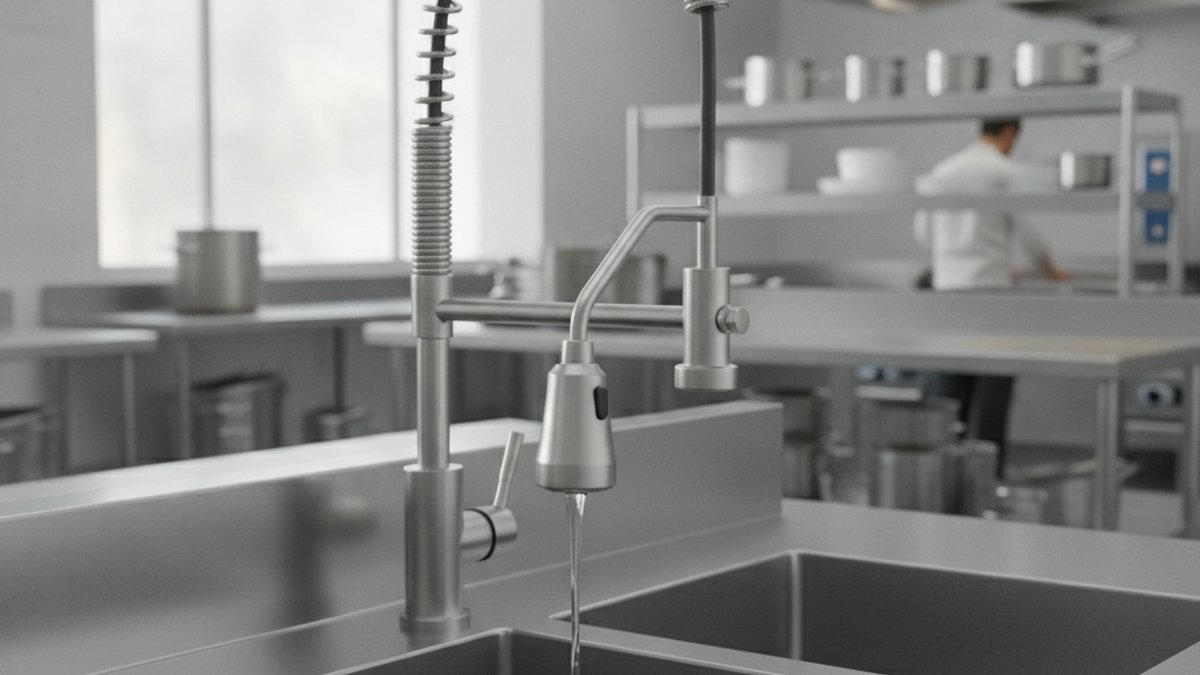
If your commercial kitchen faucet leaking problem is dripping into a busy line during dinner rush, the good news is that a leak this specific is fixable, usually in under an hour, and usually cheap. A high-cycle pre-rinse or gooseneck faucet in a restaurant gets opened and closed hundreds of times a day, so the parts that wear are predictable: ceramic discs, rubber seals, spray-valve springs, and the braided supply lines that feed it. Nine times out of ten you’re replacing a worn part, not the faucet.
Below I’ll walk you through exactly where commercial faucets leak, how to diagnose which of the three leak zones you’re dealing with, what each fix costs and takes, and when it’s genuinely time to stop repairing and replace the unit. This is written for the person actually holding the wrench behind the line — clear steps, real part names, real numbers.
Where exactly is my commercial kitchen faucet leaking from — the spout, the base, or under the sink?
Start by locating the leak, because the location tells you the part. There are three leak zones on a commercial faucet, and each one points to a different fix: the spout/spray head (cartridge or spray valve), the faucet base and handles (O-rings and seals), and under the sink (supply lines, connectors, and coupling nuts).
Dry everything with a towel, run the faucet, and watch for 30–60 seconds. Where the first bead of water reappears is your zone. Don’t guess from where the puddle sits — water travels along hoses and drips from the lowest point, which is often nowhere near the actual failure. Trace it back to the highest wet point.
| Leak zone | Most likely cause | Typical fix | Part cost |
|---|---|---|---|
| Drip from spout / spray tip when off | Worn ceramic cartridge or spray-valve seal | Replace cartridge or spray valve | $12–$45 |
| Water at faucet base or around handle | Failed O-ring or handle seal | Replace O-ring kit | $8–$20 |
| Drip along the pre-rinse spring hose | Cracked hose or loose spray-valve nut | Tighten or replace hose assembly | $25–$60 |
| Puddle under the sink / deck | Loose coupling nut or corroded supply line | Re-seat or replace supply line/connector | $10–$35 |
| Constant seep, all zones weeping | Corroded zinc body, cracked casting | Replace the faucet | $120–$400 |
Once you know the zone, you know roughly the part and the cost. Now let’s go zone by zone.
Why does my commercial faucet drip from the spout even when the handle is off?
A spout that drips when the handle is fully closed means the internal valve isn’t sealing — in a modern commercial faucet that’s the ceramic disc cartridge, and on a pre-rinse unit it can also be the spray valve in the spray head itself. Replacing the cartridge fixes the vast majority of “won’t stop dripping” complaints.
Here’s what’s happening. Inside each handle sits a cartridge with two polished ceramic discs. When you close the handle, the discs slide together to block flow. After tens of thousands of cycles — which a commercial faucet hits in months, not years — grit and hard-water scale micro-scratch those discs, and they no longer meet flush. The result is a steady drip that no amount of extra handle-cranking will stop (and cranking harder actually accelerates the wear).
On a pre-rinse sprayer, the trigger-operated spray valve has its own rubber seal and spring. If the drip is coming from the spray tip specifically and only when you’re not squeezing, the spray valve is the culprit, not the cartridge. These unscrew from the end of the hose and swap out in two minutes.
How do I replace a commercial faucet cartridge myself?
You can replace a cartridge yourself in about 20–30 minutes with basic tools. The sequence:
- Shut off both hot and cold supply valves under the sink, then open the faucet to release pressure.
- Plug the sink drain so no screws vanish, and lay a towel down.
- Pop the handle cap, remove the handle screw, and lift the handle off.
- Unthread the retaining nut or clip and pull the old cartridge straight up. Note its orientation — hot side vs. cold side matters.
- Match the old cartridge to the new one exactly (brand and model — commercial cartridges are not universal).
- Seat the new cartridge in the same orientation, reassemble, turn the water back on slowly, and test.
If you want the full step-by-step with photos of each part, our step-by-step DIY kitchen faucet leak repair guide walks through a cartridge swap in detail, and it applies directly to single-handle commercial mixers too.
What causes a leak at the base of the faucet or around the handle?
Water pooling at the base of the spout or seeping around the handle collar means a failed O-ring — a small rubber ring that seals the moving joint. This is one of the cheapest fixes on the whole faucet: an O-ring kit is often under $15, and the repair takes 15–20 minutes.
Commercial gooseneck and swivel-spout faucets rotate constantly so a dishwasher can swing them across a three-compartment sink. That swivel joint is sealed by one or two O-rings. Grease, scale, and constant rotation wear them flat, and then water weeps up out of the base every time the faucet runs. People often mistake this for a cracked body and replace the whole faucet — 90% of the time it’s a two-dollar ring.
To fix it, shut off the water, lift or unthread the spout off its base (usually it pulls straight up after you loosen a set screw or retaining ring), roll the old O-rings off, clean the scale off the post with a rag, and roll new rings on. A thin smear of food-safe silicone plumber’s grease makes them seat and last longer. Match the O-ring size precisely — too small won’t seal, too big won’t seat.
Why is my commercial kitchen faucet leaking underneath the sink?
A leak under the sink is a supply-side problem, not a faucet problem — it’s coming from the flexible supply lines, the coupling nuts, or the connector that ties the faucet to the building’s water. First step: feel each connection point with a dry paper towel; the one that comes away wet is your leak.
Under a commercial deck-mount or wall-mount faucet you’ll find braided stainless supply hoses, threaded coupling nuts, and often a pre-rinse assembly base. Any of these can loosen from vibration and heavy use, or corrode where dissimilar metals meet. Two failure patterns dominate:
- Loose coupling nut: The most common and the easiest. Snug it about a quarter turn past hand-tight with a wrench. Do not gorilla it — over-tightening cracks the nut or crushes the washer, turning a drip into a flood.
- Corroded or split supply line: Braided hoses have a finite life. If the braid is rusty, kinked, or bulging, replace the whole line rather than re-tightening it. A quality braided line is $10–$20.
If the drip is specifically at the flexible hose feeding the faucet — a very common commercial complaint — we cover the exact diagnosis and fix in why your kitchen faucet leaks from the flexible hose and how to fix it. And when the leak is at the threaded fitting that joins the faucet to the plumbing, the culprit is often the wrong or worn coupling — our guide to the right commercial sink faucet connector explains how to match thread type and size so the joint actually seals.
Should I use Teflon tape or plumber’s putty on a commercial faucet connection?
Use PTFE thread tape (Teflon tape) on threaded metal-to-metal connections, and let the rubber washer or gasket do the sealing on compression and hose fittings. Don’t put tape on a fitting that seals with a washer — the tape does nothing there and can hold the washer off its seat. Wrap threaded pipe joints three to four times clockwise (the direction you’ll tighten) so the tape doesn’t unwind as you thread it on.
Is it cheaper to repair or replace a leaking commercial kitchen faucet?
Repair it — unless the faucet body itself is cracked, corroded through, or you’ve already replaced the cartridge and seals and it still leaks. A cartridge, O-ring kit, or supply line is $10–$60 and an hour of labor; a new commercial faucet is $120–$400 plus install. The math favors repair almost every time for a single failed part.
Replace the faucet when you hit one of these:
- The casting is cracked or you see a hairline weep line in the body metal — no part fixes a cracked body.
- It’s a cheap zinc-alloy faucet that’s corroding from the inside; you’ll be chasing leaks forever. A stainless or solid-brass commercial faucet is the durable answer here — if you’re weighing materials, our comparison of zinc alloy vs. stainless steel faucets lays out why the cheaper metal fails first in a commercial setting.
- Replacement cartridges are discontinued for an old model — common on generic imports with no parts support.
- You’ve done cartridge + seals + supply lines and it still leaks, meaning the internal seat is machined out of true.
If you land on replacement, buy a faucet built for the abuse: a heavy-gauge stainless pre-rinse or gooseneck with a real cartridge you can source parts for. We keep a curated set of options that survive a real service line in our roundup of commercial sink faucets that actually survive a busy kitchen.
How do I stop my commercial faucet from leaking again after I fix it?
Most repeat leaks come from three preventable things: hard-water scale chewing up seals, over-tightening handles, and skipping the small parts. Fix the root cause once and the same drip won’t be back next month.
- Deal with hard water. Scale is what scratches ceramic discs and stiffens O-rings. If your area runs hard water, a simple inline filter or periodic descaling of the aerator and cartridge dramatically extends part life.
- Train the “off” habit. Handles need a light close, not a crank. Over-torquing is the single fastest way to destroy a fresh cartridge.
- Replace seals in sets. When you open a faucet, swap all the O-rings and the cartridge together, not just the one that failed. The others are the same age and will fail next.
- Grease moving seals. A dab of food-safe silicone plumber’s grease on every rubber seal keeps it supple and sealing far longer.
- Keep a spares kit. One spare cartridge and one O-ring kit per faucet model on the shelf turns a mid-rush leak into a five-minute swap instead of a shutdown.
What tools and parts do I need on hand for a commercial faucet leak?
You can handle 95% of commercial faucet leaks with a short list of cheap tools and a small parts kit. Keep this by the sink and you’ll rarely call a plumber for a drip:
- Adjustable wrench and a basin wrench (for those tight under-sink coupling nuts)
- Hex/Allen key set for handle set screws
- Phillips and flathead screwdrivers
- PTFE thread tape and food-safe silicone plumber’s grease
- Model-matched replacement cartridge and O-ring kit
- A spare braided stainless supply line and a spare spray valve (for pre-rinse units)
- Towels, a bucket, and a headlamp — you’re working blind under a sink
Author note & why you can trust this guide
About the author: This guide was written by the Wigafaucet product team, who specify, test, and service commercial-grade faucets for restaurants, cafés, and institutional kitchens. We’ve torn down and rebuilt hundreds of leaking pre-rinse and gooseneck units, so the failure patterns above come from real service work, not spec sheets.
Brand credibility: Wigafaucet manufactures and sells commercial and residential faucets at wigafaucet.com, with a focus on solid-brass and stainless bodies and serviceable ceramic-disc cartridges. Our commercial faucets are built to ceramic-disc valve standards rated for 500,000+ cycles, are certified lead-free to NSF/ANSI 61 and 372 for foodservice use, and are backed by a manufacturer warranty on the cartridge and finish. Always confirm your local plumbing code and, for gas or complex plumbing, use a licensed commercial plumber.
FAQ
Can I fix a leaking commercial kitchen faucet without shutting off the whole building’s water?
Yes. Every commercial faucet has dedicated hot and cold shutoff valves on the supply lines directly under the sink. Close those two valves and you can work on the faucet while the rest of the building keeps running. If those local valves are seized, that’s a separate repair worth doing — you never want to shut the main just to fix one faucet.
Why does my pre-rinse faucet leak from the spring hose?
Pre-rinse spring hoses leak for two reasons: the spray-valve nut where the hose meets the spray head has worked loose, or the hose itself has cracked from constant flexing. Tighten the nut first; if it still weeps, the hose or its internal seal is worn and the hose assembly needs replacing — it unthreads from the faucet body and swaps in a few minutes.
How long should a commercial kitchen faucet last before it starts leaking?
A quality solid-brass or stainless commercial faucet lasts 8–15 years on the body, but the wear parts — cartridge, O-rings, spray valve — are consumables that may need replacing every 1–3 years in a high-volume kitchen. Hard water and heavy cycle counts shorten that. A cheap zinc faucet may start weeping in under two years and isn’t worth repeating repairs on.
Is a dripping commercial faucet a health-code problem?
It can be. Standing water and constant drips create the kind of moisture and pooling that health inspectors flag, and a leak at the base can contaminate a food-prep surface. Beyond code, a drip of one drop per second wastes over 3,000 gallons a year. Fixing a commercial faucet leak fast is both a compliance and a cost issue.
What size cartridge or O-ring do I need for my commercial faucet?
There’s no universal size — commercial cartridges and O-rings are specific to the brand and model. The reliable method is to remove the old part and match it exactly, or look up the faucet’s model number on the manufacturer’s parts diagram. Bringing the worn part to the counter (or photographing it next to a ruler) is the surest way to get the right replacement the first time.
My faucet still drips after I replaced the cartridge — what did I miss?
Three usual suspects: the cartridge is seated in the wrong orientation (hot/cold reversed or not fully pushed down), you got a cartridge that’s close but not the exact model, or the faucet’s internal seat is scored so no cartridge will seal against it. Re-check seating first, verify the part number second; if both are right and it still drips, the body seat is worn and the faucet needs replacing.