 Wiga Tap Manufacturer
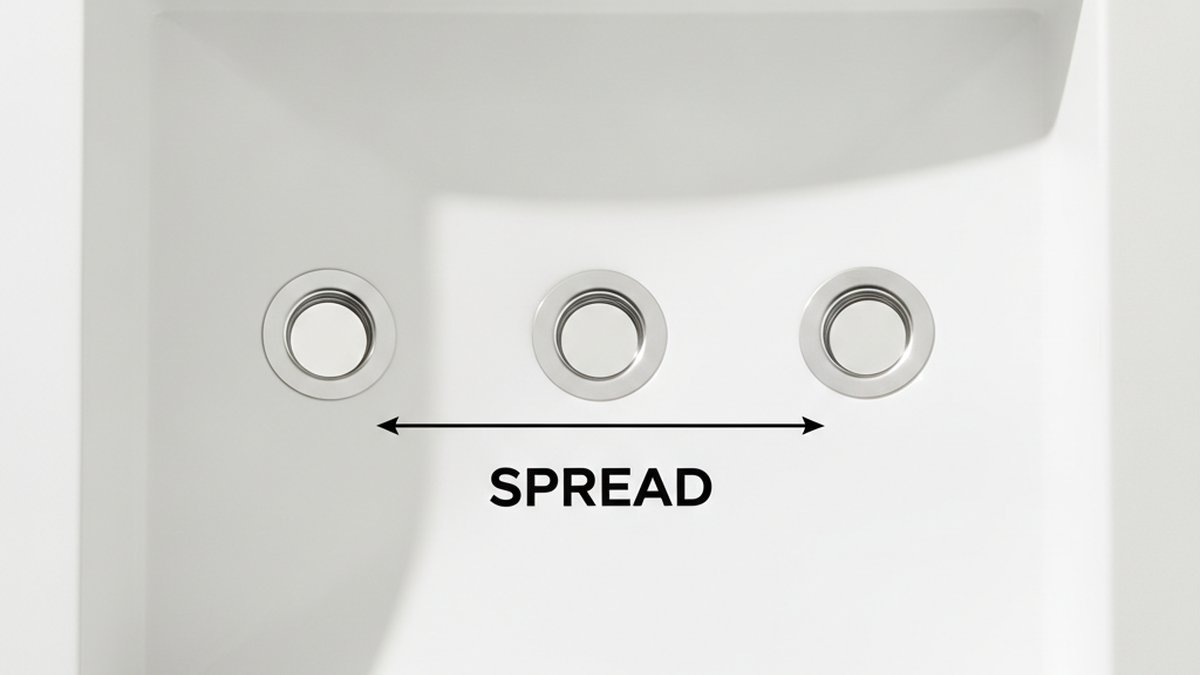
If you’ve been shopping for a new bathroom faucet, the term widespread faucet spread is the single spec that decides whether the faucet even fits your sink. It’s not marketing language — it’s a literal measurement: the distance from the center of the left handle hole to the center of the right handle hole. Get it wrong and you’ll be staring at a gap you can’t cover or holes that don’t line up. Get it right and installation is genuinely easy. Below, we’ll answer the real questions people ask before they click “buy” — how to measure it, what the standard sizes are, whether widespread is worth it over a centerset, and how to pick the right one for your specific sink.
What is the “spread” on a widespread faucet, exactly?
The spread is the center-to-center distance between the two outer mounting holes — the ones your hot and cold handles drop into. On a widespread faucet, the spout and the two handles are three completely separate pieces connected by flexible hoses underneath the sink, which is exactly why the spread is adjustable instead of fixed.
This is the key difference from other faucet styles. A centerset faucet mounts the handles and spout on one base plate, locking them at a fixed 4-inch spread. A single-hole faucet has no spread at all — everything sits on one post. Because a widespread’s three pieces aren’t tied together, you can slide the handles closer or farther apart to match your sink and your taste. Most quality widespread faucets, including the ones we build at wigafaucet, accommodate anything from roughly a 6-inch to a 16-inch spread, with 8 inches being the number the industry treats as “standard.”
Why does 8 inches get called the “standard” spread?
Because that’s what the vast majority of drilled bathroom sinks and countertops in North America use. When a sink is described as “8-inch widespread” or “3-hole 8 inch,” it means the outer holes are drilled 8 inches apart, center to center, with the spout hole in the middle. It became the default decades ago, so faucet makers optimized their hose lengths and mounting hardware around it. If your sink was made for a widespread faucet, there’s a very high chance it’s an 8-inch layout — but you should still measure, because plenty of vessel sinks, trough sinks, and imported basins break the rule.
How do I measure my sink’s faucet spread before I buy?
Measure from the center of one outer hole straight across to the center of the other outer hole. That number — in inches — is your required spread, and it’s the only measurement that decides fit. Don’t measure edge to edge, and don’t measure to the middle spout hole; center-to-center of the two outer holes is the standard everyone uses.
Here’s the reliable way to do it in under two minutes:
- Clear the sink deck and, if you have an old faucet, note that you’ll remove it after measuring.
- Find the center of the left handle hole and the center of the right handle hole.
- Lay a tape measure across and read the distance between those two centers.
- Round to the nearest common size — you’ll almost always land near 4″, 6″, 8″, or a larger custom spread.
- Count your holes: three holes usually means widespread or centerset; one hole means single-hole.
If you measure about 8 inches across three holes, you want a widespread faucet. If you measure exactly 4 inches across three holes, that’s a centerset layout — a different product. If there’s a single hole, you’re looking at a single-handle faucet, and it’s worth reading our guide on whether a chrome bathroom faucet one-hole setup is right for your sink before you force a three-piece faucet onto a one-hole basin.
Widespread vs centerset vs single-hole: which spread do I actually need?
Choose based on your sink’s existing holes first, and your style preference second. If your sink has three holes spaced 8 inches apart, buy widespread. If it has three holes 4 inches apart, buy centerset (or a widespread that adjusts down, if the maker allows it). If it has one hole, buy single-hole. Fighting your sink’s drilling almost always means an ugly workaround.
Here’s how the three common configurations stack up:
| Faucet type | Typical spread | Number of holes | Best for | Adjustable? |
|---|---|---|---|---|
| Widespread | 6″–16″ (8″ standard) | 3 separate holes | Larger vanities, upscale look, flexible layout | Yes — handles slide |
| Centerset | 4″ fixed | 3 holes on one base | Compact sinks, quick swaps, budget builds | No |
| Mini-widespread | 4″ | 3 holes | Small baths that want the “separate pieces” look | Limited |
| Single-hole | None | 1 hole | Modern, small, or vessel sinks | N/A |
Notice the “mini-widespread” row — it’s the one that trips people up. A mini-widespread looks like a widespread (three visible pieces) but fits a 4-inch centerset hole layout. So if your sink is drilled for 4-inch centerset but you love the separated look, a mini-widespread gives you that style without redrilling. True widespread starts to make sense at 8 inches and up.
Is a widespread faucet worth the extra money over a centerset?
For most mid-range and higher bathrooms, yes — a widespread faucet is worth it if you have (or can drill) an 8-inch layout and plan to keep the vanity for years. Widespread faucets generally look more substantial, give you room to clean between the pieces, and let you fine-tune handle placement. Centerset wins on price and simplicity for small or rental bathrooms.
The trade-off is cost and installation time. Because a widespread is three pieces, you have three points to seal and connect underneath, versus one base plate on a centerset. It’s not hard, but it takes longer. If you’re comparing finishes while you decide, our breakdown of the brushed nickel tap mixer covers how finish choice affects both looks and long-term cleaning — relevant because a widespread shows more hardware than a compact centerset does.
Can I put a widespread faucet on a sink drilled for something else?
Sometimes, but only in specific directions. You can usually put a widespread faucet on a sink with more room than it needs, and you can drop a single-hole or centerset faucet onto a wider layout using a deck plate to cover the extra holes. What you generally can’t do is force an 8-inch widespread onto a 4-inch centerset sink — the outer holes physically won’t reach.
A few real scenarios:
- Sink has 8″ widespread holes, you want a single-hole faucet: Use a 3-hole escutcheon/deck plate to cover the two unused outer holes. Clean and common.
- Sink has 4″ centerset holes, you want widespread: You’d need to redrill or replace the sink. Consider a mini-widespread instead.
- Sink has 8″ holes, faucet adjusts to 8″–12″: Perfect fit; just set the handles to 8″.
- Countertop-mounted, no sink deck holes: You can drill for a widespread if the material allows (granite and quartz need the right bit and care).
If your existing faucet’s reach or height is the real problem rather than the spread, that’s a separate fix — sometimes a bathroom faucet extension pipe or a taller spout solves it without changing your hole layout at all.
What spread should I choose for my specific bathroom?
Match the spread to the vanity size and the sink you already own. As a rough guide: small powder rooms and narrow vanities suit 4-inch centerset or single-hole; standard and larger vanities suit 8-inch widespread; oversized double vanities and freestanding basins sometimes call for spreads of 12 inches or more. The bigger the countertop, the more an 8-inch-plus spread looks balanced rather than cramped.
What if I have a small vanity but love the widespread look?
Go with a mini-widespread at a 4-inch spread — it delivers the three-piece, separated-handle appearance while fitting a compact centerset hole pattern. You get the upscale look without the wide footprint, and you won’t have to redrill a small sink. It’s the single most common workaround we recommend for petite powder rooms.
Does the faucet material matter more than the spread?
Spread decides fit; material decides how long the faucet lasts and how it feels day to day. Both matter, but they answer different questions. Once you’ve confirmed the spread fits, look hard at what the faucet body is made of — solid brass lasts longest, quality stainless resists corrosion well, and cheaper zinc-alloy castings can be fine at the right price if they’re built properly. If you’re weighing construction, our comparison of zinc alloy vs stainless steel faucets lays out where each one earns its price, and the same logic applies directly to widespread bodies and handles.
How hard is it to install an 8-inch widespread faucet myself?
It’s a manageable DIY job for most people — plan on 45 to 90 minutes for a first-timer with basic tools. The three-piece design means more connections than a single-hole faucet, but nothing about it requires a plumber if your supply lines and shutoffs are in normal shape. The trickiest part is working blind under the sink to tighten the mounting nuts.
The basic sequence looks like this:
- Shut off the hot and cold supply valves and open the old faucet to drain pressure.
- Disconnect and remove the old faucet from below.
- Drop the spout into the center hole and the two handles into the outer holes.
- Secure each piece from underneath with its mounting nut and washer.
- Connect the flexible hoses from the handles to the spout’s T-fitting or valve body.
- Attach the supply lines, turn the water back on slowly, and check every joint for leaks.
Tighten firmly but don’t overtorque — cross-threading a plastic mounting nut is the most common rookie mistake. Run the water for a minute and feel each connection with a dry finger or paper towel; a slow drip shows up fast. If you’d rather see the general shut-off-and-swap rhythm on a full job first, our step-by-step kitchen faucet repair guide walks through the same fundamentals — shutting off water, loosening supply lines, and leak-testing — that carry straight over to a bathroom widespread install.
Common mistakes people make with faucet spread
The single biggest mistake is buying before measuring — assuming “widespread means 8 inches” and skipping the tape measure. The second is confusing hole count with spread: three holes doesn’t automatically mean widespread, because centerset also uses three holes. Here are the errors we see most often:
- Measuring edge-to-edge instead of center-to-center (throws you off by up to an inch).
- Ordering true widespread for a 4-inch centerset sink and finding the handles won’t reach.
- Forgetting to check the faucet’s adjustable range — a faucet rated 8″–16″ won’t shrink to 6″.
- Ignoring the deck plate option and assuming extra holes mean the faucet won’t work.
- Buying a heavy widespread for a thin vessel sink that can’t support three separate mounts.
FAQ
What is the standard widespread faucet spread?
The standard widespread spread is 8 inches, measured center-to-center between the two outer handle holes. Most widespread faucets adjust to fit a range — commonly 8 to 12 or even 6 to 16 inches — but 8 inches is the layout the majority of North American bathroom sinks are drilled for.
Can a widespread faucet fit a 4-inch centerset sink?
A true 8-inch widespread faucet cannot fit a 4-inch centerset sink because the outer handles won’t reach the holes. If you want the separated three-piece look on a 4-inch layout, buy a “mini-widespread” faucet, which is designed specifically for the 4-inch centerset hole pattern.
How do I measure faucet spread on my existing sink?
Measure from the center of the left outer hole to the center of the right outer hole with a tape measure. That center-to-center number is your spread. If it’s about 8 inches you need a widespread faucet; if it’s exactly 4 inches you need a centerset or mini-widespread; a single hole means a single-handle faucet.
Is widespread better than centerset?
Widespread generally looks more upscale, offers adjustable handle placement, and suits larger vanities, while centerset is cheaper, faster to install, and better for small or rental bathrooms. Neither is universally “better” — the right choice depends on your sink’s hole spacing and vanity size. If your sink is already drilled for 8 inches, widespread is usually the natural pick.
Can I cover extra holes if I switch to a smaller faucet?
Yes. If your sink is drilled 8 inches for a widespread but you want a single-hole faucet, use a deck plate (also called an escutcheon) to cover the two unused outer holes. It’s a clean, standard solution and requires no redrilling or sink replacement.
Does a bigger spread mean better water flow or pressure?
No. Spread is purely about handle spacing and fit — it has no effect on flow rate or water pressure. Flow is governed by the faucet’s aerator and your home’s supply pressure, not by how far apart the handles sit. Choose spread for fit and looks, and check the faucet’s GPM rating separately if flow matters to you.
The bottom line on choosing your widespread faucet spread
Widespread faucet spread comes down to one number you can measure in two minutes: the center-to-center distance between your sink’s outer holes. Nail that, confirm it falls inside your chosen faucet’s adjustable range, and everything else — finish, material, handle style — is a matter of taste. For most standard and larger vanities drilled at 8 inches, a quality widespread faucet is a genuine upgrade in both looks and cleanability. For compact baths, a mini-widespread or centerset gets you there for less. When in doubt, measure first, then shop.
About the author: This guide was written by the wigafaucet product team, who spec, test, and install bathroom and kitchen fixtures full-time. We’ve fit widespread faucets to everything from builder-grade 8-inch vanities to custom stone countertops, and the advice here reflects what actually works on real sinks.
Why trust wigafaucet: wigafaucet designs and sells faucets and bathroom fixtures direct to homeowners at wigafaucet.com. Our widespread faucets are pressure-tested and built to meet North American plumbing standards for lead-free waterways and durability, and they ship with a manufacturer’s limited warranty covering the finish and cartridge. If a spec on a product page says 8-inch adjustable, it’s been verified on the bench — not estimated.