 Wiga Tap Manufacturer
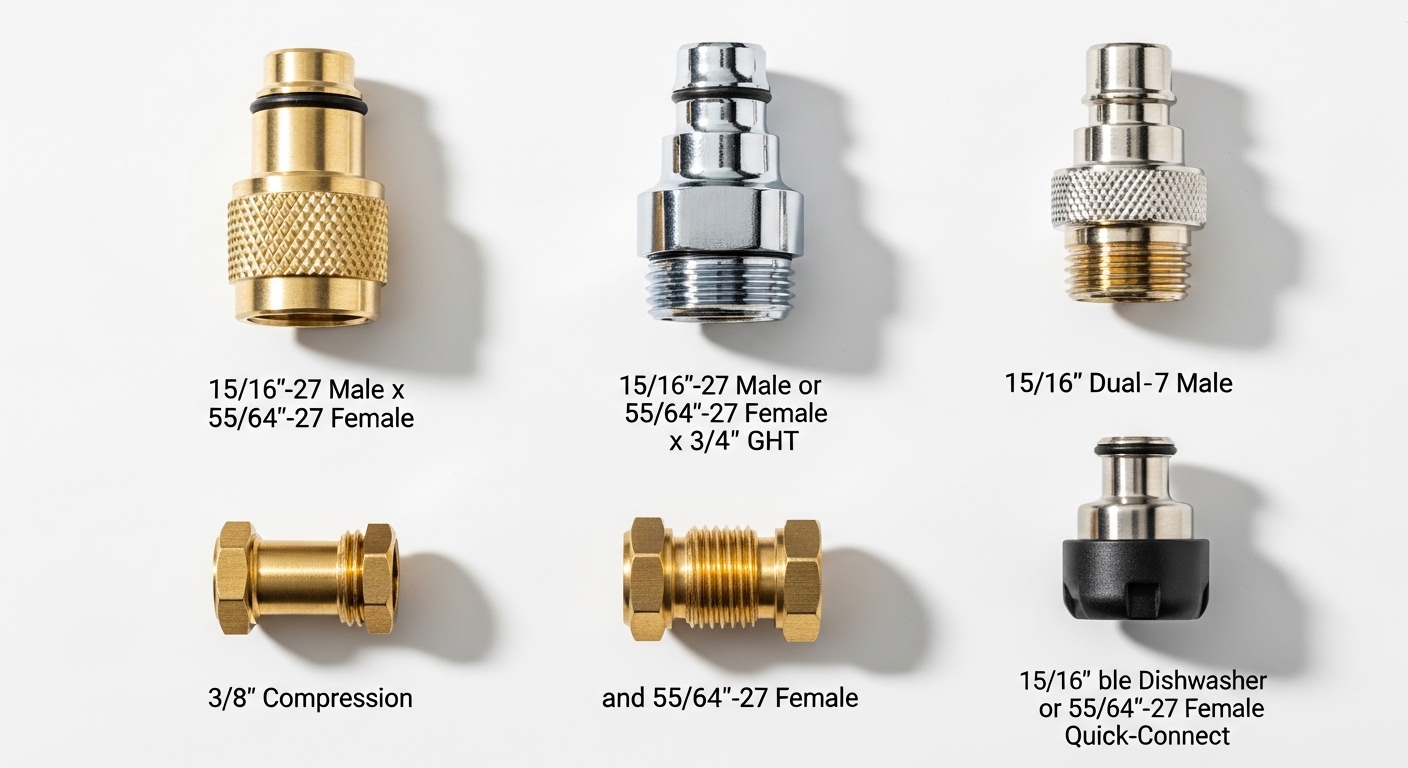
A faucet hook up adapter sounds like one product, but it’s really a small family of threaded connectors that all do the same job: they let your faucet talk to something it wasn’t originally designed to connect to. Maybe you’re trying to screw a garden hose onto a kitchen spout, feed a countertop dishwasher, hook up an RO system, or just get a new supply line to seal against an old shutoff valve. In every one of those cases, the fix is the same idea — put the correct adapter between the two mismatched threads. The trick is knowing which adapter, because a fitting that’s off by one thread size will either leak or won’t spin on at all.
Below, we’ll walk through exactly how to identify what you have, which adapter matches which job, and how to avoid the two mistakes that cause 90% of the leaks people blame on “a bad adapter.”
What exactly is a faucet hook up adapter, and what does it do?
A faucet hook up adapter is a threaded fitting — usually brass, chrome-plated brass, or occasionally plastic — that converts one connection size or style into another so two parts that don’t natively match can seal together. That’s the whole job. It adds no water pressure, no filtration, no flow; it just makes the threads agree.
In practice, “faucet hook up adapter” gets used for a few distinct situations, and it helps to name them:
- Aerator/spout adapters — screw onto the tip of your faucet where the aerator lives, converting the faucet’s aerator threads to garden-hose thread (GHT) or to a quick-connect for a filter, dishwasher, or sprayer.
- Supply-line adapters — sit under the sink between the shutoff valve and the faucet’s supply line, converting between compression, FIP (female iron pipe), and the faucet’s own inlet size.
- Coupler/extension adapters — join two supply lines or extend a line that’s a few inches too short.
- Appliance/accessory adapters — connect the faucet to a portable dishwasher, RO system, water filter, or a hose for filling buckets and aquariums.
They all look similar in the aisle, but they are not interchangeable, and that’s exactly why people get frustrated. The good news: once you can read a thread, choosing is easy.
How do I know which faucet hook up adapter size I need?
You need three pieces of information: the thread size, whether the part is male or female, and, for supply connections, whether it’s compression, FIP, or NPT. Get those three right and the adapter fits every time.
Here’s how to find each without guessing:
- Male vs. female. If the threads are on the outside of the part, it’s male. If they’re on the inside, it’s female. An adapter’s whole reason to exist is usually to flip one to the other (male-to-female, or vice versa).
- Thread size at the faucet tip. Standard US kitchen and bathroom faucet aerators come in two sizes: 15/16″-27 male (the outside threads) or 55/64″-27 female (the inside threads). Bathroom faucets are often the smaller 13/16″ or 3/4″. A cheap thread gauge or even a hardware-store “aerator key” kit tells you in seconds.
- Supply-line size under the sink. Faucet inlets are usually 3/8″ or 1/2″ compression, and shutoff valves are commonly 3/8″ compression outlet off a 1/2″ line. Portable/appliance hoses almost always use 3/4″ GHT (garden hose thread).
If you want the deep dive on the under-sink numbers — because that’s where sizing trips people up most — our guides on the right faucet supply line dimensions for your sink and what size a faucet water supply line and connector actually is lay out every common thread with plain-English photos. Read one of those before you buy if you’re connecting anything under the counter.
Which faucet hook up adapter matches which job? (Comparison table)
Here’s the fast answer: match the row to what you’re trying to connect, and buy the thread size listed. This is the table most people actually come here for.
| What you’re connecting | Adapter you need | Typical thread size | Rough price |
|---|---|---|---|
| Garden hose onto kitchen faucet | Faucet-to-garden-hose (aerator to GHT) | 15/16″-27 M or 55/64″-27 F → 3/4″ GHT | $6–$12 |
| Portable dishwasher | Quick-connect faucet adapter (brass, with collar) | 55/64″-27 F aerator → dishwasher coupler | $10–$20 |
| Countertop water filter / RO | Dual-thread diverter aerator adapter | Dual 15/16″ M & 55/64″ F | $8–$15 |
| New supply line to old shutoff | Compression-to-FIP or compression coupler | 3/8″ compression / 1/2″ FIP | $4–$10 |
| Extend a too-short supply line | Straight coupler / extension | 3/8″ x 3/8″ compression | $5–$9 |
| Bathroom faucet accessory | Small dual-thread aerator adapter | 13/16″ or 3/4″ | $6–$12 |
Notice the pattern: nearly every “connect my faucet to X” question is solved by an adapter costing under $20. If someone’s quoting you a big fix, the actual part is almost always cheap — you’re paying for the diagnosis, not the brass.
How do I connect a garden hose to my kitchen faucet without leaks?
Unscrew the existing aerator from the faucet tip, then thread on a faucet-to-garden-hose adapter that matches your aerator size — that’s the entire job, and it takes about two minutes. The garden hose then screws directly onto the adapter’s 3/4″ GHT end.
Two details make or break it:
- Check male vs. female first. When you remove the aerator, look at the faucet tip. Outside threads = you need a female adapter (55/64″-27 F). Inside threads = you need a male adapter (15/16″-27 M). Most kitchen faucets are male tips, so a female-inlet adapter is the common buy — but confirm on your own faucet.
- Keep the rubber washer. The seal at a GHT connection comes from a flat rubber washer, not from the threads. If your adapter or hose leaks, 9 times out of 10 the washer is missing, pinched, or worn. Replace it before you replace anything else.
This same approach works for filling buckets, aquariums, and pots, or running a hose to a portable washing machine. If you’re doing the reverse — pulling water off a tub spout for a hose — that’s a slightly different fitting, and we cover it in our guide to a reliable tub spout to garden hose adapter, because tub spouts don’t have aerator threads.
Why does my faucet adapter keep leaking even though it’s the right size?
A correctly-sized adapter that still leaks almost always has one of three problems: a bad or missing washer, cross-threading, or thread type mismatch (tapered NPT vs. straight aerator threads). Fix those in order and the drip stops.
Here’s the diagnostic order that saves people the most time:
- Washer. Aerator and garden-hose connections seal on a flat rubber washer. Compression connections seal on a metal ferrule. If you forced two parts together with no washer, no amount of tightening will hold. Look inside the fitting.
- Cross-threading. If it started hard to spin, you probably cross-threaded it. Back it all the way off and start again by turning counter-clockwise first until you feel it “drop” into the thread, then tighten clockwise. It should spin on with light finger pressure.
- Thread type. Tapered pipe threads (NPT/FIP) seal with thread engagement and need PTFE (plumber’s) tape; straight aerator and garden-hose threads seal with a washer and should not be over-taped. Using tape on a washer connection actually stops the washer from seating and causes leaks. Match the sealing method to the thread.
- Over-tightening. Brass and plastic adapters crack or deform their washers when you crank them. Hand-tight plus a quarter turn with pliers is plenty for most.
If the leak is happening down at the shutoff valve rather than at the faucet tip, that’s a supply-side issue, and the culprit is usually a mismatched compression vs. FIP fitting. Our brand’s technicians see this constantly on DIY installs.
Can I use a faucet hook up adapter for a portable dishwasher or RV faucet?
Yes — a portable dishwasher uses a dedicated quick-connect faucet adapter that threads onto your aerator’s female threads, and RV faucets use standard 1/2″ or 3/8″ supply adapters just like a home faucet. The key difference is that appliance adapters have a collar and a snap-on coupler, not just plain threads.
For a portable dishwasher: remove the aerator, thread on the dishwasher’s brass adapter (it’s usually 55/64″-27 female to match a male faucet tip), and the dishwasher’s hose snaps onto the collar. When you’re done, you unsnap it and put your aerator back. If your faucet has a pull-down sprayer or an unusually shaped spout, the adapter may not seat — that’s the one faucet style portable dishwashers don’t play nice with.
For an RV, the connection logic is identical to a home sink, just in a tighter space. If you’re doing that swap, our step-by-step on how to install a kitchen faucet in an RV without leaks covers the exact adapters and supply lines that fit standard RV plumbing, which often uses ½” connections and PEX rather than copper.
Are cheap plastic faucet adapters worth it, or should you buy brass?
For anything permanent or under pressure, buy solid brass; save plastic for temporary, low-stress uses like a seasonal garden-hose hookup. Brass adapters cost a couple of dollars more and last years; plastic threads strip and crack, especially where they meet metal faucet threads.
Here’s the honest breakdown:
- Solid brass: best durability, handles hot water and pressure, won’t strip against metal faucet threads. Look for lead-free (compliant with NSF/ANSI 372 for potable water) if it touches drinking water.
- Chrome-plated brass: same durability, matches shiny faucets cosmetically. Fine choice.
- Plastic/nylon: okay for temporary garden hookups and cold-water-only jobs; avoid for dishwashers, filters, or anything you’ll leave connected long-term.
The cheapest adapter is rarely the real cost — a stripped fitting that lets go while you’re out can flood a cabinet. If you want the longer argument on why the few-dollar upgrade pays off across all your fixtures, our dealers make the case in why you should never buy cheap bathroom fixtures.
A quick word on quality, testing, and who’s telling you this
Author note: This guide was written by the wigafaucet product team — the same people who spec, pressure-test, and warranty the faucets and connectors we sell. We handle adapter-fit questions from real customers every week, so the sizing advice above comes from what actually shows up in returns and support tickets, not a spec sheet.
Brand credibility: wigafaucet manufactures and distributes faucets and fixture accessories built to standard US thread specs, and our brass adapters are pressure-tested and made from lead-free brass that meets NSF/ANSI 372 for potable-water contact. Our connectors carry a manufacturer warranty, and every adapter we ship is checked against the same 15/16″-27 and 55/64″-27 aerator standards your existing faucet already uses — which is exactly why an in-spec adapter drops right on.
FAQ
What size is a standard kitchen faucet thread for an adapter?
Most US kitchen faucets use one of two aerator thread sizes: 15/16″-27 on the outside (male) or 55/64″-27 on the inside (female). Bathroom faucets are often smaller, around 13/16″ or 3/4″. Check whether the threads are on the inside or outside of your faucet tip, then buy the matching adapter.
Do all faucets fit a garden hose adapter?
No. Standard-tip faucets with removable aerators fit a garden-hose adapter easily. Faucets with pull-down sprayers, hidden aerators, or non-standard decorative tips may not have usable threads — in those cases you’d need a slip-on or brand-specific adapter, and some won’t accept one at all.
Why won’t my adapter screw onto the faucet?
Usually it’s a male/female mismatch — you bought a male adapter for a male faucet tip (or vice versa) — or you’re cross-threading it. Confirm the faucet threads are inside vs. outside, and start the adapter by turning it counter-clockwise until it drops into the thread before tightening.
Do I need plumber’s tape (PTFE) on a faucet adapter?
Only on tapered pipe threads (NPT/FIP), which seal by thread engagement. Aerator and garden-hose threads seal with a rubber washer and should not be taped — tape can prevent the washer from seating and actually cause a leak. Match the sealing method to the thread type.
Can a faucet hook up adapter reduce my water pressure?
A simple threaded adapter adds no meaningful restriction on its own. If flow drops after you add one, the cause is almost always a clogged aerator screen, a partially closed shutoff valve, or an adapter with a built-in diverter or filter that restricts flow — not the adapter threads themselves.
What’s the difference between a supply-line adapter and an aerator adapter?
An aerator adapter screws onto the visible faucet tip to connect hoses, filters, or dishwashers. A supply-line adapter lives under the sink between your shutoff valve and the faucet’s inlet, converting between compression, FIP, and NPT threads. They solve different connection problems and aren’t interchangeable.