 Wiga Tap Manufacturer
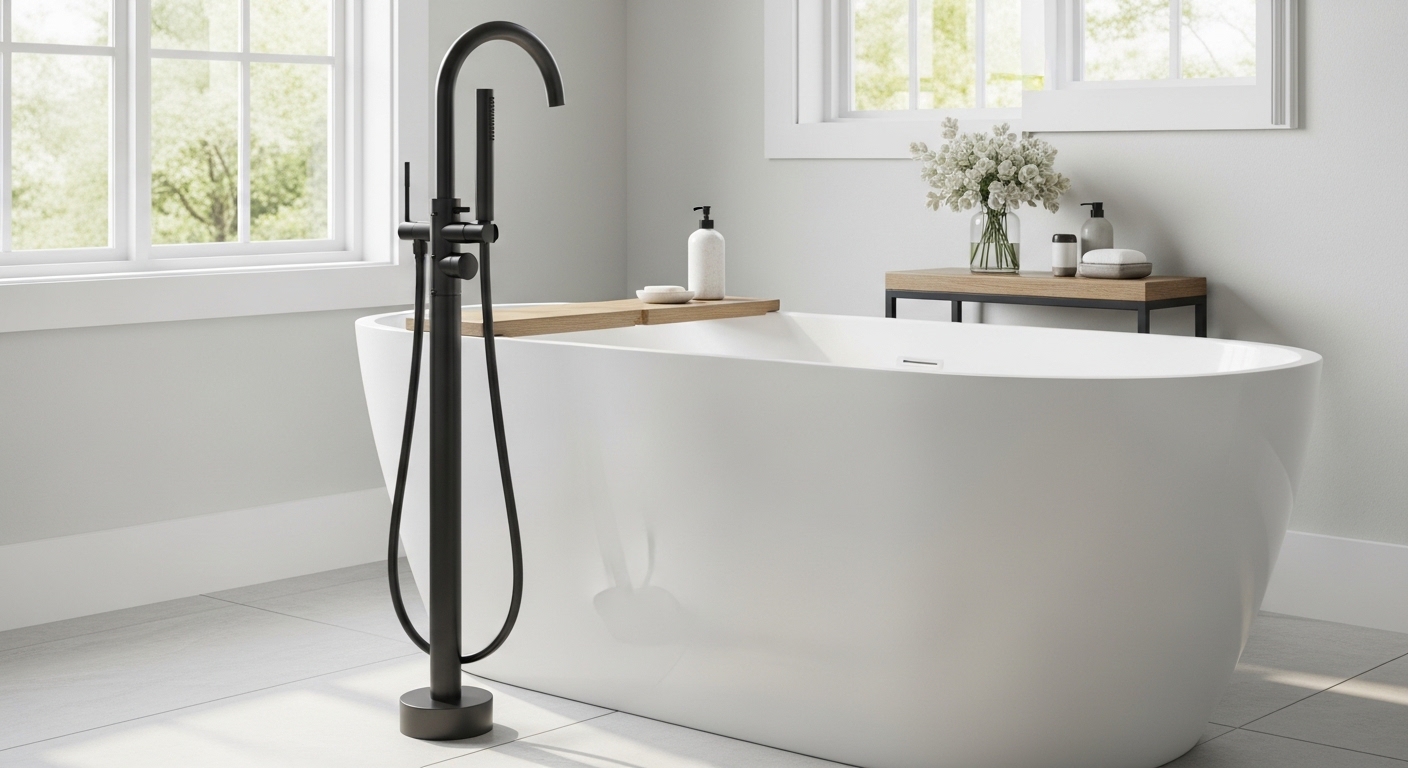
A matte black tub faucet with hand shower is a bathtub filler finished in a flat, non-reflective black that combines a main spout with a detachable handheld sprayer, letting you fill the tub and rinse (hair, kids, the dog, or the tub itself) from the same fixture. It’s the single most-requested style for modern freestanding tubs right now, and for good reason — but the finish and the diverter are exactly where cheap versions fail. Below, we’ll walk through how to pick one that lasts, what you’ll actually pay, how the mounting types differ, and whether matte black is a fad you’ll regret. We install and test these for a living, so this is the plain-English version of what we tell customers on the phone.
What exactly is a matte black tub faucet with hand shower — and how is it different from a regular tub spout?
It’s a full bathtub filler, not just a spout. A plain tub spout only pours water into the tub; a tub faucet with a hand shower adds hot/cold mixing valves (or a single lever), a diverter that switches flow between the main spout and the handheld, plus a flexible hose and sprayer on a cradle or hook. The “matte black” part just describes the finish — a flat black with no shine, achieved either by powder coating or, on better units, a PVD (physical vapor deposition) coating fused to the metal.
The practical difference matters most at bath time. With a hand shower you can rinse shampoo without dunking your head, wash a toddler who won’t sit still, clean the tub after draining, or rinse a dog — all things a bare spout can’t do. If your existing setup is just a spout and you’re trying to understand the diverter mechanics before you upgrade, our guide to a quality tub spout with diverter breaks down how that pull-up or lever diverter actually works inside.
- Main spout: fills the tub, usually 8–25 GPM depending on mounting and local code.
- Diverter: a small valve that redirects water to the hand shower — the #1 wear part.
- Hand shower + hose: typically a 59″ or 71″ stainless or nylon-braided hose.
- Valve type: ceramic disc (best), compression, or ball — ceramic outlasts the rest.
Which mounting type should you buy — freestanding, wall-mount, deck-mount, or roman?
Match the mounting to your tub and your plumbing rough-in — that decision comes before finish or price. A freestanding (floor-mounted) filler is the right choice for a standalone soaking tub with no deck; a deck-mount or roman-tub set is for tubs with a flat rim or a surround; and a wall-mount is for tubs set against a wall with in-wall supply lines. You can’t mix these up — the water supply location dictates the type.
| Mounting type | Best for | Rough-in needed | Typical price (matte black + hand shower) |
|---|---|---|---|
| Freestanding / floor-mount | Standalone soaking tubs, open floor | Floor supply lines, sturdy floor bracket | $250–$550 |
| Wall-mount | Tubs against a wall, exposed or concealed | In-wall valve + supply | $180–$420 |
| Deck-mount / Roman | Tubs with a flat deck or tiled surround | Pre-drilled deck holes (3–4) | $150–$380 |
| Wall-mount mixer (exposed) | Utility or industrial-look installs | Standard 6″ or 8″ wall centers | $120–$300 |
If your tub sits against a wall and you’re weighing an exposed mixer setup, our deep dive on the wall mount faucet mixer covers the center-to-center spacing and rough-in you’ll need to get right before you buy. Get the mounting wrong and no finish in the world will save the install.
How much floor and water pressure does a freestanding filler actually need?
A freestanding matte black filler needs a solid floor mount and at least 43–72 PSI of water pressure to fill quickly and to power the hand shower without a weak trickle. The tall gooseneck body (often 40″+ high) creates leverage, so it must anchor into a floor bracket or a mounting plate secured to the subfloor — not just screwed into finished tile. Under about 40 PSI, the hand shower on a floor-filler can feel disappointingly soft, so if you’re on a well or the end of a municipal line, check your pressure first.
Does matte black actually hold up, or will it fade and show water spots?
A quality matte black finish holds up extremely well — often better than chrome for hiding water spots and fingerprints — but only if it’s PVD or a properly cured powder coat over solid brass. Cheap matte black is spray paint over zinc alloy, and that’s the version that chalks, fades to gray, or chips at the diverter and spout tip within a year. The finish quality, not the color, decides whether you’ll love it in five years.
Here’s the counterintuitive part: matte black is one of the most forgiving finishes for hard-water households because its flat surface doesn’t reflect the way polished chrome does, so dried mineral spots are far less visible. You still want to wipe it dry, but you won’t see every droplet. If you’re comparing finishes generally and wondering whether a warmer tone suits your room better, our honest take on a brushed gold faucet for the bathroom lays out the same durability tests applied to a different finish.
- PVD matte black: molecularly bonded, scratch- and corrosion-resistant, best longevity. Look for “PVD” in the spec sheet.
- Powder-coated matte black: a cured resin layer — good, but can chip on impact at edges.
- Painted / electroplated black: the budget trap; fine for a rental flip, not for a forever bathroom.
How do you clean a matte black finish without ruining it?
Use only mild soap, warm water, and a soft cloth — never abrasive pads, vinegar, bleach, or “scrubbing” cleaners. Matte finishes have a micro-textured surface, and acidic or abrasive cleaners strip the coating and leave permanent shiny patches or gray blotches. Wipe after use to prevent hard-water buildup, and dry with a microfiber cloth. That’s genuinely the whole routine. If mineral scale does build up, a 50/50 warm-water-and-mild-dish-soap solution and patience beats any harsh chemical.
What should you spend — and what do you actually get at each price?
Plan on $220–$450 for a matte black tub faucet with hand shower that will last a decade; below about $150 you’re gambling on the finish and the diverter. Price tracks three things: body material (solid brass vs. zinc alloy), valve type (ceramic disc vs. compression), and finish process (PVD vs. paint). Everything else — box design, marketing — is noise.
| Price band | What you typically get | Honest verdict |
|---|---|---|
| Under $120 | Zinc alloy body, painted black, compression valve, short hose | Rental flips only; expect fade/drip in 1–2 yrs |
| $150–$250 | Brass-plated or partial-brass, powder coat, ceramic valve | Solid mid-range; verify the body metal |
| $250–$450 | Solid brass, PVD matte black, ceramic disc, 59″+ hose | The sweet spot — buy here for a forever bathroom |
| $450+ | Designer brands, premium warranty, thermostatic options | Great, but you’re paying for the name past ~$500 |
The cheapest-possible route almost always costs more within two years once you factor in re-buying and re-installing. Plumbers and dealers see this constantly — the story of why bargain fixtures backfire is told firsthand in why you should never buy cheap bathroom fixtures, and it’s worth two minutes before you click “add to cart” on a $79 filler.
Can you install a matte black tub faucet with hand shower yourself?
Yes, a competent DIYer can install a deck-mount or wall-mount version in 2–4 hours, but a freestanding floor-mount filler is intermediate-to-advanced because it requires accessing supply lines under the floor and setting a rock-solid mount. If your rough-in is already in place and correct, it’s mostly connect-and-seal work. If you have to move supply lines or cut the floor, that’s a plumber’s job.
- Shut off water at the main and open a lower faucet to drain the lines.
- Confirm rough-in: verify supply-line spacing and that the floor mount aligns with your tub’s fill point.
- Set the mounting bracket into the subfloor — this is what keeps a 40″ filler from wobbling.
- Wrap threads with PTFE tape and connect supply lines; hand-tight plus a quarter turn.
- Attach the hand-shower hose to the diverter outlet and seat the sprayer in its cradle.
- Turn water on slowly, check every joint for leaks, then test the diverter both ways.
One tip from the field: if you’re retrofitting and reusing an old valve, inspect the cartridge before you assume the new faucet is the problem later. Knowing how to remove an old shower faucet cartridge without wrecking the valve saves a lot of grief when a diverter starts sticking down the road.
Why does the hand shower drip after you switch back to the spout?
A little drip-down right after you switch is normal — the hose simply empties by gravity — but continuous dripping means a worn or debris-clogged diverter. On a quality ceramic-disc diverter this shouldn’t happen for years; on a cheap plastic one, grit and mineral scale wedge the seal open. The fix is usually cleaning or replacing the diverter cartridge, not the whole faucet, which is another reason to buy a unit with standard, replaceable internal parts rather than a sealed throwaway body.
What features actually matter versus marketing fluff?
Focus on four things: solid-brass body, ceramic-disc valve, hose length and material, and a real warranty — everything else is secondary. Salespeople love to talk about “aerospace coatings” and “luxury European design,” but the physics of durability come down to metal, valve, seal, and hose.
- Solid brass body: resists corrosion and holds the finish. Lift it — brass is noticeably heavier than zinc.
- Ceramic-disc cartridge: smooth handle feel, drip-free for years, rated for 500,000+ cycles.
- Hose length ≥ 59″: shorter hoses can’t reach the far end of a soaking tub or your own head comfortably.
- Braided stainless or reinforced nylon hose: resists kinking and bursting; avoid thin PVC.
- Flow rate that matches code: hand showers are typically capped at 1.8–2.5 GPM in the U.S.
- Backflow protection: a built-in vacuum breaker on the hand shower is code in most jurisdictions.
FAQ
Is a matte black tub faucet with hand shower a passing trend?
No. Matte black has been a top-three fixture finish for roughly a decade and shows no sign of fading from the market. Because it’s a neutral, it pairs with almost any tile, vanity, or hardware color, which is exactly why it has outlasted trend-cycle finishes. If you’re worried about resale, matte black reads as “current and intentional” to buyers far more than it reads as “dated.”
Will a matte black finish show hard-water spots badly?
Less than chrome or polished nickel, actually. The flat, non-reflective surface hides dried mineral spots and fingerprints better than any shiny finish. You’ll still want to wipe it dry to prevent long-term scale buildup, but day-to-day it looks clean with far less effort than gloss finishes demand.
Can I mix matte black with my existing chrome or brushed nickel fixtures?
You can, but for a deliberate look aim for either full matte black or a clear two-tone pairing (matte black with brushed gold or brushed nickel is a popular intentional combo). What looks accidental is one lone matte black piece among several mismatched shiny finishes. If you’re mid-remodel, it’s cleaner to convert the whole room’s fixtures to a matched finish over time.
What size hand-shower hose should I get for a freestanding tub?
Get at least a 59-inch (1.5 m) hose, and 71 inches if your tub is large or the filler stands far from the bathing position. A short hose is the most common regret — it can’t reach the far end of a soaking tub or comfortably rinse your own hair. Longer hoses cost only a few dollars more and are worth it.
Does a hand shower reduce the tub’s fill speed?
Only while it’s diverted to the sprayer. When the diverter sends water to the main spout, you get the full fill rate; the hand shower simply borrows that flow when engaged. On floor-mount fillers, expect a strong fill from the main spout and a normal 1.8–2.5 GPM shower flow from the handheld, assuming adequate water pressure of 43 PSI or more.
Do these faucets meet U.S. plumbing code and safety standards?
Reputable models are tested to ASME A112.18.1/CSA B125.1 and are lead-free compliant under the U.S. Safe Drinking Water Act, and quality hand showers include an integral vacuum breaker for backflow protection. Always confirm the listing states these certifications and check that the flow rate meets your state’s requirements before buying.
The bottom line: how to choose in one minute
Buy a solid-brass, PVD or powder-coated matte black tub faucet with hand shower, matched to your tub’s mounting type, with a ceramic-disc valve and a 59″+ braided hose, and budget $220–$450. That single sentence covers 95% of good buying decisions. Confirm the certifications, check your water pressure if you’re on a well, and don’t chase the cheapest listing — the finish and diverter are where corners get cut and where you’ll feel it first.
About the author & our testing: This guide was written by the WigaFaucet product team, who source, pressure-test, and finish-test tub fixtures for a living. At WigaFaucet, we bench-test diverters through repeated switching cycles, salt-spray-test matte black coatings for corrosion resistance, and verify every filler against ASME A112.18.1/CSA B125.1 before it earns a place in our catalog. Our matte black fillers ship with a limited lifetime warranty on the finish and function, because we only sell fixtures we’d install in our own bathrooms. When a finish or diverter doesn’t pass, it doesn’t get listed — full stop.