 Wiga Tap Manufacturer
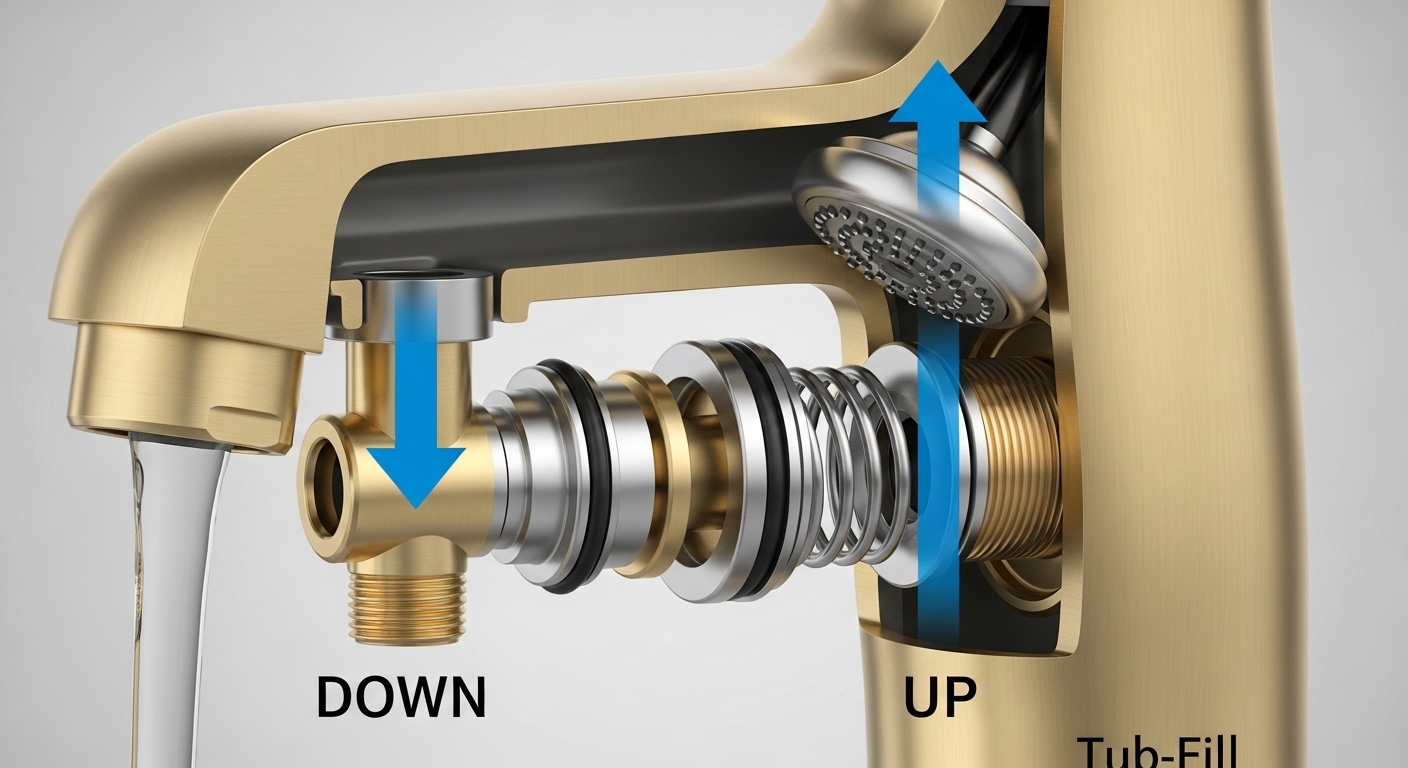
If your shower loses pressure because water keeps leaking out of the tub, the fix almost always starts with a quality tub spout with diverter. The diverter is the little valve inside the spout that either lets water fall into the tub or, when you pull it up, forces that water up to the showerhead. When it works, you get full shower pressure. When it’s cheap or worn out, you get a weak shower and a steady dribble down the wall — which is exactly why the part you choose matters more than most people think.
This guide breaks down what actually separates a good tub spout from a throwaway one, how to know which connection type you have, and what to look for so you buy once instead of three times.
What is a tub spout diverter and how does it actually work?
A tub spout diverter is a valve built into the bathtub spout that switches water between the tub outlet and the showerhead. Pull the knob up (or push a button, depending on the style) and an internal gate blocks the tub opening, so pressurized water has nowhere to go but up the riser pipe to the shower.
Here’s the mechanical reality: when the diverter closes the tub outlet, it has to create a near-complete seal. If that seal is sloppy — worn rubber, thin plastic, a loose fit — water takes the path of least resistance and keeps escaping into the tub. That’s the “my shower has no pressure and water pours out the spout” complaint you see all over Reddit and plumbing forums. Nine times out of ten it’s a failed diverter, not your water heater or your pipes.
There are two broad families of diverter spouts:
- Pull-up (lift-gate) diverters: The most common. A rod on top of the spout lifts to engage. Simple, cheap to replace, but the small internal parts wear over 3–7 years.
- Push-button and rotating diverters: Less common on tub spouts, more robust in some premium units, but with more moving parts that can seize with hard-water scale.
How do I know if I need a slip-fit or threaded tub spout with diverter?
Check the pipe coming out of your wall before you buy anything — this is the single most common reason a new spout doesn’t fit. There are two connection types, and they are not interchangeable.
Slip-fit (slip-on): A bare ½” copper pipe sticks straight out of the wall. The spout slides over it and locks with a small set screw (usually a hex/Allen screw) on the underside. Look under the spout — if you see a tiny screw, you have slip-fit.
Threaded (IPS/screw-on): A threaded pipe nipple protrudes from the wall, and the spout screws onto it. No set screw underneath. These thread on clockwise with thread-sealant tape.
The fastest way to identify yours: shine a light under the spout. Set screw = slip-fit. No set screw = threaded. Measuring matters too — note how far the pipe sticks out of the finished wall, because spouts have a specific “rough-in” depth they’re designed for.
| Connection type | How to spot it | Pipe at the wall | Install difficulty |
|---|---|---|---|
| Slip-fit (slip-on) | Small set screw on underside | Bare ½” copper stub-out | Easy — slide on, tighten screw |
| Threaded (IPS) | No set screw; spins to install | Threaded nipple / adapter | Easy — thread on with sealant tape |
| Universal / adaptable | Ships with both fittings | Works with either | Easiest — no guessing |
If you’re unsure or renting and don’t want to open the wall, a universal spout that ships with adapters for both connection types is the safest buy.
What actually makes a tub spout with diverter “quality” versus cheap?
Material and the diverter seal are what separate a quality tub spout from a cheap one — everything else is secondary. A good spout is machined from solid brass with a real internal seal; a bad one is zinc alloy or thin plastic with a rubber flapper that hardens and cracks.
Here’s what to check, in order of how much it matters:
- Body material: Solid brass is the gold standard — it resists corrosion, handles hard water, and won’t crack when you tighten it. Pick it up; brass has real heft. A suspiciously light spout is usually zinc (ZAMAK) or plastic, which corrode and fail faster.
- Diverter internals: The gate and seal should feel firm and snap into position, not mushy. Metal-and-rubber assemblies outlast all-plastic ones. This is the part that fails first, so it’s the part that matters most.
- Finish quality: Look for a durable PVD (physical vapor deposition) finish, especially on brushed nickel, matte black, and brushed gold. PVD resists scratching and tarnish far better than electroplating that flakes in a couple of years.
- Set screw hardware (slip-fit): Brass or stainless set screws won’t rust and seize the way cheap steel ones do — which matters the day you need to remove the spout.
- Standards and warranty: Look for compliance with cUPC / NSF and low-lead standards, plus at least a limited lifetime or 5-year warranty. A brand that won’t stand behind the diverter is telling you something.
One honest note from the trade: the cheapest spouts often work fine on day one and fail within 12–18 months, usually right at the diverter. Our dealers put it bluntly in why you should never buy cheap bathroom fixtures — the $12 spout that gets replaced twice costs more than the $45 spout you install once.
Why is water still coming out of my tub spout when the shower is on?
If water dribbles from the tub spout while you’re showering, the diverter isn’t sealing — either it’s worn out, clogged with mineral scale, or the whole spout is cheap enough that it never sealed well to begin with. A small trickle is common on older spouts; a steady stream means the diverter has essentially failed and it’s time to replace the spout.
Before you assume the worst, rule these out:
- Low water pressure: Diverters need adequate flow to lift and hold the gate closed. If your home pressure is very low, even a good diverter may weep slightly.
- Hard-water scale: Mineral buildup props the gate open. Sometimes soaking a removed spout in white vinegar restores it, but if the seal is already degraded, replacement is the smarter move.
- Worn rubber seal: The internal washer hardens over years. On most spouts this isn’t a serviceable part — you replace the whole spout, which is cheap and quick.
Because the diverter is a sealing valve, it’s worth understanding the concept across your fixtures. The same principle shows up at the sink — if you’ve ever dealt with a sink sprayer diverter valve that stopped sending water to the side sprayer, it’s the exact same idea: a small valve redirecting flow, failing when its seal wears.
How do you replace a tub spout with diverter yourself?
You can replace most tub spouts in 10–15 minutes with no plumber, as long as you match the connection type. Here’s the clean version:
- Identify your connection. Look under the old spout for a set screw (slip-fit) or spin it slightly to feel threads (threaded). Buy the matching new spout.
- Remove the old spout. Slip-fit: loosen the set screw with a hex key and pull the spout straight off. Threaded: turn counterclockwise — a cloth-wrapped pipe wrench or a wooden dowel inside the spout for leverage helps.
- Clean the pipe. Wipe the copper stub or threads clean. For threaded, wrap 3–4 turns of PTFE (plumber’s) tape clockwise.
- Install the new spout. Slip-fit: slide on, seat it against the wall, tighten the set screw. Threaded: hand-thread on, then snug it up so it points straight down. Don’t over-tighten.
- Test. Run water, pull the diverter, and confirm full pressure at the showerhead with no dribble below.
If you’re doing a bigger shower valve job at the same time — say the cartridge behind the wall is also worn — pair this with our guide on how to remove an old shower faucet cartridge without wrecking the valve. And if you’re the type who repurposes the tub outlet for filling buckets or watering, there’s even a tub spout to garden hose adapter option worth knowing about.
What size tub spout do I need, and does length matter for the diverter?
Match two measurements: the pipe connection (½” copper slip-fit or ½” IPS threaded) and the spout length/reach so it clears the tub edge. Length doesn’t change how the diverter works, but it affects fit and looks — a spout too short can splash behind the tub lip, and one too long can crowd the faucet handle.
Standard tub spouts run roughly 4″ to 8″ long. The critical dimension is actually the rough-in: how far the pipe sticks out from the finished wall. Slip-fit spouts are designed for the copper stub to reach a specific depth inside the spout so the set screw grabs and the back of the spout sits flush against the tile. Measure that stub-out length before buying, especially for slip-fit models.
| Spec | What to measure | Why it matters |
|---|---|---|
| Connection size | ½” copper (slip) or ½” IPS (threaded) | Wrong type = won’t attach |
| Spout length | Wall to spout tip, 4″–8″ | Clears tub edge, avoids splash |
| Rough-in / stub-out | Pipe protrusion from finished wall | Ensures slip-fit seats and set screw grabs |
| Finish | Chrome, brushed nickel, matte black, brushed gold | Matches your shower trim |
Which finish holds up best in a hard-water bathroom?
For hard-water homes, brushed nickel and matte black with a PVD finish hide water spots and mineral haze far better than polished chrome. Chrome looks great but shows every droplet and fingerprint; brushed finishes are more forgiving day to day.
Whatever finish you choose, keep it consistent with your showerhead, valve trim, and handles so the bathroom reads as one set rather than mismatched parts. If you’re leaning toward a warmer look, a brushed gold or champagne tone can work beautifully on a tub spout — just confirm the diverter mechanism underneath is still solid brass, because a pretty finish over a plastic body is still a plastic body.
Author’s note & why trust wigafaucet
Written by the wigafaucet product team. We design, spec, and stress-test tub spouts, shower fixtures, and diverter valves as our core business — not as a sideline. Every diverter spout we recommend is evaluated for solid-brass construction, seal durability under repeated cycling, and compliance with cUPC/NSF low-lead standards, and our fixtures carry manufacturer-backed warranties. The guidance here reflects what we see come back on returns and warranty claims: the failures are almost always cheap materials at the diverter, and they’re almost always avoidable by spending a little more up front.
FAQ
How long should a quality tub spout with diverter last?
A solid-brass tub spout with a well-made diverter should last 8–15 years. Cheap zinc or all-plastic spouts often fail at the diverter within 1–2 years. Hard water shortens the life of any diverter, so periodic vinegar cleaning helps.
Can I replace just the diverter, or do I need a whole new spout?
On most modern tub spouts the diverter isn’t a separate serviceable part — you replace the entire spout, which is inexpensive and takes about 10 minutes. Only some older or premium spouts have a removable diverter cartridge you can swap individually.
Why does my shower lose pressure when I pull the diverter up?
If pressure drops and water leaks from the tub spout, the diverter isn’t fully sealing the tub outlet. Water is splitting between the tub and showerhead instead of going all the way up. Replace the spout with a quality diverter model and full pressure returns.
Are slip-fit and threaded tub spouts interchangeable?
No. Slip-fit slides over a bare copper pipe and locks with a set screw; threaded screws onto a threaded nipple. You must match your wall connection. If you’re unsure, buy a universal spout that includes both adapters.
Is a more expensive tub spout with diverter really worth it?
Usually yes. A $40–$70 solid-brass spout with a durable seal typically outlasts three $12 zinc spouts, so it costs less over time and saves you repeated tear-outs. The diverter seal and body material are where the extra money actually goes.
Does a tub spout diverter reduce my shower pressure on purpose?
No. A working diverter should deliver essentially full pressure to the showerhead. Any noticeable pressure loss or dribble from the tub outlet means the diverter is worn, scaled, or cheaply made — not a normal trade-off.