 Wiga Tap Manufacturer
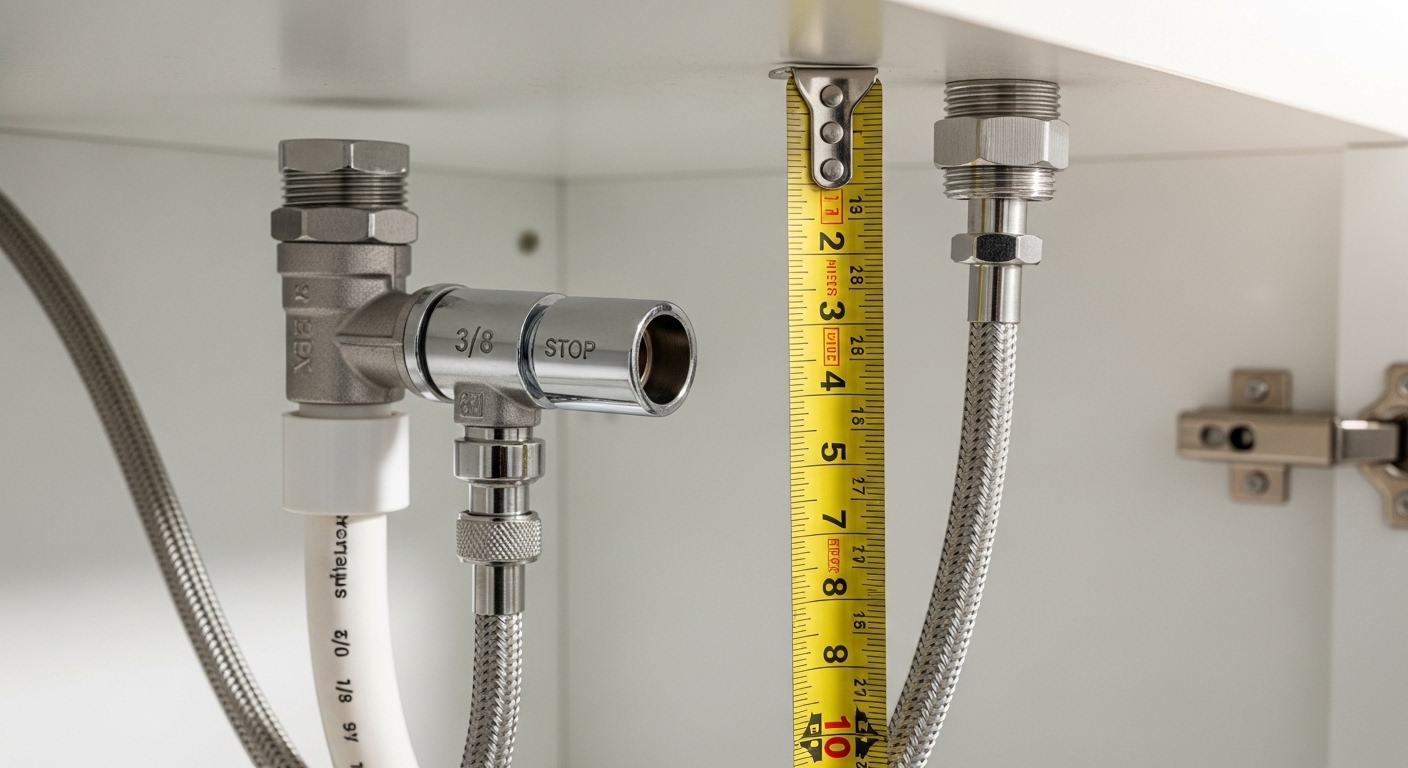
Getting the faucet supply line dimensions right is the difference between a leak-free 15-minute hookup and three trips to the hardware store. The supply line (also called a faucet connector or flexible riser) is the short flexible hose that carries water from your shut-off valve up to the faucet’s inlet. Its “dimensions” really mean three separate measurements: the valve-side connection size, the faucet-side connection size, and the overall hose length. Mix any of those up and the line either won’t thread on, won’t reach, or won’t seal. This guide breaks down every size you’ll actually encounter, in real numbers, so you can buy the correct line the first time.
What size are most faucet supply lines — and which one fits my sink?
The most common residential faucet supply line is a 3/8″ compression × 1/2″ FIP braided line in a 20-inch length. That single spec covers a huge share of standard kitchen and bathroom faucets in U.S. homes built or remodeled in the last 30 years. But “most common” isn’t “always,” so let’s define what those numbers mean before you buy.
A supply line has two ends, and each end is sized and threaded independently:
- Valve end (bottom): Connects to your angle stop / shut-off valve. The overwhelming standard here is 3/8″ compression (often written 3/8″ comp or 3/8″ OD). A smaller share of older or utility installs use 1/2″ compression or 7/16″–1/2″ “slip-joint” style ends.
- Faucet end (top): Connects to the faucet’s tailpiece or shank. This is where it varies most. Common sizes are 1/2″ FIP (female iron pipe thread), 3/8″ compression, 7/16″, and on many modern faucets a captive 1/2″-13 or M10 metal nut that comes pre-attached to the faucet’s own pigtail.
- Length: The flexible portion, measured end to end, typically 12″, 16″, or 20″, with 30″ available for deep cabinets or floor-mounted valves.
Here’s the catch a lot of DIYers miss: many newer faucets ship with the supply lines already permanently attached to the faucet body (these are the thin braided “pigtails” hanging off the bottom). In that case you’re not sizing the faucet end at all — you only need to match the valve end of an adapter or coupling. Always look under your faucet first before assuming you need a full new line.
How do I measure faucet supply line dimensions correctly?
Measure the connection by its thread type and outside diameter (OD), not by eyeballing it — a 3/8″ compression fitting and a 3/8″ FIP fitting are completely different and won’t interchange. Compression sizes refer to the OD of the tube the nut slides over; pipe-thread (IP/FIP) sizes refer to the nominal pipe size, which is bigger than the number suggests.
Do it in this order:
- Shut off the water at the angle stop (turn the oval handle clockwise) and open the faucet to release pressure. Keep a towel under the joint.
- Identify the valve outlet. If the visible copper or plastic tube sticking out of the valve measures about 3/8″ across, you have a 3/8″ compression outlet — by far the most common.
- Identify the faucet inlet. Look at the threaded shank under the faucet. A 1/2″ FIP inlet has internal threads roughly 13/16″ across the opening. A captive pigtail means the faucet supplies its own line.
- Measure the gap. With a tape measure, run from the valve outlet up to the faucet inlet, following the natural curve. Add a couple of inches of slack so the line isn’t pulled taut — a kinked or stretched line is a future leak.
A quick word on why people buy the wrong length: a too-short line gets stretched tight and stresses the connections, while a too-long line coils and kinks against the cabinet wall. Aim for a gentle “S” or “C” curve with no sharp bends. If you’re already under the sink for this and notice your sprayer or diverter acting up, our guide on the sink sprayer diverter valve covers a related part that lives in the same crowded cabinet space.
3/8″ vs 1/2″ supply line: what’s the difference and which do I need?
The difference is the connector size, and for residential faucets you almost always want 3/8″ on the valve end — it matches standard angle stops and delivers more than enough flow for any sink faucet. The 1/2″ designation usually shows up as the faucet-side FIP thread or on higher-demand fixtures. Here’s how the common combinations stack up.
| Supply line spec | Valve end | Faucet end | Best for |
|---|---|---|---|
| 3/8″ comp × 1/2″ FIP | 3/8″ compression | 1/2″ female pipe thread | Most bathroom & kitchen faucets (the default pick) |
| 3/8″ comp × 3/8″ comp | 3/8″ compression | 3/8″ compression | Faucets with a 3/8″ copper tailpiece; toilets share this end |
| 3/8″ comp × 7/16″ & 1/2″ slip | 3/8″ compression | Dual 7/16″/1/2″ | Older faucets with ballcock-style inlets |
| 1/2″ comp × 1/2″ FIP | 1/2″ compression | 1/2″ female pipe thread | Utility sinks, some laundry & older homes |
| 3/8″ comp × M10 / captive nut | 3/8″ compression | Pre-attached faucet pigtail | Modern pull-down kitchen & vanity faucets |
Flow-wise, don’t overthink the 3/8″ vs 1/2″ debate for a sink. A 3/8″ supply line moves plenty of water for a faucet rated at 1.5–2.2 GPM; you’d only feel the difference on a high-flow tub filler or a whole appliance. The connector size is about fit and seal far more than pressure. If your real complaint is weak flow, the bottleneck is usually the aerator, not the supply line — see our walkthrough on how to remove the kitchen faucet flow restrictor before you blame the plumbing.
How long should a faucet supply line be — 12, 16, or 20 inches?
Buy a line that’s 2 to 4 inches longer than the measured gap between your valve and faucet inlet, then let it form a gentle curve. For a typical bathroom vanity, that lands at 16″ or 20″; for a kitchen sink with the valves mounted low at the cabinet floor, 20″ or even 30″ is common. A line that’s slightly long and gently looped is always safer than one stretched tight.
Real-world length guidance:
- Bathroom vanity faucet: 12″–16″ if valves sit just below the sink; 20″ if they’re mounted near the cabinet floor.
- Kitchen faucet: 20″ is the workhorse length because kitchen valves usually sit low and the faucet shank is high.
- Vessel sinks / tall faucets: 20″–30″, since the inlet sits higher above the deck.
- Floor-mounted or remote valves: measure carefully and size up — running short here means a coupling joint you don’t want.
If you’re planning a fresh vanity install and want the whole sequence (mounting, supply lines, drain), our step-by-step on how to install a bathroom vanity faucet yourself walks through exactly where the supply lines fit into the job.
What are braided stainless vs other supply line materials, and which lasts longest?
Braided stainless steel supply lines are the most durable and the safest default for almost every faucet. The braided sleeve protects an inner PEX or EPDM tube from bursting and resists the kinking that destroys cheaper lines. They cost only a dollar or two more than plain plastic and dramatically lower your odds of a hidden leak.
| Material | Typical lifespan | Pros | Watch out for |
|---|---|---|---|
| Braided stainless steel | 8–10+ years | Burst-resistant, kink-resistant, easy to route | Cheap versions hide thin inner tubes — buy a known brand |
| Vinyl / PVC mesh | 3–5 years | Cheapest, flexible | Degrades and can split; not ideal long-term |
| Rigid copper riser | 20+ years | Extremely durable, clean look | Must be bent/cut to exact length; no flex for error |
| PEX (plain) | 10+ years | Inexpensive, freeze-tolerant | Less common as a finished faucet connector |
Manufacturers test braided connectors to burst-pressure and cyclic standards (look for products certified to ASME A112.18.6 / CSA B125.6, the joint standard for flexible water connectors), and many quality lines carry a multi-year or limited-lifetime warranty. That certification is your assurance the line was pressure-tested, not just assembled. When in doubt, choose the certified braided stainless line — the small upcharge buys real peace of mind under a closed cabinet where a slow leak can go unnoticed for weeks.
Do I need to match my faucet brand’s supply line, or is any line fine?
You don’t need a brand-matched line — supply lines are universal as long as the connector sizes and threads match. A 3/8″ comp × 1/2″ FIP braided line works the same whether it’s on a budget faucet or a premium one. The only time brand matters is when a faucet ships with a captive, pre-attached pigtail in a proprietary metric thread; then you keep the factory line and only supply an adapter at the valve.
Two practical rules:
- Threads must match in both size AND type. Compression seals on the tube; FIP/IP seals on tapered pipe threads with tape or the gasket. Never force a compression nut onto pipe threads.
- Use the right sealing method. Compression and FIP connectors with a rubber gasket should be hand-tight plus about a quarter to half turn with a wrench — no thread tape needed on gasketed ends. Over-tightening cracks the seal; that’s the #1 cause of weeping connections.
If you’re shopping for a new fixture entirely and weighing layouts, our overview of the widespread faucet layout explains how three-piece faucets handle their supply connections differently from single-hole models — worth knowing before you buy lines.
Author note & why you can trust this guide
This guide was written by the product and installation team at wigafaucet, drawing on hands-on bench testing of hundreds of faucet and connector combinations across kitchen, bath, and utility fixtures. wigafaucet (wigafaucet.com) designs and supplies faucets and bathroom fixtures for homeowners and trade installers worldwide, and we spec our supply connections to recognized flexible-connector standards. We don’t recommend a size we wouldn’t install in our own showroom sinks. As always, if your plumbing looks non-standard or you hit corroded valves, call a licensed plumber — a $5 part isn’t worth a flooded cabinet.
FAQ
What is the most common faucet supply line size?
The most common is a 3/8″ compression valve end paired with a 1/2″ FIP faucet end, in a 20-inch braided stainless line. This combination fits the majority of standard residential kitchen and bathroom faucets. Always confirm your faucet’s inlet before buying, since some modern faucets come with the line pre-attached.
Are all faucet supply lines the same size?
No. Supply lines vary by valve-end connector (usually 3/8″ compression, sometimes 1/2″), faucet-end connector (1/2″ FIP, 3/8″ compression, 7/16″, or a captive metric nut), and length (12″, 16″, 20″, or 30″). The flexible hoses are universal in fit, but the threaded ends must match both your valve and your faucet exactly.
What size supply line do I need for a bathroom faucet?
Most bathroom faucets use a 3/8″ compression valve connection and either a 1/2″ FIP faucet connection or a pre-attached pigtail. A 12″ or 16″ length usually fits a vanity, while 20″ suits valves mounted near the cabinet floor. Measure the gap and add 2–4 inches of slack.
Can I use a 3/8 supply line on a 1/2 inch valve?
Not directly — the connector sizes must match. If your shut-off valve has a 1/2″ compression outlet but your line is 3/8″, you need either a 1/2″ line or a reducing adapter. Forcing a mismatched nut will not seal and will leak under pressure. Identify the valve outlet OD first, then buy to match.
How long do braided stainless steel faucet supply lines last?
Quality braided stainless lines typically last 8–10 years or more and resist bursting and kinking. Cheaper vinyl lines last about 3–5 years. Inspect any supply line that’s over a decade old, and replace it proactively if you see corrosion, bulging, or rust spots on the braid — a slow leak in a closed cabinet can cause real damage.
Do I need plumber’s tape on a faucet supply line?
Usually not on the gasketed ends. Compression connections and FIP connections with a built-in rubber washer seal mechanically, so thread tape isn’t needed and can even interfere. Hand-tighten, then add a quarter to half turn with a wrench. Only use tape on tapered pipe threads without a gasket, and even then sparingly.