 Wiga Tap Manufacturer
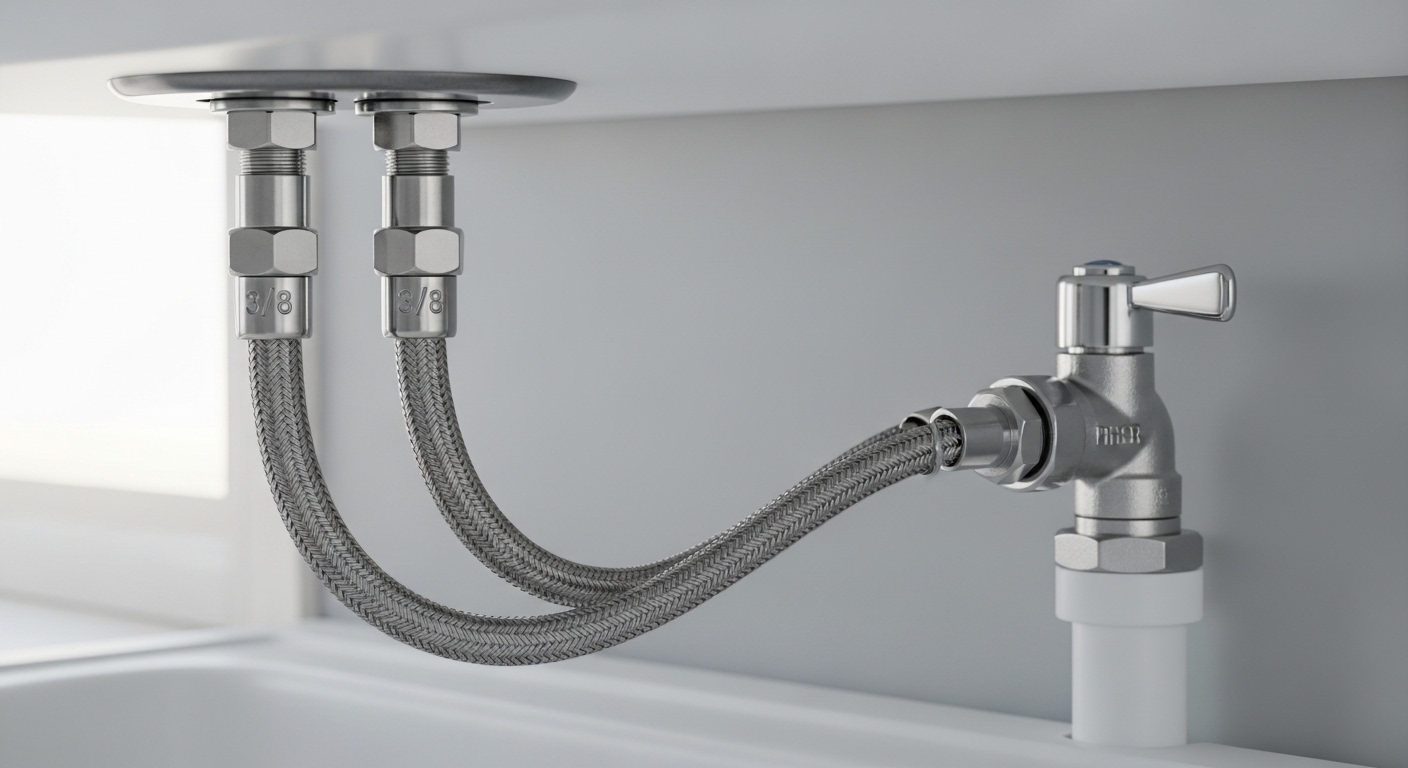
Figuring out the right pfister faucet water supply line size trips up more DIY installers than almost any other part of a faucet swap, and it’s almost always because two different “sizes” are being confused: the size stamped on the faucet’s supply tubes and the size of the shut-off valve coming out of your wall. Get those two straight and the whole install stops being a guessing game. Below, we’ll walk through exactly what Pfister ships in the box, what your under-sink valves are likely to be, how to measure so you buy the right braided line the first time, and how to avoid the slow drip that shows up three days after you think you’re done.
This guide sticks strictly to supply lines and connectors for Pfister faucets — kitchen, bathroom vanity, and bar/prep. If you’re mid-install and want the universal sizing math, our companion piece on the right faucet supply line dimensions for your sink covers it in plain English, and this article zooms in on the Pfister-specific details.
What size supply line does a Pfister faucet actually use?
Nearly every modern Pfister faucet uses a 3/8-inch compression connection on the faucet side. That’s the industry default for residential faucets sold in North America, and Pfister follows it. The braided supply hoses that come pre-attached to most Pfister pull-down kitchen faucets and many bathroom models already end in a 3/8-inch compression nut, ready to thread straight onto a standard 3/8-inch angle stop.
Here’s the important nuance: “3/8-inch” refers to the compression fitting’s tube diameter, not the water volume flowing through it. So when a spec sheet, a plumber, or a hardware store associate says your faucet needs a “3/8 line,” they mean the fitting size that mates with the valve — not how much water it moves. The three sizes you’ll run into under a typical sink are:
- 3/8-inch compression — the most common shut-off valve outlet in homes built or re-plumbed in the last few decades, and the native fit for Pfister supply hoses.
- 1/2-inch compression or 1/2-inch FIP (female iron pipe / threaded) — older or larger-diameter valve outlets; you’ll need a supply hose sized 1/2-inch on the valve end and 3/8-inch on the faucet end.
- 7/16-inch and 1/2-inch faucet-side connectors — some faucets (including a few Pfister lav faucets with integrated shanks) use a coupling nut that fits either a 7/16 or 1/2-inch inlet; the braided hose you buy has a “faucet connector” end designed to fit these.
If you remember only one thing about pfister faucet water supply line size, make it this: the faucet end is almost always 3/8-inch compression, and the only variable you really have to confirm is what’s coming out of your wall.
Are Pfister supply lines 3/8 or 1/2 inch — how do I tell what I have?
You tell by looking at the valve outlet under your sink, not the faucet. The faucet end is fixed at 3/8-inch compression on the vast majority of Pfister models; the wall/valve end is the one that varies between 3/8 and 1/2 inch. Shut off the water, then check the little chrome or plastic angle stop where the supply line meets the wall or floor.
A quick visual test: a 3/8-inch compression outlet is noticeably slimmer — the threaded stub is about the width of a pencil. A 1/2-inch outlet looks chunkier and is common on older copper stub-outs and on valves that thread directly onto 1/2-inch pipe. If you’re unsure, unscrew the existing supply line (water off, towel down) and take it — or a clear photo — to the store. The nut size tells the whole story.
You can also measure the tube diameter directly. Slide a tape measure or caliper across the outside of the metal tube the compression nut grips. Roughly 3/8-inch across means a 3/8 line; roughly 1/2-inch means a 1/2 line. Don’t measure the threads or the nut flats — measure the tube itself, because that’s what the “size” names.
What if my Pfister faucet has hoses already attached?
Then you don’t buy faucet-side hoses at all — you match the valve. Many Pfister kitchen faucets (the Stellen, Zuri, and Lita pull-downs, for example) ship with permanently attached braided lines ending in a 3/8-inch compression nut. In that case you have two choices: if your valve is 3/8-inch compression, the attached hose threads on directly; if your valve is 1/2-inch, you add a short 1/2-inch-to-3/8-inch adapter or, cleaner, replace the angle stop with a 3/8-inch one.
How long should the supply line be for a Pfister faucet?
Buy a hose 2 to 4 inches longer than the straight-line distance from your valve outlet to the faucet inlet — never dead-on and never wildly long. A supply line stretched taut puts constant tension on both fittings and is the number-one hidden cause of slow leaks months later. Too much slack, and the hose kinks or coils against the cabinet, which restricts flow and stresses the braid.
To measure: with the water off, run a flexible tape from the top of the shut-off valve up to where the faucet’s inlet shank sits under the deck. For a standard kitchen sink that’s usually 16 to 20 inches; for a bathroom vanity it’s often 12 to 16 inches. Add your 2–4 inches of comfortable slack and round up to the nearest stocked length (common braided lines come in 12″, 16″, 20″, and 24″). Pfister pull-down kitchen faucets also need extra reach for the spray hose and its weight, but that’s a separate line — don’t confuse it with the water supply.
| Pfister faucet type | Faucet-side connection | Typical valve-side need | Common supply line length |
|---|---|---|---|
| Kitchen pull-down (Stellen, Zuri, Lita) | 3/8″ compression (often pre-attached) | 3/8″ comp valve | 16″–20″ |
| Bathroom vanity / lav (Ashfield, Courant) | 3/8″ comp or 1/2″/7/16″ coupling nut | 3/8″ comp valve | 12″–16″ |
| Widespread bathroom (3-hole) | 3/8″ compression per side | 3/8″ comp valve | 12″–16″ (x2) |
| Bar / prep faucet | 3/8″ compression | 3/8″ comp valve | 12″–16″ |
If you’re installing a widespread set, the two-line layout has its own quirks worth understanding before you buy — our guide on the widespread faucet layout explains how the valve bodies and hot/cold supplies route under the deck.
What connector and materials should I buy for a Pfister supply line?
Buy braided stainless steel supply lines with a 3/8-inch compression nut on the faucet end and whichever size (3/8 or 1/2 inch) your valve needs on the other end. Braided stainless is the standard for good reason: it resists bursting far better than the old poly or vinyl lines, it’s flexible enough to route around a garbage disposal, and quality ones carry a lifetime or long warranty. Look for lines that meet the ASME A112.18.6 / CSA B125.6 standard for flexible water connectors — that’s the third-party benchmark meaning the hose was pressure- and life-cycle-tested, not just crimped and shipped.
The connector ends you’ll see on the packaging:
- 3/8″ compression — a smooth cone nut that seats against the valve’s ferrule. This is your faucet end and, usually, your valve end too.
- 1/2″ FIP (female threaded) — internal threads that spin onto a 1/2-inch male valve or nipple. Buy this if your angle stop is threaded rather than compression.
- 7/16″ & 1/2″ dual faucet connector — an oversized coupling nut common on the faucet end of some lav faucets. Many braided lines are labeled “faucet connector to 3/8 compression,” which covers both the faucet shank and the valve in one hose.
Do not over-tighten compression fittings. Hand-tight plus a quarter to half turn with a wrench is the target. Cranking down on a 3/8-inch compression nut deforms the ferrule and causes the exact leak you were trying to prevent. Use two wrenches on the faucet inlet — one to hold the shank steady and one to turn the nut — so you don’t twist the faucet’s internal connections.
Do I need thread tape or thread sealant on a Pfister supply line?
Only on threaded (FIP/NPT) connections, never on compression seals. Compression fittings and the rubber-washer faucet-connector ends seal by mechanical compression or a gasket, so PTFE tape there does nothing useful and can actually interfere. If you’re threading a 1/2-inch FIP end onto a male threaded valve, two or three wraps of PTFE (plumber’s) tape on the male threads is appropriate. When in doubt, follow the direction printed on the connector packaging — Pfister’s own install sheets call out this same distinction.
Why is my new Pfister faucet supply line leaking after install?
Nine times out of ten it’s one of three things: an over-tightened compression nut with a crushed ferrule, a missing or misseated rubber washer on the faucet-connector end, or debris caught on the sealing surface. The fix is almost never “tighten it harder” — that’s what caused it. Shut the water off, disconnect, inspect the washer and ferrule, wipe the mating surfaces clean, and re-seat with the correct light torque.
A second common culprit is a mismatched size forced together. If someone tried to thread a 3/8-inch line onto a 1/2-inch valve (or vice versa) with an adapter that isn’t seated square, it’ll weep no matter how tight it gets. That’s why confirming your pfister faucet water supply line size before you buy — rather than at the counter under pressure — saves the return trip and the redo. If your leak is coming from the faucet body or spray head instead of the supply connection, that’s a different diagnosis, and our walkthrough on installing a bathroom vanity faucet in under two hours shows how the inlet shanks and gaskets seat correctly from the start.
How often should supply lines be replaced?
Replace braided stainless supply lines any time you pull a faucet, and inspect them every couple of years. Even good hoses have a service life — the rubber core inside the braid ages, and a burst supply line under constant household pressure is a genuine flood risk. Whenever you’re already under the sink for a faucet swap, spend the few dollars and put in fresh lines rather than reusing kinked or corroded ones. It’s cheap insurance against water damage that costs thousands.
Can I reuse my old supply lines with a new Pfister faucet?
You can if they’re the right size, undamaged, and reach comfortably — but you usually shouldn’t. Old lines that have been compressed and bent to a specific route rarely reseat cleanly on a new faucet’s shank, and a hose that looks fine on the outside can be brittle inside. Given that a pair of quality braided 3/8-inch lines costs less than a takeout meal, reusing old ones to save a couple of dollars is a bad trade against the risk of a leak inside a closed cabinet you won’t notice for weeks.
The one time reuse makes sense: your existing lines are recent braided stainless, the correct 3/8-inch fit on both ends, long enough with slack, and undamaged. In that case, inspect the washers, clean the ends, and reconnect with light torque. Otherwise, replace them. If you’re the kind of buyer who wants to do it once and not think about it again, that philosophy — buy the quality part, not the cheap one — is exactly what our dealers argue in why you should never buy cheap bathroom fixtures.
Quick step-by-step: connecting the supply lines to a Pfister faucet
- Turn off both hot and cold shut-off valves under the sink and open the faucet to relieve pressure.
- Confirm your valve outlet size (3/8″ or 1/2″) and buy braided stainless lines to match, with a 3/8″ compression faucet end.
- Route each line without kinks — hot to hot (left inlet), cold to cold (right inlet).
- Hand-thread the faucet-end nut onto the Pfister inlet shank; snug with two wrenches (one holding, one turning), a quarter to half turn past hand-tight.
- Hand-thread the valve-end nut onto the angle stop; snug the same way. Use PTFE tape only on threaded FIP ends, never on compression.
- Slowly open both valves, then run the faucet and check every fitting for drips with a dry paper towel. Re-snug gently only if you see moisture — don’t crank.
That sequence, plus the right size line, is the whole job. Most Pfister supply-line installs take under fifteen minutes once the faucet body is mounted.
Author note & why trust this guide
This guide was written by the WigaFaucet fixtures team — sales engineers and installers who spec, test, and fit faucets and their connectors every day across kitchen and bath jobs. WigaFaucet (wigafaucet.com) is a dedicated faucet and bathroom-fixtures specialist, and our sizing recommendations follow the same ASME A112.18.6 / CSA B125.6 standard that governs flexible water connectors sold in North America, along with Pfister’s published installation specifications and warranty guidance. We recommend braided stainless lines carrying a manufacturer’s lifetime warranty, and we always advise replacing supply lines during a faucet swap rather than reusing aged hoses.
FAQ
Is a Pfister faucet supply line 3/8 or 1/2 inch?
On the faucet side, virtually all Pfister faucets use a 3/8-inch compression connection. The 1/2-inch dimension you sometimes hear about refers to the shut-off valve outlet on the wall side, which can be either 3/8 or 1/2 inch depending on your plumbing. Match the valve size on one end of the hose and keep 3/8-inch on the faucet end.
Do Pfister faucets come with supply lines included?
Many Pfister kitchen pull-down faucets ship with braided supply hoses already attached, ending in a 3/8-inch compression nut. Most bathroom lav and widespread faucets do not include supply lines, so you’ll buy braided stainless lines separately to match your valve outlet.
What supply line do I need if my shut-off valve is 1/2 inch?
Buy a braided stainless line that is 1/2-inch on the valve end (compression or FIP, matching your valve) and 3/8-inch compression on the faucet end. These “1/2 to 3/8” lines are standard stock at any hardware store, so you don’t need a separate adapter.
How tight should I make the compression fittings?
Hand-tight plus about a quarter to half turn with a wrench. Over-tightening crushes the brass ferrule and is the most common cause of a leak that appears days later. Use two wrenches on the faucet inlet so you don’t twist the shank while tightening.
Can I use a longer supply line than I need for a Pfister faucet?
A little extra is good — aim for 2 to 4 inches of slack beyond the straight-line distance so the hose isn’t under tension. Too much extra length causes coiling and kinks against the cabinet, which stresses the braid and can restrict flow, so don’t go dramatically oversized.
Should I replace the supply lines every time I install a new faucet?
Yes. Fresh braided stainless lines cost only a few dollars and eliminate the risk of reseating an aged, kinked, or internally brittle hose. A burst supply line under constant pressure can flood a cabinet, so replacing them during any faucet swap is cheap insurance.