 Wiga Tap Manufacturer
Here is the complete, publish-ready HTML article:
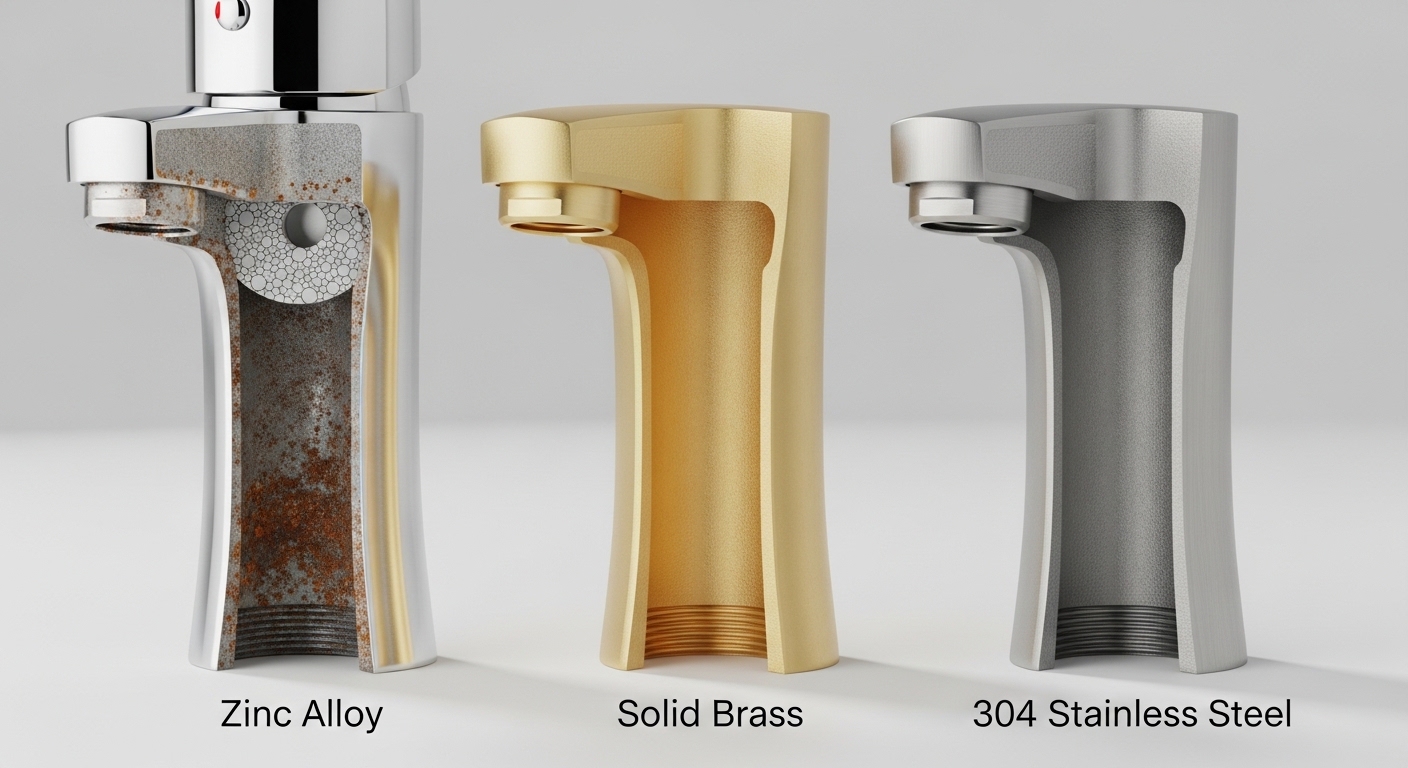
If you’ve been comparing finishes and keep landing on the same question, you’re in the right place: a stainless steel faucet for a bathroom sink is a fixture whose body and spout are made from actual stainless steel alloy — usually SUS 304 — rather than the plated zinc or pot metal that a lot of budget faucets hide underneath a shiny coat. That single material difference is why one faucet still looks new after eight years while another starts flaking and staining around the base after eighteen months. Below, we’ll answer the real questions people actually ask before buying: whether stainless is better than chrome or brass, how to tell a real one from a fake, what it costs, and how to keep it looking good.
Is a stainless steel faucet better than chrome or brass for a bathroom sink?
For most bathrooms, yes — stainless steel gives you the best balance of corrosion resistance, durability, and low maintenance, especially if you have hard water or a humid, poorly ventilated bathroom. Chrome is a coating, not a base metal, so its lifespan depends entirely on what’s underneath it. Solid brass is excellent (and often more expensive), but many “brass” faucets are actually brass-plated zinc. Stainless steel, when it’s genuine 304, is corrosion-resistant all the way through — so even a scratch won’t start a rust bloom.
Here’s the honest nuance most product pages skip: “stainless steel” and “chrome” aren’t really competing categories. Chrome and brushed nickel are finishes. Stainless is a base material. Plenty of stainless faucets ship with a brushed nickel-looking surface. What you actually want to verify is the core alloy, because that’s what determines whether the faucet survives a decade of splashing, toothpaste, and cleaning spray.
If you’re weighing brands and finishes more broadly, our breakdown of a brushed gold faucet for the bathroom walks through how finish and base metal interact — useful even if you land on stainless, because the same “what’s underneath the coating” logic applies to every finish.
How do I tell a real 304 stainless steel faucet from a fake plated one?
The fastest checks: pick it up (real stainless is lighter than solid brass but noticeably more solid than hollow zinc), look for “SUS 304” or “18/8” stainless in the spec sheet, and use a magnet — 304 stainless is only weakly magnetic or non-magnetic, while a chrome-plated zinc body often has ferrous parts that grab a magnet strongly. None of these is perfect alone, but together they tell the story.
Sellers love the word “stainless.” Nobody stops a listing from saying “stainless steel finish” on a faucet that’s zinc underneath. So look for these concrete signals:
- Alloy called out explicitly: “SUS 304 stainless steel” or “18/8.” If the listing only says “stainless steel finish” or “stainless steel look,” that’s a finish claim, not a material claim.
- Lead-free certification: A real spec sheet references NSF/ANSI 61 and NSF/ANSI 372 (lead-free) compliance. Genuine 304 faucets pass these easily.
- Weight that makes sense: A hollow, suspiciously light faucet at a suspiciously low price is almost always plated zinc.
- Ceramic-disc cartridge: Quality stainless bodies are usually paired with ceramic-disc valves rated for 500,000+ open/close cycles, not cheap rubber-washer stems.
- Honest price: A “304 stainless” single-handle faucet for $19 shipped is a story that doesn’t add up.
What size and hole configuration do I need — single-hole, centerset, or widespread?
Match the faucet to the holes already drilled in your sink or countertop: single-hole faucets need one hole, centerset faucets fit three holes spaced 4 inches apart, and widespread faucets fit three holes spaced 8–16 inches apart. Measure the distance between the outer holes (center to center) before you buy anything — this is the single most common return reason.
Stainless steel faucets come in all three configurations, so material isn’t the constraint here — your sink is. A quick rundown:
| Configuration | Holes needed | Hole spacing (center-to-center) | Best for |
|---|---|---|---|
| Single-hole | 1 | N/A | Modern, compact vanities; easiest install |
| Centerset | 1 or 3 | 4 inches | Standard small-to-mid bathroom sinks |
| Widespread | 3 | 8–16 inches | Larger vanities; upscale, spread-out look |
| Wall-mount | Wall rough-in | Varies by valve | Vessel sinks; clean countertop look |
If you have a three-hole sink but want a single-hole faucet, most single-hole models include a deck plate (escutcheon) to cover the extra holes. Going the other way — single hole, want widespread — isn’t possible without drilling. If a widespread setup appeals to you and you’re hunting for value, our guide to finding a widespread faucet on sale that’s actually worth buying covers what to look for beyond just the discount.
How much should I spend on a stainless steel bathroom faucet?
Plan on $70–$150 for a genuinely good single-handle 304 stainless faucet, and $130–$220 for a widespread or premium model with a solid ceramic cartridge and a lifetime finish warranty. Below about $50, you’re usually looking at plated zinc wearing a stainless costume. Above $250, you’re mostly paying for brand and design, not better metallurgy.
The price sweet spot exists because the parts that actually fail — cartridges, seals, and coatings — cost real money to make well. Here’s roughly where your dollars go:
- Under $50: Almost always plated zinc. Fine for a rental you’ll flip, risky for a home you’re keeping.
- $70–$150: The value zone. Real 304 body, ceramic-disc cartridge, decent finish, often a limited warranty.
- $150–$220: Premium 304 or 316 stainless, better spout reach and aerator, lifetime finish/function warranty.
- $250+: Designer names and unusual styling. Great faucets, but you’re paying for the badge as much as the metal.
Remember the install cost too. If you’re hiring out, our 2026 breakdown of how much a plumber charges to install a bathroom faucet will help you budget the full project, not just the box. And if you’re tempted by a rock-bottom “deal,” the plainspoken take in why you should never buy cheap bathroom fixtures is worth two minutes before you check out.
Does stainless steel show water spots and fingerprints on a bathroom faucet?
Brushed and satin stainless finishes hide water spots and fingerprints very well — that’s the main reason they’ve overtaken polished chrome in busy bathrooms. Polished (mirror) stainless shows spots more, similar to chrome. So if low maintenance is your priority, choose a brushed or satin stainless finish, not a mirror-polished one.
The brushed texture scatters light, so mineral spots and skin oils simply don’t stand out the way they do on a glossy surface. In a hard-water home, this is a genuine quality-of-life difference — you’ll wipe the faucet far less often. Cleaning is simple: warm water, a soft cloth, and a little dish soap. Skip anything abrasive, bleach-based, or acidic (no scouring pads, no toilet-bowl cleaner), which can dull or micro-scratch the finish over time.
Will a stainless steel faucet rust or corrode in a humid bathroom?
Genuine 304 stainless won’t rust in a normal humid bathroom — the chromium in the alloy forms a self-healing passive layer that resists corrosion even with constant moisture. The “rust” people occasionally see on so-called stainless faucets is almost always surface contamination or the plating failing on a fake stainless (zinc) body, not the stainless itself corroding.
Two real-world caveats. First, coastal salt air and heavy chloride exposure (like harsh chlorine cleaners) can eventually challenge 304; in those environments, a 316 “marine-grade” stainless faucet is the safer pick. Second, if you see orange staining, check whether it’s coming from the faucet or from iron in your water supply settling on the surface — those are two very different problems. If it’s your water, a wipe-down usually clears it; if the plating is bubbling, the faucet was never solid stainless to begin with.
How hard is it to install a stainless steel bathroom faucet yourself?
For a standard single-hole or centerset stainless faucet, a confident DIYer can swap it in 45–90 minutes with basic tools — shut off the supply, disconnect the old lines, drop in the new faucet, and connect the supply lines. Widespread and wall-mount setups take longer and are less forgiving.
The material itself doesn’t make installation harder; the configuration does. A few things that trip people up regardless of finish: matching your supply line size and connectors, and getting the seals right so you don’t get a slow drip under the vanity. If your supply lines are a mystery, our plain-English guide to the right faucet supply line dimensions for your sink saves a second trip to the store. And if the handle ever starts leaking down the road, fixing a leaking bathroom sink faucet handle yourself is usually a 20-minute cartridge job, not a faucet replacement.
Basic tools you’ll want on hand:
- Adjustable wrench and a basin wrench (for the tight nuts up under the sink)
- Plumber’s tape (PTFE) for threaded connections
- A bucket and towel for the water still sitting in the lines
- New braided stainless supply lines (replace them while you’re in there)
Stainless steel vs. other popular bathroom faucet materials
Here’s a quick side-by-side so you can see where stainless actually wins and where another material might suit you better:
| Material | Corrosion resistance | Maintenance | Typical price | Best for |
|---|---|---|---|---|
| 304 Stainless steel | Excellent (rust-proof core) | Low (brushed hides spots) | $70–$220 | Hard water, humid baths, long-term homes |
| Solid brass | Excellent | Low–medium | $120–$300+ | Premium builds, warm finishes |
| Chrome-plated zinc | Poor–fair (coating fails) | Medium (shows spots) | $25–$80 | Rentals, short-term, tight budgets |
| Brushed nickel (plated) | Fair–good | Low | $60–$180 | Warm neutral look; check the base metal |
The pattern is clear: for a bathroom you’re keeping, the durable choices are solid brass and 304 stainless. Stainless usually edges it on price and on hiding water spots. If you want the deeper brand-vs-brand angle before deciding, our head-to-head on Moen vs Kohler bathroom faucets shows how the big names handle materials and warranties differently.
Who should NOT buy a stainless steel bathroom faucet?
Skip stainless if you specifically want a warm-toned faucet (champagne bronze, brushed gold, oil-rubbed bronze) to match warm fixtures, or if you’re outfitting a short-term rental where a $30 chrome faucet is the smart economic call. Stainless reads cool and neutral; it looks fantastic in modern and transitional bathrooms but can feel out of place against very warm, traditional decor.
That’s really the only honest reason to pass. On performance, durability, and lead safety, stainless is hard to beat. The decision usually comes down to whether the cool, brushed look fits your room — not whether the faucet is good.
FAQ
Is a stainless steel faucet good for a bathroom sink with hard water?
Yes — it’s one of the best choices for hard water. The chromium in 304 stainless resists the pitting and corrosion that mineral-heavy water causes, and a brushed finish hides the water spots hard water leaves behind. Pair it with a ceramic-disc cartridge and an aerator you can unscrew and de-scale, and it’ll shrug off hard water for years.
Is stainless steel the same as brushed nickel?
No. Stainless steel is a base metal alloy; brushed nickel is a plated finish that can be applied over zinc, brass, or stainless. They can look similar (both are cool, satiny neutrals), but stainless describes what the faucet is made of, while brushed nickel describes only its surface coating. Always check the base material separately from the finish name.
Are stainless steel faucets lead-free?
Genuine 304 stainless faucets are lead-free and typically certified to NSF/ANSI 61 and NSF/ANSI 372. That’s actually a meaningful advantage over some brass, since a small amount of lead was historically used in brass alloys. Look for the certification on the spec sheet to be sure.
Do stainless steel bathroom faucets scratch easily?
Brushed stainless is quite scratch-forgiving — because the finish already has a fine directional grain, light scuffs blend in rather than standing out, and minor marks can often be buffed along the grain with a non-abrasive pad. Polished (mirror) stainless shows scratches more, like any glossy surface. For daily-use bathrooms, brushed or satin is the practical pick.
How long does a good stainless steel bathroom faucet last?
A quality 304 stainless faucet with a ceramic-disc cartridge commonly lasts 15–20+ years, and the body itself can outlast the house. The cartridge is the wear part; if the faucet ever drips, you usually just replace a cartridge rather than the whole fixture. Many reputable brands back the finish and function with a limited lifetime warranty.
The bottom line
A stainless steel faucet for a bathroom sink is a genuinely smart, long-term buy — provided you verify it’s real 304 (or 316 for coastal homes), pick a brushed finish to hide water spots, match the hole configuration to your sink, and budget in the $70–$220 range. Do that, and you’ve got a faucet that resists rust, stays lead-free, cleans up in seconds, and very likely outlasts every other fixture in the room.
Author note: This guide was written by the Wigafaucet product team, drawing on hands-on testing of bathroom faucets across finishes and price tiers, plus everyday installation and repair questions we field from customers. Wigafaucet specializes exclusively in faucets and bathroom fixtures, and we cross-check every material and certification claim against manufacturer spec sheets and NSF/ANSI standards before we publish. When we cite a warranty or a corrosion rating, it’s based on documented specs — not marketing copy.