 Wiga Tap Manufacturer
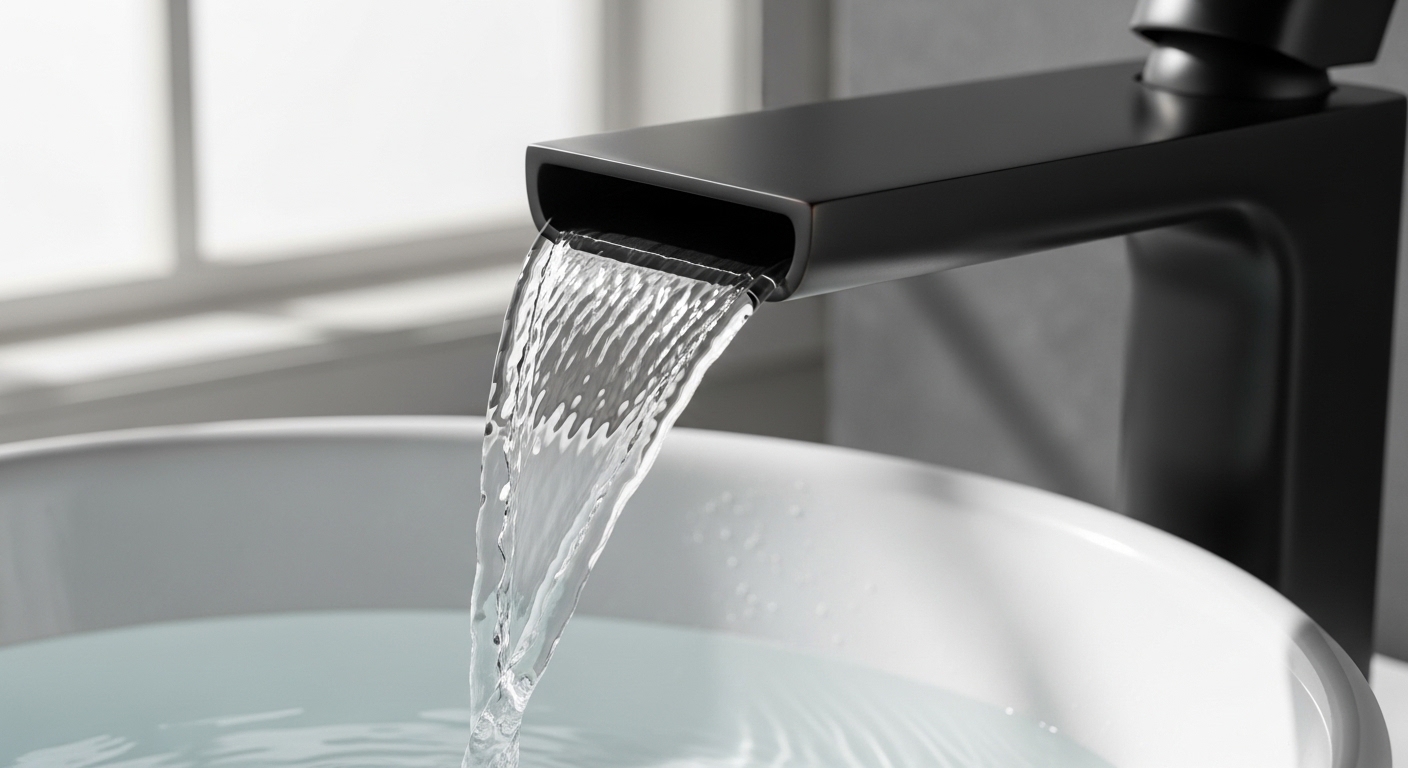
If you’ve been shopping for a spa vibe, you’ve almost certainly landed on a bathroom faucet open top design — the kind where you can literally see the water gather in an open channel and spill out in a wide, glassy sheet. They photograph beautifully, they feel modern, and they’re everywhere on Pinterest and hotel-bathroom mood boards. But an open-top waterfall faucet behaves differently from a normal enclosed spout, and a few real-world quirks decide whether you’ll love it or return it. Below is the honest, plumber’s-eye breakdown: what it is, who it’s actually for, how it performs on real home water pressure, and which specs to check before you spend the money.
What Does “Open Top” Actually Mean on a Bathroom Faucet?
“Open top” means the spout has an exposed upper channel — a shallow open trough — instead of a closed internal waterway. Water rises up inside the faucet body, fills that open ledge, and then pours over the edge as a flat waterfall stream. You can see the water the whole way, which is the entire point of the look.
This is different from three things people confuse it with:
- A standard high-arc faucet: the spout is closed; you only see water at the aerator tip.
- A “waterfall” faucet with a hidden channel: some faucets give a wide flat stream but keep the channel enclosed under a cover. Open-top leaves it visible.
- A glass-spout LED faucet: often open-top too, but marketed on the light show rather than the open channel itself.
Because the top is open, the water is not pressurized through a tiny aerator screen. That’s the single fact that explains almost every pro and con below — the feel, the pressure, the splash, and the cleaning.
Is an Open-Top Waterfall Faucet Worth It, or Is It Just a Looks Thing?
Short answer: it’s worth it if the look matters to you and your sink is deep enough — but be honest that you’re buying it mostly for aesthetics and feel, not for function. An open-top faucet does not clean your hands better or fill a cup faster. What it delivers is a wide, soft, quiet stream that feels gentle and looks like a mini waterfall, which is genuinely calming in a powder room or a spa-style master bath.
Here’s the trade-off in plain terms. Because water leaves an open channel instead of a compressed aerator, the stream is wider and flatter but lower-velocity. On a vessel sink that sits high on the counter, that flat sheet can splash if the faucet is too tall or the basin is too shallow. On a deeper undermount or drop-in basin, it behaves beautifully. So the real question isn’t “is open-top good?” — it’s “does open-top match my sink?”
If you’re weighing this against a more traditional look, it’s worth reading our take on whether a stainless steel faucet for a bathroom sink is actually worth it — that piece covers the durability side of the decision, which pairs directly with the finish concerns of an exposed open-top spout.
How Does an Open-Top Faucet Handle Low Home Water Pressure?
This is the make-or-break question, so here’s the direct answer: open-top waterfall faucets need decent pressure to look their best, and they perform poorly on very low-pressure homes. If your household static pressure is under about 40 psi, the “waterfall” can sag into a weak dribble instead of a clean sheet.
A normal aerated faucet mixes air into the stream and masks low pressure — the stream still looks full even at 1.2 GPM. An open-top faucet can’t do that. The visual sheet depends on water volume flowing over the ledge, so weak pressure reads as a weak, uneven pour. Most quality open-top faucets are rated around 1.2–1.8 GPM, and they look their best when your home delivers a steady 45–60 psi.
Before you buy, it’s genuinely worth checking your pressure with a $10 gauge on an outdoor spigot. And if you already know your bathroom runs weak, diagnose that first — our guides on why a bathroom faucet has low water pressure and how to fix it will tell you whether the problem is the faucet, the supply lines, or a clogged aerator, before you spend on a fixture that will only expose the issue.
Open Top vs. Standard Aerated vs. Enclosed Waterfall: Which Should You Buy?
Direct answer: choose open-top for a statement spa look with a deep basin and good pressure; choose an enclosed waterfall for the wide-stream look with less splash and easier cleaning; choose a standard aerated faucet if you want maximum function, water savings, and zero fuss. Here’s how they stack up.
| Feature | Open-Top Waterfall | Enclosed Waterfall | Standard Aerated |
|---|---|---|---|
| Look | Most dramatic — visible cascade | Wide flat stream, spout closed | Classic, understated |
| Best sink type | Deep vessel or undermount | Most basins | Any basin |
| Splash risk | Higher (shallow basins) | Medium | Low |
| Performance on low pressure | Poor | Fair | Excellent |
| Typical flow rate | 1.2–1.8 GPM | 1.2–1.5 GPM | 1.0–1.5 GPM |
| Cleaning effort | Higher — exposed channel | Medium | Low |
| Price range (2026) | $70–$300+ | $60–$250 | $40–$200 |
Notice the cleaning column. An open channel collects a little toothpaste splash and hard-water mineral film that a closed spout hides. It’s a 15-second wipe, not a chore — but if you have very hard water and you’re a set-it-and-forget-it type, that exposed ledge will show spots faster than a sealed spout.
What Finish Holds Up Best on an Open-Top Bathroom Faucet?
Direct answer: brushed/matte finishes (matte black, brushed nickel, brushed gold) hide water spots and fingerprints far better than polished chrome on an open-top faucet, because the channel is fully visible and shiny finishes broadcast every mineral speck. For an exposed-channel design, a matte or brushed PVD finish is the smart, low-maintenance pick.
Finish matters more here than on a normal faucet precisely because you see more of the spout, more of the time, with water sitting in it. Quick guidance:
- Matte black: hides spots best, high drama, but shows dried-white mineral crust in very hard water — wipe after use.
- Brushed nickel / brushed gold: the best all-rounder; disguises spots and fingerprints, warm and forgiving.
- Polished chrome: cheapest and brightest, but every drop and fingerprint shows on the open ledge.
- PVD-coated finishes: worth paying for — the physical-vapor-deposition coating resists scratching and tarnish, which matters on a spout you touch and wipe daily.
If your water is hard enough to leave crust, that’s not just a cosmetic issue — mineral buildup also affects flow. Our explainer on what a faucet aerator gauge is and how to find the right size is useful even for open-top faucets, since many still hide a small flow restrictor at the base that scales up over time.
How Do You Install and Maintain an Open-Top Faucet Without Problems?
Direct answer: installation is nearly identical to a standard single-hole bathroom faucet — two supply lines, one mounting nut, a pop-up drain — but you must confirm deck thickness and the height-to-basin ratio to avoid splash, and you should clean the open channel weekly. Most open-top faucets are single-hole, single-handle designs, so they drop into a standard 1.25″–1.375″ faucet hole.
A realistic install and upkeep checklist:
- Measure spout height vs. basin depth. For a vessel sink, aim for the water to land 1–2 inches from the drain, not near the front rim, or you’ll splash the counter.
- Check reach. The waterfall should land in the bowl’s center, not the back wall of the basin.
- Shut off both angle stops, connect supply lines hand-tight plus a quarter turn. Don’t overtighten braided lines.
- Test the stream at full flow. Adjust the aerator/restrictor if the sheet is uneven — sometimes a factory restrictor is slightly clogged from shipping debris.
- Wipe the open channel weekly with a soft cloth and a little vinegar solution for hard-water spots. Never use abrasive pads on a PVD or matte finish.
Comfortable with a wrench? This is a genuine DIY job for most people. Not comfortable, or dealing with corroded shutoffs? It’s worth knowing the going rate — see how much a plumber charges to install a bathroom faucet in 2026 so you can decide before you commit. And if your faucet ever starts dripping down the line, the fix is usually a cheap part, not a new faucet — our guide to the single-handle faucet cartridge covers the exact swap for the single-handle designs most open-top faucets use.
Who Should Skip an Open-Top Bathroom Faucet?
Direct answer: skip it if you have very low water pressure, very hard water plus a hate of wiping fixtures, small kids who’ll splash a shallow vessel sink, or a rental where function beats flair. In those cases a standard aerated faucet will make you happier day to day.
Open-top is a lifestyle-and-look purchase. In a guest powder room, a spa master bath, or any space where the faucet is meant to be a centerpiece, it delivers. In a busy family bathroom where the sink gets hammered a dozen times a day, the splash and the wiping get old. Match the faucet to how the room is actually used — that’s the whole game.
What to Look for Before You Buy (Quick Buyer’s Checklist)
Before you check out, confirm these specs. This is the list that separates a faucet you’ll love from a return label:
- Flow rate: 1.2 GPM minimum for a visible sheet; 1.5–1.8 GPM ideal.
- Valve/cartridge: ceramic disc cartridge — it outlasts rubber-washer valves by years and resists drips.
- Body material: solid brass, not zinc alloy, for corrosion resistance in a wet, exposed channel.
- Finish: PVD-coated brushed or matte for spot resistance.
- Certification: look for cUPC/NSF/ANSI compliance and a lead-free (NSF/ANSI 372) rating.
- Warranty: a real lifetime finish-and-function warranty signals the maker trusts the build.
- Mounting: confirm single-hole vs. widespread and your deck thickness (usually up to ~2″).
FAQ
Does an open-top bathroom faucet splash more than a normal one?
It can, in shallow or wide vessel sinks, because the flat waterfall sheet spreads out and hits the basin at an angle. In a deeper basin where the water lands 1–2 inches from the drain, splash is minimal. The fix is matching spout height and reach to your specific sink, not the faucet type itself.
Can I use an open-top waterfall faucet with low water pressure?
Not ideally. Open-top faucets rely on water volume flowing over an open channel to create the sheet, so they look weak below roughly 40 psi. If your home runs low, either boost your pressure or choose an aerated faucet that masks low pressure with air. Diagnose the cause of weak flow first before blaming the fixture.
Are open-top faucets harder to keep clean?
Slightly. The exposed channel collects a bit of toothpaste splash and hard-water film that a sealed spout hides. It’s a quick weekly wipe with a soft cloth and diluted vinegar. A brushed or matte finish disguises spots far better than polished chrome, which shows every drop.
What sink works best with an open-top bathroom faucet?
A deep vessel sink or a deep undermount basin. Depth gives the waterfall room to land near the drain without splashing over the rim. Very shallow decorative vessel bowls are the worst match, especially with a tall faucet, because the water travels too far and spreads.
Are open-top faucets more expensive than regular bathroom faucets?
Generally a little, yes. Expect $70–$300+ in 2026 versus $40–$200 for a comparable standard faucet, mostly because of the design tooling and the wider, PVD-coated spouts. The premium is for the look and finish quality, not better cleaning or flow performance.
Do open-top faucets meet U.S. plumbing codes and water-efficiency rules?
Quality ones do. Look for cUPC certification, NSF/ANSI 61 and 372 lead-free compliance, and a flow rate at or under 1.5 GPM if you’re in a WaterSense-conscious state like California or Colorado. Reputable brands publish these ratings on the spec sheet — if a listing hides them, treat that as a red flag.
The Bottom Line
An open-top bathroom faucet is a genuine upgrade in feel and drama when it’s matched to the right sink and decent water pressure — a deep basin, 45+ psi, and a brushed or matte PVD finish is the winning combo. It’s the wrong call for low-pressure homes, splash-prone shallow vessels, and anyone who won’t do a weekly wipe. Buy for the look with clear eyes about the trade-offs, check the flow rate and certifications, and you’ll get that spa-cascade you were after without the buyer’s remorse.
Author note: This guide was written by the Wigafaucet product team, drawing on hands-on testing of open-channel and aerated bathroom faucets across a range of home water pressures and sink types. At wigafaucet.com we specialize exclusively in faucets and bathroom fixtures — we evaluate builds for solid-brass bodies, ceramic-disc cartridges, and PVD finish durability, and every faucet we recommend meets cUPC and NSF/ANSI 372 lead-free standards and carries a manufacturer warranty. We test for finish spotting, flow consistency, and splash behavior so our buying advice reflects real bathroom use, not just spec sheets.