 Wiga Tap Manufacturer
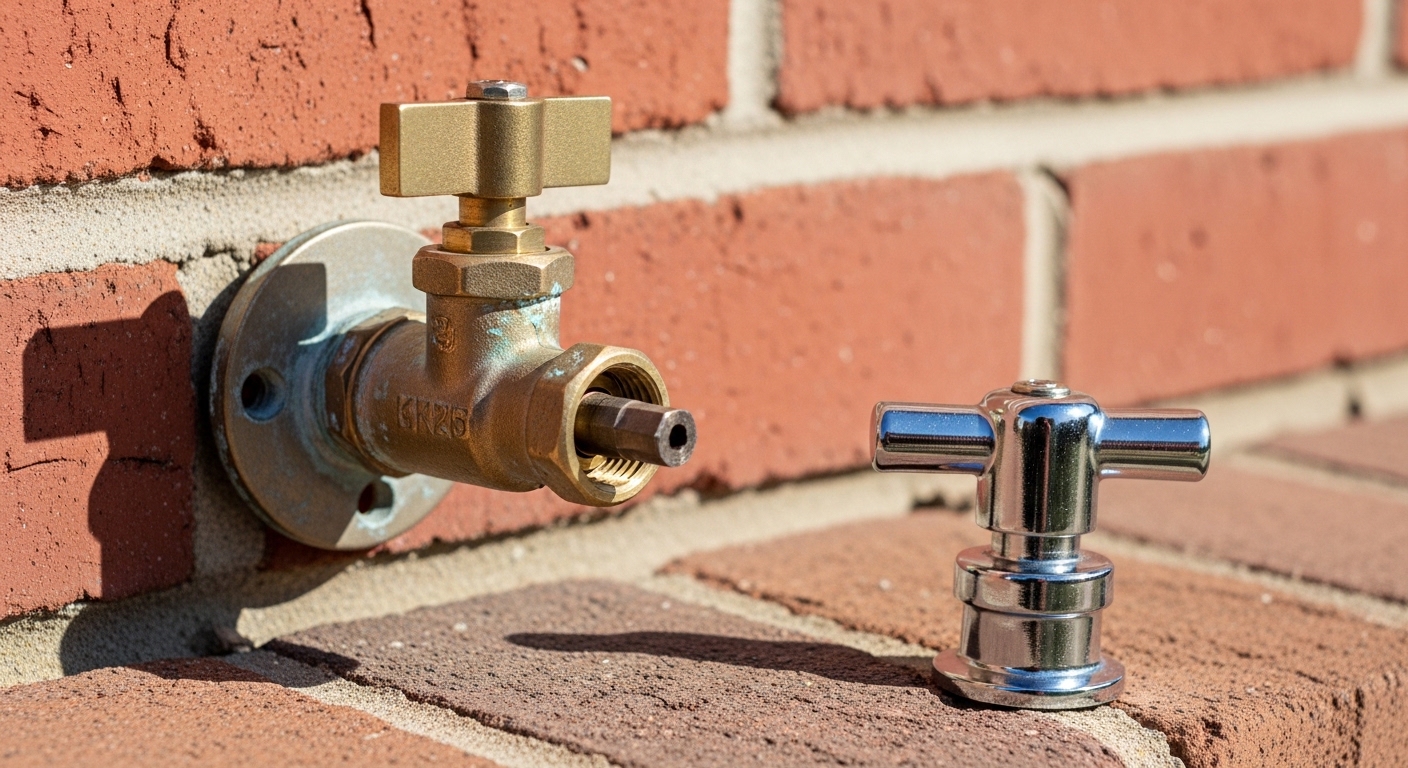
If you’ve ever walked up to a spigot on the side of a commercial building, a park, or an older home and found a bare metal stub where the handle should be, you’ve met a keyed hose bibb — and you need an outdoor faucet key to turn it on. The key isn’t a lock-and-tumbler key; it’s a hand tool, usually a stamped-steel T or a small ratchet socket, that slips over the exposed valve stem so you can open and close the water. Below I’ll walk you through exactly which type fits your faucet, how to measure your stem so you buy the right size the first time, and when a keyed faucet is genuinely worth installing versus when a standard handle is fine.
What exactly is an outdoor faucet key, and how is it different from a regular spigot handle?
An outdoor faucet key is a detachable handle. Instead of a wheel or lever permanently bolted to the valve stem, a keyed faucet leaves the stem bare, and you carry the key separately to operate it. Pull the key off, and the faucet physically cannot be turned by hand — that’s the entire point.
Regular hose bibbs and sillcocks have a fixed handle (a round wheel, a cross/tee, or a lever) that anyone can grab and turn. Keyed faucets — sometimes sold as “loose key hose bibbs,” “anti-vandal faucets,” or “self-closing faucets” — remove that convenience on purpose. They’re the standard in places where you don’t want the public, tenants, or passersby helping themselves to water: apartment building exteriors, restaurants, gas stations, schools, community gardens, RV parks, and public restrooms with exterior wash-down spigots.
There are two mechanical families you’ll run into:
- Loose-key compression faucets — the stem stays exactly where you leave it. Turn it a few rotations to open, turn it back to close. This is the classic keyed hose bibb.
- Self-closing (spring-loaded) faucets — you turn or push the key and water flows only while you hold pressure; release it and a spring snaps the valve shut. These are metering-style and common in high-traffic public installs where someone always leaves the water running.
The key that fits one won’t necessarily fit the other, so knowing which mechanism you have matters before you buy.
How do I know which size outdoor faucet key I need for my spigot?
Measure the exposed stem — its shape and its width across the flats decide everything. Nearly every keyed outdoor faucet uses one of a handful of standard stem broaches, so once you measure, matching a key is easy.
Take the handle off (or look at the bare stem if it’s already keyed) and check two things: the shape of the stem and the size across the flats. Most residential and light-commercial keyed spigots use a small square stem; larger commercial wall hydrants sometimes use a five-sided (pentagon) or a special notched broach specifically so a garden-variety key can’t open them.
| Stem type | Typical size (across flats) | Where you’ll find it | Key style you need |
|---|---|---|---|
| Small square stem | 1/4″ (about 6.3 mm) | Residential loose-key hose bibbs, older homes | Loose-key T-handle, 1/4″ square socket |
| Standard square stem | 5/16″ (about 8 mm) | Light-commercial spigots, self-closing faucets | T-handle or ratchet key, 5/16″ square |
| Large square stem | 3/8″ – 1/2″ | Commercial wall hydrants, wash-down valves | Heavy socket wrench key |
| Pentagon (5-sided) | ~1/2″ point-to-flat | Fire-safe / anti-vandal municipal hydrants | Pentagon socket key (utility/hydrant wrench) |
| Notched / proprietary | Brand-specific | Woodford, Prier, Zurn wall hydrants | Manufacturer-matched loose key |
Two practical tips. First, if you can, buy the key and the faucet as a set from the same maker — the fit will be exact, and you avoid the “close but rattles” problem that rounds off a soft brass stem over time. Second, a 4-way or universal outdoor faucet key with multiple square sockets (1/4″, 5/16″, 3/8″, and a pentagon) is cheap insurance if you manage several properties or don’t know every stem size in advance.
Why would I choose a keyed outdoor faucet over one with a normal handle?
You choose a keyed faucet when unauthorized water use is a real risk or a real cost. The removable key is a deterrent: no handle means no casual “I’ll just fill my cooler / wash my car / water this planter” from someone who isn’t paying the water bill.
Here’s where a keyed outdoor faucet earns its place:
- Landlords and multi-unit buildings — one exterior spigot on a shared meter can quietly cost you hundreds a season if tenants or neighbors use it freely.
- Commercial and retail exteriors — restaurants, car washes, and shops keep wash-down water available to staff only.
- Public parks, campgrounds, and community gardens — self-closing keyed faucets stop water waste from taps left running.
- Vacation and rental homes — you control outdoor water when you’re not there, which also reduces the risk of a hose being left on.
- Drought-restricted regions — where outdoor water use is regulated, a keyed faucet enforces the rule.
The trade-off is convenience. If it’s your own backyard and you water the garden every morning, a keyed faucet is just an extra step and a key you’ll eventually misplace. In that case a standard frost-free sillcock with a fixed handle is the friendlier choice. Think of the key as a feature you add when access control is worth more to you than grab-and-go speed.
Can I convert my existing outdoor faucet to a keyed one, or do I have to replace it?
In most cases you replace the whole faucet, but there’s a simpler middle path: on many standard hose bibbs you can just remove the handle. If your existing spigot has a stem that continues as a square broach under a screw-on wheel handle, unscrew the handle bonnet nut, pull the wheel off, and you’ve effectively created a keyed faucet — now any correctly sized loose-key will operate it.
That said, it only works cleanly if the exposed stem is a true square. Many modern handles clamp onto a splined or D-shaped stem that a loose key won’t grip well, so forcing it will round the metal. When that’s the case, swapping in a purpose-built loose-key hose bibb (they thread onto the same 3/4″ MIP or sweat connection as your current one) is the right move and usually a 15-minute job with thread tape and a wrench.
While you’re at it, check what’s downstream of the spigot. If you attach hoses, splitters, or a filter, make sure your fittings still line up — outdoor connections are all about matching the right adapter to the right thread. If you’re plumbing a hose or a fill line off a tub or utility connection nearby, our guide on the tub spout to garden hose adapter covers how those thread sizes and adapters actually fit together, and our breakdown of the faucet hook up adapter options explains how to bridge a faucet to a hose or supply line without leaks.
How do you use an outdoor faucet key without stripping the stem?
Seat the key fully onto the stem before you apply any turning force, and use steady pressure — not a hard yank. Stripping happens when the key is loose, cocked at an angle, or the wrong size, and you crank on it anyway. Here’s the reliable routine:
- Match the size first. The key should slip on snug with almost no wobble. If it rattles, it’s too big — stop and get the right one.
- Push it all the way down so the socket fully engages the flats, then keep light inward pressure while you turn.
- Turn counterclockwise to open (for compression/loose-key faucets), usually two to four full turns until water flows freely.
- Don’t over-tighten to close. Snug is enough. Cranking hard on the closed position is what chews up the rubber washer inside and starts a drip.
- For self-closing faucets, turn or press and hold — water runs only while you maintain pressure, and releasing shuts it automatically.
If the faucet is stiff or squeals, the packing or washer is likely worn — the same kind of internal wear you’d address in any compression valve. The fix is similar in spirit to swapping a worn cartridge on an indoor tap; if you want a sense of how those internals come apart and get replaced, our walkthrough on the single handle faucet cartridge shows the same washer-and-seat logic that keeps a compression valve sealing. And if the reason you went keyed is that the stem sits too deep in a recessed wall box for a handle to reach, a tap valve extender can bring the stem out far enough to operate comfortably.
What should I look for when buying an outdoor faucet key or a keyed faucet in 2026?
Buy solid brass or forged steel, match the broach exactly, and favor a self-closing valve for any high-traffic or public spot. Cheap zinc keys and stamped-tin handles are the ones that flex, round off, and fail in a season. Here’s a quick spec checklist worth applying before you add to cart:
- Material: Forged steel or solid brass key; lead-free brass faucet body (look for compliance with the U.S. Safe Drinking Water Act low-lead standard if it’s a potable line).
- Broach match: Confirm the key’s square/pentagon size against your stem — 1/4″, 5/16″, 3/8″, or 1/2″.
- Frost protection: In cold climates, choose a frost-free keyed sillcock with the correct wall length (4″, 6″, 8″, 10″, 12″) so the valve seat sits inside the heated wall.
- Vacuum breaker: A built-in anti-siphon/backflow preventer is code in most areas for any hose connection.
- Self-closing option: For public or shared taps, a spring-loaded metering valve stops water waste from taps left open.
- Spares: Buy two keys. You will lose one. Keep a backup on a labeled ring or zip-tied near the meter.
At wigafaucet we test our keyed hose bibbs and loose keys to standard supply pressures (up to 125 psi) and cycle the valves through thousands of open-close operations before they ship, and our faucet bodies carry a limited lifetime warranty against manufacturing defects. That testing matters most on the two parts that actually wear: the stem broach (which must stay crisp so the key keeps gripping) and the internal seal (which must keep sealing after a full season outdoors).
FAQ
Are all outdoor faucet keys the same size?
No. The most common are 1/4-inch and 5/16-inch square broaches, but commercial wall hydrants use 3/8-inch or 1/2-inch squares, and some anti-vandal municipal valves use a five-sided pentagon socket. Always measure your stem across the flats before buying, or get a universal multi-size key that covers the common squares plus a pentagon.
What can I use if I lost my outdoor faucet key?
In a pinch, an adjustable wrench, small locking pliers, or a correctly sized socket from a ratchet set will grip most square stems well enough to turn the water on. Use them gently to avoid rounding the brass, and treat it as temporary — a properly fitted loose key applies force evenly and won’t chew up the stem. Then buy two replacements so you always have a spare.
Can I turn a keyed outdoor faucet with pliers or a wrench?
Yes, for a one-off. Locking pliers or an adjustable wrench will open a square-stem keyed faucet. The risk is over-clamping and deforming the stem or the washer, which leads to drips and a key that no longer fits snugly. It works, but it’s a backup, not a habit.
Why does my keyed outdoor faucet drip after I shut it off?
A drip after closing almost always means a worn rubber washer or seat inside the compression valve, not a problem with the key. Over-tightening to force it shut accelerates that wear. Replacing the stem washer (a cheap part) or the whole stem usually stops the leak — the same fix as any compression bibb. If it’s leaking around the stem rather than the spout, the packing needs tightening or replacing.
Do keyed outdoor faucets prevent freezing in winter?
Not by themselves — being keyed only controls who can operate it. For freeze protection you need a frost-free (frost-proof) sillcock, which places the actual shut-off valve deep inside the heated wall. You can absolutely get a faucet that’s both keyed and frost-free; just match the wall length to your wall thickness and always disconnect hoses before a freeze so the valve can drain.
Where should I keep the key so it’s handy but still secure?
Keep it out of sight but reachable to authorized people — inside a nearby utility box, a garage hook, or on the property manager’s ring — not hanging on the spigot itself, which defeats the purpose. Many owners keep one working key at the point of use and a labeled spare stored with other property keys. If a tap is shared among staff, a self-closing keyed faucet plus one controlled key is the cleanest setup.
The bottom line
An outdoor faucet key is the small, cheap tool that turns access control into reality for your outdoor water. If your spigot shows a bare stem, measure it — square shape, size across the flats — and match a forged-steel or brass loose key to it, ideally from the same maker as the faucet. Choose a keyed faucet when you’re a landlord, run a commercial exterior, or manage public or drought-restricted water; stick with a standard handle for your own convenient backyard use. And whichever you pick, buy a spare key today, because the one certainty about an outdoor faucet key is that you’ll eventually set it down somewhere you can’t remember.
Author note: This guide was written and reviewed by the wigafaucet product team, who spec, source, and bench-test hose bibbs, sillcocks, and outdoor valves for residential and light-commercial installs. Recommendations here reflect hands-on testing against standard supply pressures and real-world stem-wear conditions — not marketing spec sheets. As always, check your local plumbing code for backflow and frost-protection requirements before you install.