 Wiga Tap Manufacturer
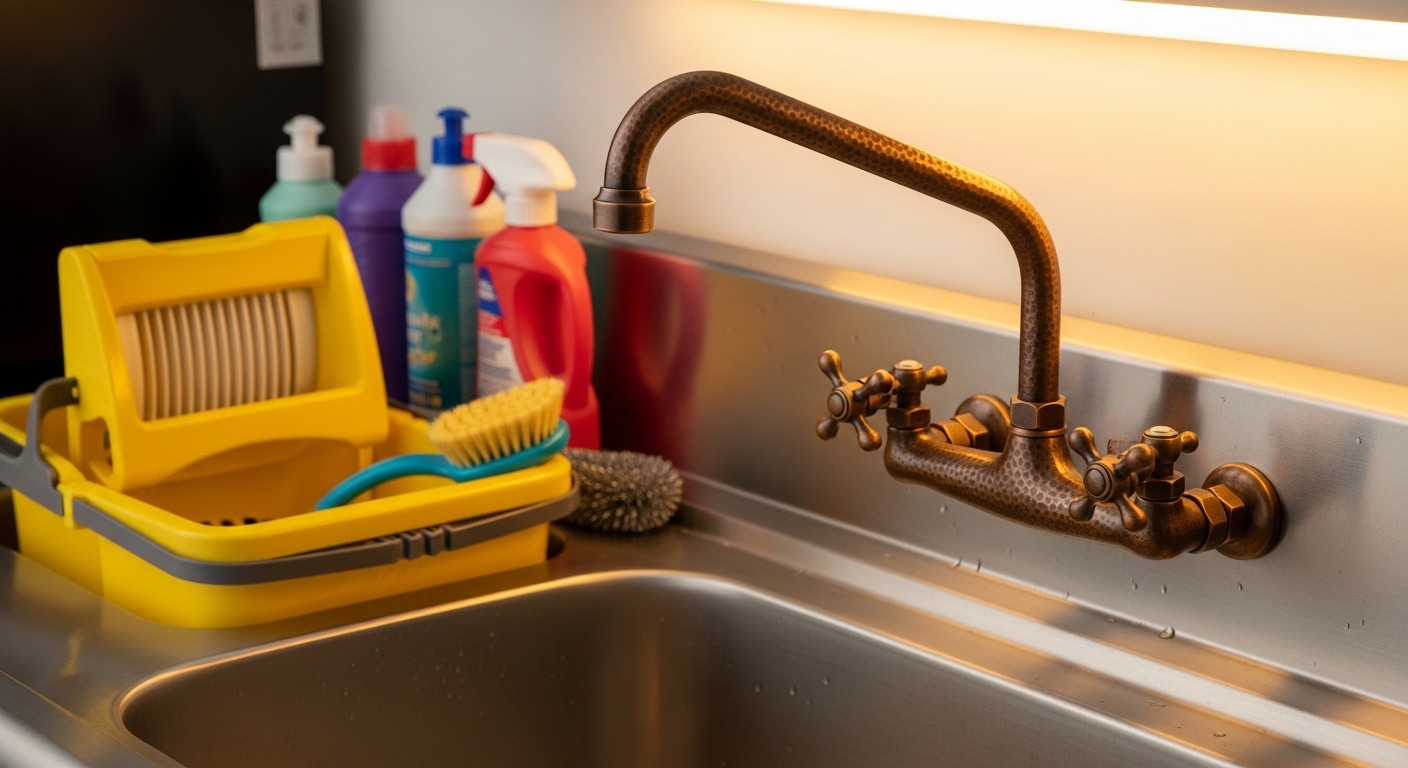
A copper utility faucet is the workhorse of any back-of-house plumbing setup — built to survive bleach baths, hot rinses, freezing garages, and the relentless on/off cycles of a commercial laundry or janitorial closet. Unlike chrome-plated zinc units that flake within two seasons, a solid-copper or copper-alloy utility faucet develops a protective patina that actually extends its service life. For facility managers, contractors, and small-business owners shopping wigafaucet.com, this guide breaks down the engineering, the certifications, the finishes, and the commercial-grade picks that justify the upgrade.
Whether you’re outfitting a mop sink in a quick-service restaurant, a deep utility basin in a commercial laundromat, or a wash-down station in a microbrewery, the right copper utility tap pays for itself through fewer service calls, lower lifetime water cost, and compliance with NSF/ANSI 61 and the federal Safe Drinking Water Act lead-free mandate.
Why Choose a Copper Utility Faucet Over Standard Chrome or Plastic?
The case for a copper utility faucet starts with metallurgy. Solid copper and copper-alloy bodies (typically C36000 or C46500 brass with high copper content) resist the chloride-induced pitting that destroys cheap zamak and stamped-steel utility taps. In a commercial environment where chlorine bleach, citric acid descalers, and quaternary ammonium sanitizers cycle through the spout daily, that corrosion resistance translates directly into a longer mean-time-between-failures.
Copper also has a documented antimicrobial property — the EPA registered solid copper alloys in 2008 as the first metallic surface proven to continuously kill bacteria. For food-service utility sinks and healthcare mop stations, that’s not a marketing gimmick; it’s a measurable hygiene benefit that supplements your sanitation SOP.
Total Cost of Ownership: Copper vs. Alternatives
Sticker price isn’t the whole story. A $39 plastic-bodied laundry tap that needs replacement every 14 months costs more over five years than a $189 copper utility faucet rated for a decade of commercial service. Factor in the labor cost of each replacement — easily $120–$180 per visit for a licensed plumber in most U.S. metros — and the math overwhelmingly favors copper in any commercial or multi-family residential context.
Anatomy of a Commercial Copper Utility Faucet
Understanding the parts list helps you spec correctly the first time. A typical commercial-grade copper utility faucet includes:
- Body: Cast or forged copper alloy, typically 0.090″–0.125″ wall thickness for commercial duty
- Spout: Swing or rigid gooseneck, often 8″–12″ reach for filling 5-gallon buckets
- Outlet: 3/4″ GHT (garden hose thread) is the commercial standard; some specs call for 55/64″-27 aerator threads
- Handles: Quarter-turn ceramic disc cartridges (1/4-turn) on premium units; compression stems on legacy designs
- Inlets: 1/2″ NPT female or 1/2″ IPS male, sometimes with integral check valves
- Vacuum breaker: ASSE 1011-listed atmospheric vacuum breaker required by most U.S. plumbing codes for hose-end outlets
- Mounting: Wall-mount (8″ centerset is most common) or deck-mount (4″ or 8″ spread)
Ceramic Disc vs. Compression Cartridges
For commercial duty, insist on ceramic disc cartridges rated to at least 500,000 cycles. Compression stems with rubber washers will fail within 18 months under heavy use — they’re acceptable only in low-cycle residential garages. The premium copper utility faucets on wigafaucet.com use European-sourced ceramic discs that exceed the NSF 61 cycle requirement by a wide margin.
Wall-Mount vs. Deck-Mount: Choosing the Right Configuration
Configuration drives both installation cost and long-term ergonomics. Wall-mount copper utility faucets are the dominant choice in commercial mop closets and laundry rooms because they keep the deck of the basin clear for buckets, leave the rim free for hanging mop heads, and simplify cleaning behind the fixture. Deck-mount units are more common above utility tubs in basements and laundry rooms where the wall behind the basin isn’t a finished surface suitable for mounting.
If you’re working with a slop sink that already has 8″ on-center holes punched in the rear deck, a deck-mount copper utility faucet is a straight swap. For new construction or a full remodel, wall-mount typically wins on cleanability — a meaningful factor when the local health inspector visits.
Finishes: Living Copper, Lacquered, PVD & Oil-Rubbed Bronze
“Copper” on a spec sheet can mean five very different finishes. Knowing the difference prevents warranty surprises and finish mismatch headaches.
| Finish | Appearance | Maintenance | Best For | Typical Lifespan |
|---|---|---|---|---|
| Living (Unlacquered) Copper | Bright copper that darkens to natural patina | Wipe with mild soap; embrace patina | Hospitality, breweries, design-forward laundry rooms | 20+ years |
| Lacquered Copper | Bright copper held under clear coat | No abrasives; lacquer can chip | Low-use residential utility rooms | 5–8 years before re-lacquer |
| PVD Antique Copper | Warm, slightly darkened copper tone | Wipe with soft cloth; no harsh chemicals | Commercial kitchens, restaurants, healthcare | 15+ years |
| Hammered Copper | Textured, artisan look | Toothbrush in the recesses | Boutique hotels, themed restaurants | 15+ years |
| Oil-Rubbed Bronze (copper alloy) | Dark brown with copper highlights | Wax annually; no acidic cleaners | Traditional commercial settings | 10–15 years |
For high-cycle commercial applications, PVD (physical vapor deposition) antique copper is the smartest specification. PVD bonds the finish at the molecular level, producing a surface that resists chlorine, citric acid, and the abrasive nylon scrub pads that destroy lacquered finishes. If you appreciate the warm tones of oil-rubbed bronze, our companion guide on 8 inch widespread faucet oil rubbed bronze options walks through the closely related dark-copper-alloy finishes that pair beautifully alongside copper utility taps in mixed-use commercial bathrooms.
Lead-Free Compliance, NSF Certification & Warranty
Since January 4, 2014, the federal Reduction of Lead in Drinking Water Act has required all faucets sold for human consumption to contain no more than 0.25% weighted-average lead in wetted surfaces. While utility faucets in some jurisdictions are exempt because they aren’t intended for drinking, the smart commercial spec calls for full NSF/ANSI 61 and NSF/ANSI 372 certification anyway — health inspectors increasingly hold utility fixtures to the same standard, and California’s AB 1953 explicitly does.
Every wigafaucet copper utility faucet ships with:
- NSF/ANSI 61 certification for drinking-water-system components
- NSF/ANSI 372 lead-free certification (≤ 0.25% weighted average)
- ASSE 1011 atmospheric vacuum breaker compliance on hose-end outlets
- CUPC listing for U.S. and Canadian plumbing code acceptance
- Cartridge tested to 500,000+ cycles per ASME A112.18.1 / CSA B125.1
- Lifetime limited warranty on the body and finish, 10-year warranty on the ceramic cartridge for commercial use
Sizing the Spout & Flow for Commercial Tasks
Flow rate and spout reach should be matched to the work the faucet performs. A commercial mop sink benefits from a 2.2–2.5 GPM flow rate and a 10″–12″ gooseneck reach — enough to fill a 35-quart mop bucket in under two minutes without the spout fighting the bucket rim. A laundry utility tap can drop to 1.8 GPM with a 6″–8″ swing spout. Brewery wash-down stations often spec full-port 4.0 GPM utility valves with no aerator at all.
For pre-rinse operations adjacent to a three-compartment sink, you may be better served by a dedicated pre-rinse unit. Our deep-dive on the commercial kitchen faucet category covers the spring-arm and pull-down options that complement a copper utility installation in the same back-of-house footprint.
Reading a Flow Spec Sheet
Manufacturers quote flow at 60 PSI dynamic. If your facility runs at 45 PSI (common in older urban buildings) expect 15–20% lower real-world flow. Conversely, water hammer arrestors are a worthwhile $30 add-on whenever supply pressure exceeds 80 PSI — without them, quarter-turn ceramic cartridges in a copper utility faucet can be hammered into early failure.
Installation Best Practices
Even the finest copper utility faucet underperforms if it’s installed poorly. Follow these commercial-grade installation steps:
- Shut off and drain the supply lines at the building isolation valve, then crack a downstream tap to relieve pressure.
- Flush the supply lines for 30 seconds before connecting — debris from new copper sweat joints will lodge in ceramic cartridges and void the warranty.
- Use PTFE thread tape (3 wraps clockwise) on every threaded connection. Avoid pipe dope on copper-alloy threads as solvents can attack PVD finishes if it migrates.
- Hand-tighten plus 1.5 turns with a strap wrench. Never use channel-lock pliers directly on a finished copper body.
- Verify the vacuum breaker is oriented per code — typically the breaker must sit 6″ above the flood-level rim of the fixture it serves.
- Pressure-test for 15 minutes at static line pressure before closing up the wall.
- Operate both handles fully for 30 seconds each on first commissioning to seat the ceramic discs.
If your installation includes downstream aerators that may need future servicing, our walkthrough on faucet aerator key removal covers the recessed-aerator extraction tools every commercial maintenance kit should carry.
Comparing Top Copper Utility Faucet Configurations
| Configuration | Mounting | Spout Reach | Outlet | Typical Use Case | Flow @ 60 PSI |
|---|---|---|---|---|---|
| Compact Wall-Mount | 8″ centerset wall | 6″ swing | 3/4″ GHT | Janitorial closet, mop sink | 2.2 GPM |
| Gooseneck Wall-Mount | 8″ centerset wall | 12″ gooseneck | 3/4″ GHT + aerator | Commercial laundry, brewery | 2.5 GPM |
| Deck-Mount Laundry | 4″ centerset deck | 8″ swing | 55/64″ aerator | Basement laundry, garage | 1.8 GPM |
| Heavy-Duty Service Sink | 8″ centerset wall | 10″ rigid | 3/4″ GHT, no aerator | Industrial wash-down | 4.0 GPM |
| Frost-Free Garage Copper | Wall sillcock | 4″ stub | 3/4″ GHT | Unconditioned garage / shop | 3.5 GPM |
Maintenance: Keeping a Copper Utility Faucet Performing
Routine maintenance for a copper utility faucet is straightforward but specific. Avoid every chlorine-based bathroom cleaner, every acidic limescale dissolver containing hydrochloric acid, and every abrasive sponge with green nylon scrub material. Stick to dish soap, warm water, and a microfiber cloth for the body. For a living-copper finish, embrace the patina; for PVD or lacquered finishes, a monthly application of paste wax extends the finish life dramatically.
Annually, exercise the quarter-turn handles through ten full cycles to keep the ceramic discs running smoothly. Inspect the vacuum breaker for mineral buildup — a $14 replacement cartridge every 3–4 years prevents code violations. Disassemble the aerator (if present) and soak in white vinegar for 20 minutes to dissolve hard-water scale.
Troubleshooting Common Issues
If flow drops noticeably, the aerator or hose-end outlet screen is the first suspect. If you see drips from under a handle, the ceramic cartridge needs replacement — typically a 10-minute job. Persistent water hammer on shut-off indicates either excessive static pressure or worn cartridge ceramics; a hammer arrestor is usually the simpler fix.
Where the Copper Utility Faucet Fits in Your Commercial Spec Book
A copper utility faucet rarely lives alone. In a commercial laundry, it complements a stainless 304 utility basin and an oversized P-trap. In a microbrewery, it sits alongside floor drains and trench grates. In a restaurant back-of-house, it’s adjacent to a three-compartment sink and a pre-rinse spray valve. Spec the surrounding fixtures with equal care — a premium copper utility faucet bolted to a thin-gauge stamped basin is a mismatched system that won’t deliver the service life either component is rated for.
For mixed-use commercial bathrooms where the same designer also chooses the lavatory taps, the warm copper tones harmonize beautifully with traditional basin faucet selections — particularly in hospitality and boutique-retail settings where the back-of-house aesthetic shouldn’t shock the eye when staff move between zones.
About wigafaucet & Our Engineering Standards
wigafaucet has manufactured and exported commercial-grade brassware since 2003, serving hospitality groups, multi-family developers, and food-service operators across North America, Europe, and the Middle East. Every copper utility faucet in our catalog is forged from low-lead C46500 alloy, finished with European PVD processes (or supplied as living copper for the patina-friendly), and tested in our in-house lab to ASME A112.18.1 / CSA B125.1. Our products carry NSF/ANSI 61 and 372 certifications and CUPC listings, and we back commercial installations with a 10-year cartridge warranty and a lifetime warranty on body and finish.
Author note: This guide was written by the wigafaucet product specification team in consultation with our commercial sales engineers, who collectively spec more than 40,000 utility faucets per year for facility managers, contractors, and design-build firms. We update the article quarterly to reflect changes in plumbing code, lead-free regulation, and finish technology.
FAQ
Is a copper utility faucet safe for potable water connections?
Yes, every wigafaucet copper utility faucet is NSF/ANSI 61 and NSF/ANSI 372 certified, meaning it meets the federal Safe Drinking Water Act lead-free standard of ≤ 0.25% weighted-average lead in wetted surfaces. It can be installed on potable supply lines without issue, although the faucet itself is engineered for utility, not consumption, use.
Will a copper utility faucet turn green over time?
Only unlacquered “living” copper develops the green-blue verdigris patina, and even then it usually deepens to chocolate brown long before reaching true green. Lacquered and PVD-finished copper utility faucets retain their original appearance for 5–15+ years depending on the finish system. The patina is purely cosmetic and does not affect performance, water quality, or code compliance.
What’s the difference between a utility faucet and a laundry faucet?
The terms overlap heavily. “Utility faucet” is the broader commercial category covering mop sinks, service sinks, slop sinks, and industrial wash-down stations. “Laundry faucet” usually refers specifically to deck-mount or wall-mount taps above a residential laundry tub. A copper utility faucet works in both applications, but commercial mop-sink specs typically require a larger 3/4″ GHT outlet and an integral atmospheric vacuum breaker that residential laundry faucets often lack.
Can I install a copper utility faucet myself, or do I need a licensed plumber?
For residential garage or laundry applications, a confident DIYer with PTFE tape, a strap wrench, and a shutoff valve can complete the installation in 45 minutes. Commercial installations almost always require a licensed plumber because most jurisdictions mandate permitted work on commercial plumbing, and the atmospheric vacuum breaker placement, cross-connection control, and air-gap requirements must be inspected. Check your local code before starting.
How do I clean a copper utility faucet without damaging the finish?
Use only mild dish soap, warm water, and a microfiber cloth. Avoid chlorine bleach (which etches copper), acidic descalers containing hydrochloric or sulfuric acid, and abrasive scrubbers. For mineral buildup on aerators or vacuum breakers, soak the disassembled component in white vinegar for 20 minutes — never apply vinegar to the faucet body itself. For lacquered or PVD finishes, a monthly paste-wax application extends the finish life by years.
What flow rate should I specify for a commercial mop-sink copper utility faucet?
2.2 to 2.5 GPM is the commercial sweet spot. It fills a 35-quart mop bucket in approximately 90 seconds at 60 PSI, complies with most state water-efficiency codes, and matches the realistic supply pressure of older commercial buildings. For brewery and industrial wash-down stations where full-port flow is needed, step up to a 4.0 GPM non-aerated utility valve.
Does wigafaucet offer custom finishes or OEM specifications for large projects?
Yes. For projects over 50 units, our engineering team can supply custom PVD color matches, alternative spout reaches, OEM-branded handles, and specification documentation for architects and design-build firms. Lead times for custom orders typically run 6–8 weeks. Contact our commercial sales desk through wigafaucet.com for a quote.