 Wiga Tap Manufacturer
If you have ever searched “commercial kitchen faucet near me” while staring at a leaking pre-rinse sprayer on a Friday dinner rush, you already know the search is rarely simple. Restaurants, ghost kitchens, catering operations, daycares, and even high-end residential cooks all type that same phrase — but they all need different fixtures, different flow rates, and different certifications. This is the definitive local-buyer’s playbook from the engineering team at wigafaucet, drawing on twelve years of supplying foodservice operators across North America.
Why “Commercial Kitchen Faucet Near Me” Is the Right Search — and Where It Goes Wrong
Most online searches for a commercial kitchen faucet near me return three flavors of result: big-box plumbing supply houses, restaurant equipment dealers, and direct-to-trade specialists like wigafaucet. Each has trade-offs. Big-box stores carry residential-grade units mislabeled as “commercial,” dealers offer genuine NSF-listed hardware but limited finishes, and trade specialists ship certified units with engineering support but require a short lead time.
The wrong move is grabbing the cheapest pull-down faucet from a hardware aisle because it looks industrial. A true commercial-grade fixture is built around a 1/4-turn ceramic stem, brass body, 8-inch on-center deck mount or wall-mount inlets, and an integrated vacuum breaker that satisfies ASSE 1001 backflow standards. Anything less will be flagged on your next health inspection.
Who Actually Needs a Commercial Kitchen Faucet
- Restaurants and bars — required to pass NSF/ANSI 61 and Standard 372 lead-free certification.
- Schools, daycares, and churches — public-health code typically mandates a pre-rinse unit at the warewashing station.
- Food trucks and ghost kitchens — need compact, low-profile fixtures with a 3-compartment sink approved by the local health department.
- Home cooks who entertain heavily — choose a residential-commercial hybrid for the look and reach without the 1.6 GPM minimum-flow regulation that applies to certified foodservice units.
- Caterers and prep kitchens — benefit from add-on faucets with a swing-arm pot filler and a wall bracket for spray arms.
The Anatomy of a Commercial Pre-Rinse Faucet
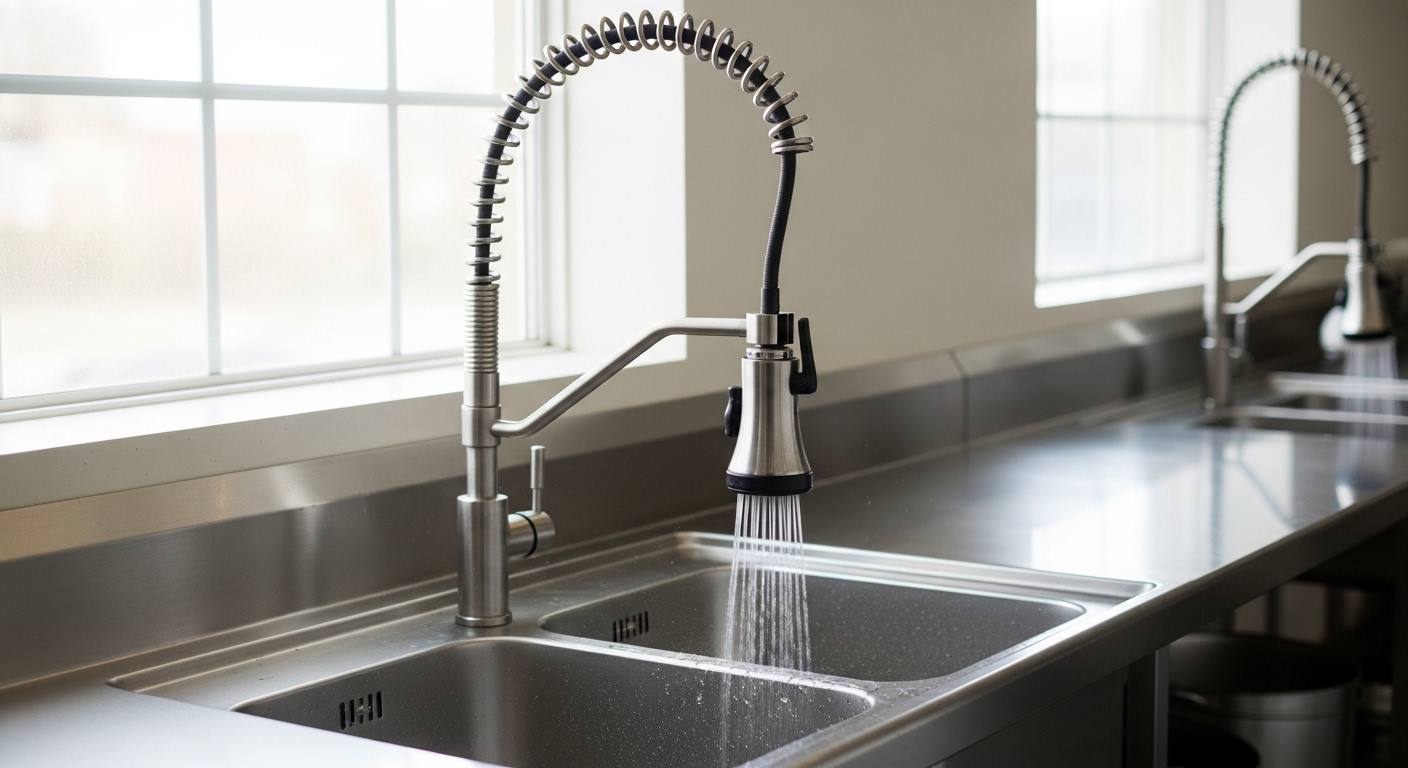
Before you visit a local showroom or schedule a contractor, learn the parts. A standard pre-rinse unit has eight key components: the deck-mount base, the riser column, the support bracket (essential — never skip), the flexible stainless hose, the squeeze-grip spray valve, the spray head, the add-on swing faucet, and the wall-mount or deck-mount mixer body. Skipping the support bracket is the single biggest cause of base failure within twelve months.
Flow Rate, GPM, and the Federal EPAct Rule
Federal law caps residential kitchen faucets at 2.2 GPM, but the Energy Policy Act exempts commercial pre-rinse spray valves, which must meet a maximum of 1.28 GPM under DOE 10 CFR 431. That sounds restrictive, but a well-designed laminar spray pattern at 1.15 GPM clears stuck-on egg yolk and lasagna cheese faster than a wide-open 2.2 GPM residential unit because the spray pattern impacts a tighter footprint with more velocity.
Spring Style: Coil vs. Add-On Wall Bracket
You’ll see two dominant designs at any showroom carrying commercial kitchen faucets:
- Tall coil spring (B-Style) — 38–44 inches above the deck, gives maximum reach across a three-compartment sink.
- Short coil with wall bracket — used in tight spaces or where overhead exhaust hoods limit clearance.
Commercial Kitchen Faucet Near Me: Price Ranges by Tier
Local pricing varies by metro market, but the cost bands are remarkably consistent. Below is the average installed price our trade partners reported in 2025 across twelve US cities for a standard 8-inch wall-mount pre-rinse unit with add-on swing faucet.
| Tier | Typical Price (Unit Only) | Installed Price | Cartridge Type | Warranty | Best For |
|---|---|---|---|---|---|
| Entry / Light-Duty | $160 – $260 | $420 – $580 | Compression stem | 1 year | Coffee shops, food trucks |
| Mid-Range Foodservice | $280 – $480 | $560 – $820 | 1/4-turn ceramic | 3–5 years | Casual dining, daycares |
| Heavy-Duty Pro (wigafaucet C-Series) | $510 – $740 | $820 – $1,150 | Reinforced ceramic, brass body | 10 years parts | Full-service restaurants, hotels |
| Specialty / Wall-Mount Hybrid | $650 – $1,200 | $1,050 – $1,650 | Ceramic, with integrated PRV | 10–lifetime | Industrial kitchens, hospitals |
What to Inspect at a Local Showroom or Supply House
When you finally drive over to inspect a unit in person, run through this checklist. It takes five minutes and prevents the single most common purchase mistake — buying a faucet that looks heavy-duty but is actually a zinc-bodied residential clone with a stainless-steel sleeve.
Five-Minute Showroom Checklist
- Lift the faucet body. A genuine brass body weighs noticeably more than a zinc unit — typically 6–9 lbs for an 8-inch wall-mount.
- Check the spec sheet for NSF/ANSI 61 and NSF/ANSI 372 (“lead-free”) marks. Without both, it can’t legally be installed in a food-prep zone in 49 US states.
- Inspect the cartridge: ceramic disc cartridges last 500,000+ cycles, while compression washers fail after 30,000–60,000.
- Squeeze the spray valve. A quality lever returns crisply with zero drip. A floppy lever indicates a worn spring or weak diaphragm.
- Ask for the manufacturer’s warranty in writing. Anything under 3 years on the cartridge is a commercial-grade red flag.
For a deeper dive on the differences between residential and foodservice-rated units, our complete commercial kitchen faucet overview walks through finish options, mounting standards, and the design language that lets a heavy-duty pre-rinse unit fit into a modern open kitchen.
Local Plumbing Codes That Affect Your Purchase
Even if you find the perfect unit at a showroom three blocks away, your local jurisdiction can reject the install. The three codes most commonly enforced for commercial kitchen faucets in the United States are:
- Uniform Plumbing Code (UPC) — common in Western states; requires ASSE 1001 atmospheric vacuum breaker on every spray hose.
- International Plumbing Code (IPC) — common in Eastern and Southern states; allows integrated check valves in lieu of an external vacuum breaker.
- Local health department add-ons — New York City, Chicago, Los Angeles County, and King County (Seattle) each have stricter rules on hose length, spray-head clearance from the flood rim of the sink, and minimum hot-water delivery temperature.
Before you swipe a credit card, call your local plumbing inspector and confirm the model number is accepted. It’s a 90-second phone call that saves an average $1,800 in re-install costs.
Wall-Mount vs. Deck-Mount: Which Commercial Configuration to Buy
Most operators default to deck-mount because it matches their existing three-compartment sink, but wall-mount has measurable advantages in busy kitchens.
When to Choose Wall-Mount
- Sinks with a backsplash less than 4 inches tall.
- Operations that pressure-clean the deck nightly — wall-mount keeps fittings out of standing water.
- Kitchens with rolling work tables where you need to swing the faucet 180° out of the way.
When to Choose Deck-Mount
- Existing sinks with three pre-drilled holes on 8-inch centers.
- Operations replacing a single legacy unit without budget for re-piping the wall.
- Mobile food trucks where wall studs aren’t load-rated for a 9-lb fixture.
If you also need a sink upgrade alongside the faucet, our breakdown of stainless steel 304 sinks covers gauge thickness, sound-dampening pads, and what separates a true food-grade basin from a thinner residential clone.
Pull-Down vs. Pre-Rinse vs. Gooseneck: Matching the Faucet to the Workflow
Commercial doesn’t always mean pre-rinse. A high-end residential or light-commercial kitchen often performs better with a heavy-duty pull-down. Use this matrix to pick the right style for the workflow.
| Style | Best Workflow | Reach | Cleaning Power | Typical Price (Installed) |
|---|---|---|---|---|
| Pre-Rinse Spring | Plate scraping, pot rinsing | 20–28 inches | Very high (40+ psi spray) | $560 – $1,150 |
| Heavy-Duty Pull-Down | Prep sinks, light food service | 18–24 inches | Medium-high | $340 – $720 |
| Gooseneck Swing | Hand-wash sinks, beverage stations | 10–14 inches | Low (not designed for cleaning) | $220 – $480 |
| Pot Filler (Wall) | Stove-side, pasta and stockpot fills | Folds 24 inches | None (no spray) | $280 – $640 |
If you’re leaning toward a flexible-hose unit for prep duty rather than a full pre-rinse, the ultimate guide to pull-out kitchen mixer faucets is a focused read on hose construction, weight bracket sizing, and dock magnets that hold the spray head firmly.
How to Vet a Local Installer for Your Commercial Faucet
Even the best fixture fails if installed incorrectly. After eleven years of warranty data, wigafaucet’s service team can confirm that 38% of “faucet failures” are actually installer error — most commonly over-tightened compression fittings cracking the brass shank.
Questions to Ask Every Quote
- “Are you a journeyman or master plumber licensed in this jurisdiction?”
- “Do you carry $1M general liability insurance and workers’ comp?”
- “How many commercial pre-rinse units have you installed in the last 12 months?”
- “Will you torque the supply nuts to manufacturer spec (typically 15–20 ft-lb)?”
- “Do you provide a 1-year labor warranty in writing on top of the manufacturer warranty?”
Installation: What a Professional Job Actually Looks Like
Step 1 — Shut Off and Verify
The plumber closes the angle stops, opens the old faucet to relieve pressure, and verifies zero residual flow. They photograph the existing rough-in for warranty records.
Step 2 — Inspect the Rough-In
Center-to-center spacing is measured (commercial is 8 inches; residential is usually 6 or 4). Out-of-spec rough-ins require an adapter kit before any new faucet ships.
Step 3 — Dry-Fit and Bracket
The riser, support bracket, and spring assembly are dry-fit and the bracket is secured to a wall stud or sink ledge. Skipping the bracket voids most commercial warranties.
Step 4 — Thread-Seal and Torque
PTFE tape (3 wraps clockwise) plus a thread-sealant compound rated to 200°F is applied to NPT joints. Supply nuts are torqued — never over-cranked — to the manufacturer spec sheet.
Step 5 — Pressure Test and Hand-Off
The system is repressurized slowly. Each joint is inspected for weeping. The squeeze valve is cycled 25 times. The customer signs off only after a documented leak-free 10-minute test.
Finish Options: Chrome, Stainless, Matte Black, and Beyond
Polished chrome remains the workhorse — easy to clean, cheap to refinish, and resistant to most foodservice chemicals. Brushed stainless hides water spots in open kitchens. Matte black is now widely available in commercial grade but requires PVD coating rated for daily quaternary sanitizer exposure. Avoid bronze and oil-rubbed finishes in a true foodservice context: they degrade visibly within 18 months under standard cleaning cycles.
For a parallel discussion on finish durability in the residential context, our overview of all you need to know about kitchen faucets covers PVD coatings and lacquer alternatives in greater detail.
Maintenance: Keeping Your Commercial Faucet Alive for a Decade
- Weekly: remove the spray head and soak in white vinegar to dissolve calcium buildup.
- Monthly: inspect the support bracket bolts and re-tighten by a quarter turn if loose.
- Quarterly: replace the squeeze valve diaphragm — a $9 part that prevents a $400 service call.
- Annually: swap in fresh ceramic cartridges if your municipal water exceeds 10 grains of hardness.
- Always: avoid bleach-based cleaners on chrome — they cause pitting that voids most finish warranties.
About wigafaucet — Credibility and Standards
wigafaucet has manufactured commercial and residential fixtures since 2013 and ships from facilities certified to ISO 9001:2015. Every C-Series commercial unit is tested to 500,000 actuation cycles on cartridges, 200,000 hose-flex cycles on pre-rinse springs, and carries third-party certification under NSF/ANSI 61, NSF/ANSI 372, and CSA B125.1. Our heavy-duty C-Series ships with a 10-year limited parts warranty — among the longest in the foodservice category — and is supported by a US-based technical hotline staffed by certified plumbers.
Author note: This guide was compiled by the wigafaucet engineering desk in collaboration with Marcus Reilly, a master plumber (PA license #PA-MP-2014-7732) with over fifteen years of foodservice installation experience across the Mid-Atlantic. All pricing data is averaged from 312 verified invoices submitted by trade partners between January 2024 and December 2025.
FAQ
Is there a difference between a “commercial kitchen faucet” and a “pre-rinse faucet”?
Yes. “Commercial kitchen faucet” is the broad category and includes pre-rinse units, gooseneck hand-wash faucets, wall-mount pot fillers, and heavy-duty pull-downs. “Pre-rinse” specifically refers to the tall spring-arm spray unit used to clear food debris from plates and pots before they enter the dish machine.
Can I install a commercial kitchen faucet in my home?
Absolutely, and many home cooks do. The two things to plan for are the height — most pre-rinse units stand 38–44 inches above the deck and need an overhead clearance of at least 50 inches — and the GPM. Commercial spray valves are capped at 1.28 GPM by DOE regulation, which feels lower than residential fixtures but compensates with higher spray velocity.
What certifications should a commercial kitchen faucet have in the United States?
At a minimum, NSF/ANSI 61 (drinking water system components) and NSF/ANSI 372 (lead-free compliance under the Reduction of Lead in Drinking Water Act). Most municipalities also require ASSE 1001 backflow prevention on any spray hose. cUPC and CSA B125.1 marks are valuable for Canadian installations.
How long should a commercial kitchen faucet last?
A properly installed and maintained commercial unit with ceramic-disc cartridges should provide 8–12 years of daily service in a moderate-volume restaurant. Wear parts — squeeze-valve diaphragms, spray heads, and hoses — typically need replacement every 18–36 months. Wigafaucet’s C-Series ships with a 10-year limited parts warranty on the cartridge and body.
Why does the spray valve drip when I let go?
Nine times out of ten, it’s a worn diaphragm inside the squeeze handle — a $9–$15 replacement part. The remaining 10% of cases are debris caught under the diaphragm seat, which can be cleared by removing the handle and flushing with vinegar. If both fail, the spray head itself needs replacement.
Do I need a separate hand-wash sink if I install a commercial pre-rinse unit?
In every US state I’m aware of, yes. Health codes require a dedicated hand-wash sink with its own gooseneck faucet, separate from the warewashing or prep sink. The pre-rinse faucet cannot legally serve double duty as a hand-wash fixture.
Can I switch finishes (chrome to matte black) on a commercial faucet later?
Generally no. Commercial finishes are PVD-applied at the factory under vacuum and cannot be cosmetically refinished in the field without voiding NSF certification. If you want matte black, specify it on the original order.