 Wiga Tap Manufacturer
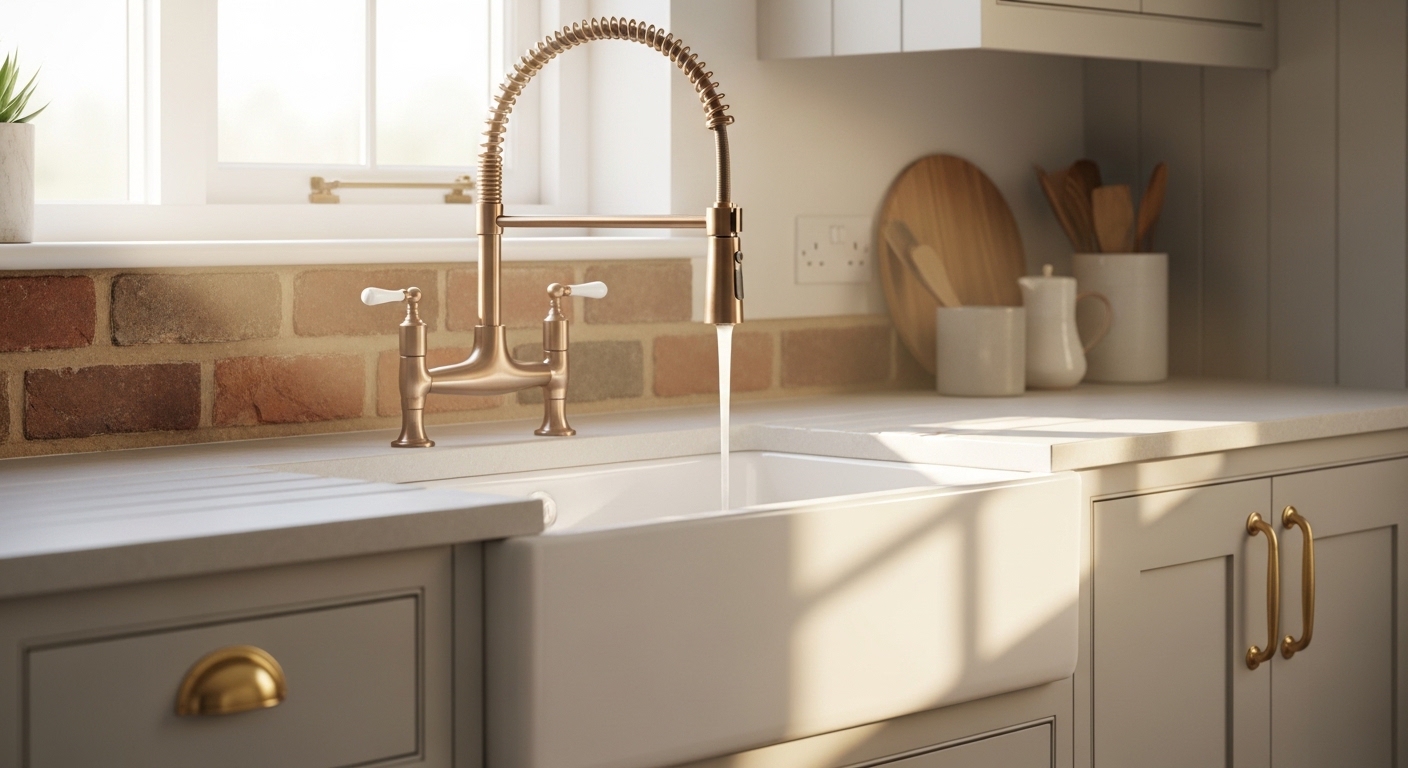
If you’ve been searching for copper taps UK homeowners actually recommend, you’ve probably noticed the market is split into two very different worlds: gorgeous, warm-toned mixers that anchor a country kitchen for a decade, and bargain-bin lookalikes that turn patchy and green by the second summer. This guide cuts through the noise. We’ll cover what “copper” really means on a UK tap spec sheet, which finishes survive Thames Water and Yorkshire limescale, how UK building regs (WRAS, KIWA, Reg 4) affect what you’re allowed to install, realistic prices in pounds, and the exact questions to ask before you click buy.
Written by the Wigafaucet product team — we’ve been manufacturing brass-bodied mixers for the UK, EU and North American markets since 2008, and every tap we ship to British retailers is pressure-tested to 1.6 MPa and supplied with WRAS-approved ceramic cartridges. We’ll be straight with you about where copper taps shine and where they don’t.
What does “copper tap” actually mean on a UK spec sheet?
In 99% of cases, a UK “copper tap” is a solid brass tap body with a copper-coloured surface finish, not a tap machined from a solid block of copper. Pure copper is too soft and too expensive to make a reliable mixer body — it would deform under hose-bibb torque and pinhole within years. So when a retailer writes “copper kitchen tap,” they almost always mean one of three things:
- PVD copper — physical vapour deposition. A vacuum-bonded molecular layer fused to brass at ~400°C. Hardest, most scratch-resistant, 10+ year colour stability. This is the premium option.
- Electroplated copper with lacquer — a real copper layer electrochemically deposited and sealed with a clear coat. Warmer “real penny” tone but the lacquer can craze if you scrub with abrasive cleaners.
- Powder-coated / spray copper — paint, essentially. Avoid for kitchens and bathrooms. Fine for decorative outdoor taps that never get touched.
A genuinely useful detail: ask the seller for the finish code. Reputable UK suppliers will tell you “PVD-CU” or “brushed copper PVD” on the datasheet. If the listing just says “copper effect,” assume it’s painted.
Are copper taps any good in UK hard-water areas like London, Kent or Essex?
Short answer: yes — often better than chrome, because limescale shows up far less on a warm matte copper than on a polished mirror finish. The catch is the finish quality. A brushed PVD copper tap in a hard-water postcode will look excellent for 8–10 years if you wipe it down weekly with a soft cloth. A lacquered electroplated tap in the same kitchen needs gentler care because acidic limescale removers (anything with citric or sulphamic acid) will eat through the clear coat and expose the copper underneath, which then oxidises into patchy green-blue verdigris.
If you live anywhere south or east of Birmingham, your water hardness is likely 200–350 mg/L CaCO₃. In those areas we strongly recommend a brushed or matte copper PVD finish rather than polished — the texture hides waterspots between cleans. For soft-water areas (Scotland, Wales, the North West), polished copper looks stunning and stays bright with very little effort.
How much do copper taps cost in the UK in 2026?
Here’s a realistic price map based on current UK retail across Wigafaucet and the main bathroom showrooms. These are the prices that actually deliver a tap you won’t regret.
| Tap type | Budget (avoid) | Mid-range (recommended) | Premium | Typical lifespan |
|---|---|---|---|---|
| Kitchen mixer (single lever) | £25–£60 painted | £180–£320 PVD brass | £380–£650 PVD with pull-out | 8–15 years |
| Pull-down kitchen tap | £45–£90 painted | £240–£420 PVD | £480–£780 with dual-spray | 8–12 years |
| Basin mixer | £20–£50 painted | £90–£180 PVD | £220–£360 designer PVD | 10–15 years |
| Bath/shower mixer | £60–£120 painted | £220–£400 PVD | £480–£900 thermostatic | 10–15 years |
| Traditional bridge tap (twin lever) | £80–£140 painted | £190–£340 plated | £420–£700 solid brass body | 15–25 years |
One thing worth knowing: the £25 “antique copper” tap on big marketplaces is almost always a zinc-alloy (Zamak) body with a thin paint coat. Zinc alloy can’t be re-threaded if you damage it during install, and the wall thickness near the inlet shanks is often under 1.5 mm. UK plumbers refuse to warranty them. Spend the extra £150 — it’s the single biggest determinant of whether you’ll love the tap in five years.
Which UK water regulations matter when buying a copper tap?
Any tap connected to UK mains water must comply with the Water Supply (Water Fittings) Regulations 1999, and the practical proof of that is a WRAS approval (or the newer equivalents — KIWA UK, NSF Reg 4, or DVGW W270). For copper taps specifically, three details matter:
- The cartridge must be WRAS-listed. The visible body can be any finish — regulators care about what touches the drinking water. Insist on a ceramic disc cartridge from a known supplier (Sedal, Kerox, Hydroplast, Flühs).
- Lead content under 0.25%. Cheap brass alloys can leach lead. UK-compliant taps use low-lead brass (often DZR — dezincification-resistant — brass), which is also why a good copper tap weighs noticeably more than a fake one. Pick it up: a 1.4 kg basin mixer is real; an 800 g one isn’t.
- Flow rate and aerator. Most UK kitchens are happy at 7–9 L/min. Bathroom basins should be 4–6 L/min under the Water Label scheme. PVD copper aerators are widely available and don’t change the look.
If you’re renovating a whole bathroom, you may also be juggling shower mixers, basin mixers and bath fillers in matched copper. Our deep-dive on concealed shower mixer sets walks through how to match thermostatic valves to surface finishes so the family looks coordinated even when components come from different ranges.
What’s the best copper kitchen tap for a busy family kitchen under £400?
For a busy UK family kitchen, the winning combination is a solid-brass pull-down mixer in brushed copper PVD with a magnetic dock and a ceramic Sedal cartridge, priced between £240 and £380. That hits the sweet spot of durability, flow, and finish longevity without paying designer-label tax.
Here’s why “pull-down” beats “pull-out” for most British kitchens: pull-down spouts give you 360° spout rotation and let you rinse a roasting tray in a deep Belfast sink without contorting your wrist. The magnetic dock matters because, after about three years, plastic-clipped pull-outs sag and the spray head dangles. Magnets don’t wear.
If your kitchen is small or you have low wall cabinets above the sink, a folding or foldable spout design is a smarter pick than a tall gooseneck — our guide to the folding kitchen mixer covers the geometry. And if you want the high-arc look with serious reach, the pull-out kitchen mixer guide compares spray-head mechanisms in detail.
Copper, brushed copper, antique copper, rose gold — what’s the difference?
These names get used interchangeably by retailers, which is half the reason people end up disappointed. Here’s the short, honest version:
- Polished copper — bright, mirror-like, pink-orange. The “new penny” look. Stunning in classic and country kitchens. Shows watermarks.
- Brushed copper — directional satin grain, slightly muted. The most forgiving day-to-day finish. Pairs well with brushed brass hardware.
- Antique copper — darker, with intentional shading or “smoked” tones. Reads almost bronze. Beautiful with traditional cross-handle bridge taps.
- Rose gold — pinker, cooler, more jewellery-like. Often confused with copper but contains gold or palladium in the PVD recipe. More expensive, less warm.
- Living copper / unlacquered copper — designed to oxidise and patina over time. A love-it-or-hate-it choice. Beautiful in country settings; high-maintenance in modern kitchens.
Can I install a copper tap myself, or do I need a UK plumber?
You can DIY a like-for-like swap if your existing tap uses standard 1/2-inch BSP flexible tails and you have shut-off isolation valves under the sink — that’s about 70% of UK kitchens built after 2005. Allow 45–90 minutes. You’ll need an adjustable spanner, a tap-back nut wrench (about £8), PTFE tape, and a torch.
You should call a plumber if: your isolation valves are seized or missing, you’re moving from a twin-tap basin to a single mixer (requires re-piping), you’re installing a thermostatic shower mixer, or your existing taps are on copper compression fittings without isolation. For commercial or food-service installs — say, a café or a small restaurant — please use a Water Industry Approved Plumber and check our commercial kitchen faucet guide for spec requirements that go beyond domestic regs.
One UK-specific gotcha: many older houses still have 3/4-inch tails on the hot supply from gravity-fed cylinders. Modern copper mixers are almost universally 1/2-inch. You’ll need adapter tails or new flexis — they cost £6–£12 a pair and take two minutes to swap.
How do I clean and maintain a copper tap so it lasts 10+ years?
The single rule: warm soapy water and a soft microfibre cloth, wiped dry. That’s it for 90% of the work. Avoid the following, which kill copper finishes faster than anything else:
- Limescale removers containing citric, acetic, sulphamic or phosphoric acid (Viakal, CLR, Cillit Bang, white vinegar)
- Abrasive cream cleaners (Cif, Astonish) on lacquered or electroplated copper
- Bleach or chlorine-based bathroom sprays
- Steel wool, scouring pads or “magic erasers” (melamine foam — it’s a mild abrasive)
For stubborn limescale on PVD copper, soak a microfibre in 50/50 warm water and washing-up liquid, drape it over the affected area for 15 minutes, then wipe. For unlacquered “living” copper that you want to maintain bright, a paste of flour, salt and lemon juice once a quarter brings it back — but be aware you’re effectively chemically polishing the surface each time.
Wigafaucet’s quality and testing standards
Every Wigafaucet copper-finish tap shipped to the UK goes through five tests before it leaves the factory: a 1.6 MPa hydraulic pressure test, a 500,000-cycle cartridge endurance test, a 96-hour CASS salt-spray test on the finish, a torque test on the spout swivel, and a final flow-rate check against the labelled spec. Our cartridges are Sedal or Kerox WRAS-listed. The brass bodies are DZR (CW602N) for resistance to dezincification — important for UK water chemistry. Standard warranty on the body and finish is 5 years; ceramic cartridges are warrantied for 7 years. If you’re comparing copper options across our range, the copper utility faucet buyer’s guide covers the commercial-grade end of the catalogue.
FAQ
Are copper taps hygienic and antimicrobial?
Yes — copper has well-documented antimicrobial properties (it’s why hospital touch surfaces are sometimes copper-clad). However, on a tap, the antimicrobial benefit only applies to the touchable surface and only on uncoated copper. PVD-coated and lacquered taps are sealed, so the antimicrobial effect is mostly aesthetic at that point. Hand-washing still matters more than tap finish.
Do copper taps change the taste of UK tap water?
No. Water touches the brass waterway and ceramic cartridge inside the tap, not the copper-coloured exterior. Any WRAS-approved tap with low-lead brass and a quality cartridge will deliver water that tastes identical to the water leaving your stopcock. If you’re tasting metal, it’s almost always old lead or galvanised pipework upstream, not the tap.
Will a copper tap go green or develop patina in a UK bathroom?
Not if it’s PVD or properly lacquered electroplated — those finishes are sealed and won’t oxidise. Patina (verdigris) only forms on bare, unsealed copper exposed to moisture and acids. If your “copper” tap is going green within 6–18 months, it’s a sign the finish has failed (usually paint flaking off zinc alloy) and you should claim under warranty.
What’s the difference between copper taps and rose gold taps?
Copper PVD uses copper as the primary deposition material, giving a warm orange-pink tone. Rose gold PVD blends copper with gold or palladium for a cooler, pinker, more jewellery-like finish. Rose gold tends to be 25–40% more expensive and is more colour-stable under direct sunlight, but most people find true copper warmer and more “homely” — especially against natural wood and stone. For a deeper look at finish choices generally, see our walkthrough of 8-inch widespread faucets in oil-rubbed bronze, which covers similar warm-finish principles.
Can I mix copper taps with chrome or stainless steel appliances?
Absolutely, and it’s a popular look in UK kitchens. The trick is to commit: pick one warm metal (copper) and one cool metal (stainless or chrome) and use them consistently. Copper tap + stainless oven + brushed brass cabinet handles works because the brass bridges the two. Copper tap + chrome cabinet handles + chrome towel ring usually feels uncoordinated.
Are cheap copper taps from Amazon or eBay any good?
Generally, no. Anything under £60 for a kitchen tap or under £40 for a basin tap is almost certainly a painted zinc-alloy body without WRAS approval. The listing photos look identical to premium products, but the giveaways are weight (under 1 kg), warranty (12 months or less), the absence of a finish code on the spec sheet, and “copper effect” or “copper coloured” wording rather than “copper PVD.” Buy from a UK-registered bathroom retailer with a returns address in the UK.
What flow rate should I expect from a copper kitchen tap?
Between 7 and 9 litres per minute at 3 bar pressure is standard for UK kitchen mixers, with the aerator engaged. Pull-down sprays typically deliver 6–8 L/min in stream mode and 4–6 L/min in spray mode. If you’re on a low-pressure gravity system (common in older UK houses with cold-water tanks), look for taps explicitly rated for “low pressure 0.2 bar” — many copper designer taps need at least 1 bar to perform properly.
About the author
This guide was written by the Wigafaucet UK product team — engineers and product specialists who design, test, and ship brass-bodied taps to British and European retailers from our ISO 9001-certified factory. We work directly with UK plumbers, kitchen designers, and bathroom showrooms, and we’d rather you buy the right tap once than the wrong one twice. Questions? Email the team via wigafaucet.com.