 Wiga Tap Manufacturer
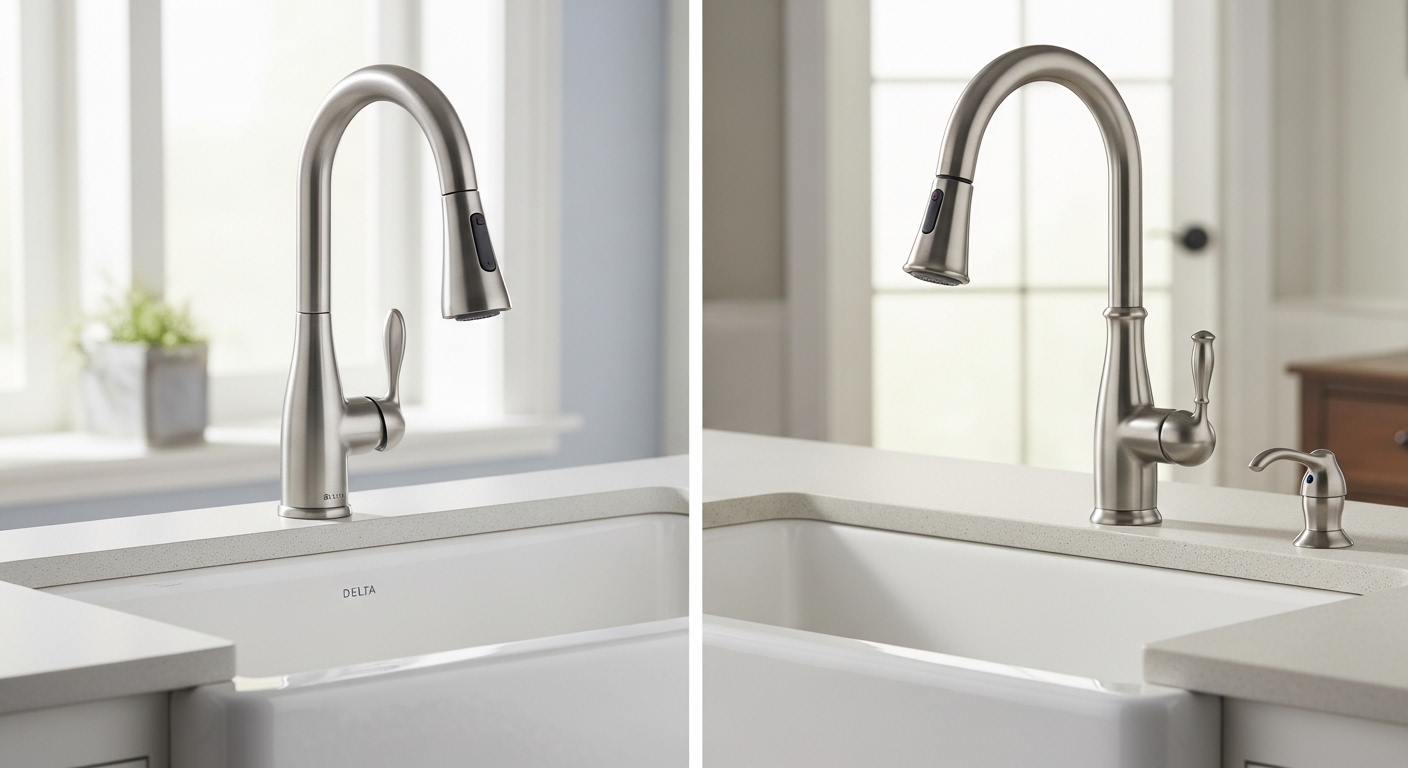
The honest truth about the delta vs kohler sink faucet debate is that you almost can’t lose — these are two of the most reliable American faucet brands you can put on a kitchen or bathroom sink. But “you can’t lose” isn’t a buying decision, and you’re here because you have a specific sink, a specific budget, and a specific finish in mind. So let’s skip the brochure talk and get into how these two brands actually differ where it counts: water flow, valve type, repairability, finish durability, warranty, and real-world price.
At wigafaucet, we install, test, and stock faucets from dozens of brands every week, and we field this exact question constantly. Below is the same plain-English breakdown we’d give a friend standing in front of their sink trying to decide.
What’s the real difference between a Delta and a Kohler sink faucet?
The core difference is engineering philosophy: Delta is built around serviceability and clever technology (Touch2O, MagnaTite docking, DIAMOND Seal valves), while Kohler is built around materials and design (heavier solid brass, ceramic-disc valves, and a deep catalog of designer finishes). Delta tends to be the easier faucet to live with and repair; Kohler tends to be the more substantial faucet to look at and touch.
Here’s what that means in practice. A Delta faucet usually uses the brand’s DIAMOND Seal Technology — a valve coated with real diamond particles — which lets Delta promise lifetime, leak-free performance and skip plumber’s grease. Kohler leans on Ceramic Disc Valve technology, the industry standard for smooth, drip-free operation that’s rated to exceed standard longevity testing. Both are genuinely good. The difference you’ll feel is that Delta handles are light and “techy,” while Kohler handles often feel weightier and more deliberate.
| Factor | Delta Sink Faucet | Kohler Sink Faucet |
|---|---|---|
| Valve technology | DIAMOND Seal / ceramic disc | Ceramic disc (Kohler-engineered) |
| Signature tech | Touch2O touch-on, MagnaTite docking, ShieldSpray | Response touchless, Sweep/Boost spray, DockNetik magnet |
| Typical build | Brass + engineered polymer body | Often heavier solid brass |
| Finish system | SpotShield / Spot-Resist | Vibrant + PVD finishes |
| DIY repairability | Excellent — simple cartridges, huge parts supply | Good — but parts can cost more |
| Typical price range | $90–$350 | $130–$600+ |
| Warranty | Lifetime limited (residential) | Lifetime limited (residential) |
Which brand is easier to install and repair myself?
Delta is the easier brand for a DIY installation and especially for repairs — its cartridges are simple, widely stocked at any hardware store, and the company’s parts support is the best in the business. If you’re the kind of person who’d rather fix a drip in 15 minutes than call a plumber, Delta is the safer pick.
That doesn’t mean Kohler is hard. A typical single-hole Kohler installs the same way a Delta does, and both brands now ship with quick-connect supply lines and tool-light mounting hardware. But when something eventually wears out years down the road, here’s the difference:
- Delta: Cartridges and seats/springs are cheap, color-coded, and available everywhere. A repair kit is often under $20, and YouTube is full of Delta-specific walkthroughs.
- Kohler: Ceramic-disc cartridges are extremely durable, so you’ll rarely replace one — but when you do, the part can cost more and may need to be ordered for certain designer models.
- Both: Honor a lifetime limited residential warranty that covers the faucet and finish for the original owner, and both ship free replacement parts under that warranty if you call them.
If you want to brush up before you start, our guide on installing a bathroom vanity faucet yourself in under 2 hours walks through the exact steps that apply to either brand, and our faucet supply line dimensions guide will keep you from buying the wrong connectors.
Delta vs Kohler for a kitchen sink under $250 — which wins?
Under $250, Delta usually wins for a kitchen sink because you get more useful technology — touch-on activation, magnetic spray docking, and spot-resist stainless — at that price than Kohler typically offers in the same band. Kohler’s strongest value tends to start a little higher, where its solid-brass pull-downs and Vibrant finishes really shine.
For a busy family kitchen on a budget, a Delta pull-down with Touch2O (tap anywhere with a wrist or forearm to start water when your hands are full of raw chicken) and MagnaTite docking (the sprayhead snaps back firmly instead of drooping over time) is genuinely hard to beat near $200. It’s the practical choice.
Spend up to $350–$450 and the math changes. That’s Kohler’s sweet spot: a model like a Kohler Simplice or Sensate gives you that heavier solid-brass feel, a high-arc swivel spout, and a finish that looks more like a designer showroom piece. If your kitchen is a centerpiece and the faucet is jewelry, Kohler earns the premium. If the faucet is a hardworking tool, Delta gives you more for less. If you’re weighing spray styles, our deep dive on the pull-out kitchen mixer faucet explains pull-out vs pull-down so you don’t overpay for the wrong spray head.
Which is better for a bathroom sink — Delta or Kohler?
For a bathroom sink, Kohler has a slight edge on style and finish variety, while Delta has the edge on price and easy single-handle simplicity — so choose Kohler if the look leads your decision and Delta if function and budget do. Both make excellent centerset, single-hole, and widespread bathroom faucets.
The deciding factor for a bathroom sink is almost always your sink’s hole configuration, not the brand badge. Count your holes first:
- 1 hole: A single-hole faucet (both brands offer many). Cleanest, most modern look.
- 3 holes, 4 inches apart: A centerset faucet — handles and spout on one base plate.
- 3 holes, 8 inches apart: A widespread faucet — separate handles and spout for a high-end look.
Both Delta and Kohler cover all three layouts, but Kohler’s catalog of finishes — brushed gold, matte black, polished nickel, and its Vibrant line — is deeper if you’re matching a specific design scheme. If you’re leaning toward a spread-out installation, our explainer on the widespread faucet layout shows whether it fits your vanity before you commit, and if warm metals are your thing, the brushed gold bathroom faucet guide covers how those finishes hold up day to day.
Which brand’s finish lasts longer and resists spots better?
Both brands use durable PVD-grade finishes, but Delta’s Spot-Resist / SpotShield stainless is the single best-known finish for hiding water spots and fingerprints, while Kohler’s Vibrant finishes are bonded at an ionic level for outstanding scratch and tarnish resistance. For a fingerprint-prone household, Delta’s spot-resistant stainless is the most forgiving; for long-term color richness, Kohler’s Vibrant is exceptional.
A few real-world notes on finishes:
- Matte black: Stunning but shows hard-water residue and dried soap on both brands — wipe with a damp cloth, never abrasive pads.
- Stainless / brushed nickel: The most forgiving everyday finish from either brand. Delta’s spot-resist version edges it for low maintenance.
- Chrome: Cheapest, easiest to clean, but shows every water droplet. Great in a guest bath.
- Brushed gold / champagne bronze: Kohler’s designer warm tones are gorgeous and hide spots well.
One overlooked factor: hard water is harder on finishes and aerators than the brand you choose. If you have mineral-heavy water, you’ll be cleaning the aerator regardless of badge — our guide to removing cache and recessed aerators without damage will save you a scratched finish when that day comes.
Do Delta and Kohler have the same water flow and pressure?
Yes — both Delta and Kohler kitchen faucets ship at the federally standard 1.8 gallons per minute (GPM) flow rate, and both bathroom faucets meet the 1.2 GPM WaterSense standard, so neither brand gives you meaningfully “stronger” water out of the box. Perceived pressure comes from spray design and your home’s plumbing, not the brand.
If your water feels weak with either faucet, the culprit is almost always the aerator or the flow restrictor, a clogged supply line, or low household pressure — not a Delta-vs-Kohler issue. Delta’s ShieldSpray and Kohler’s Sweep/Boost spray modes are both engineered to make a given GPM feel more powerful by concentrating the stream. If you want noticeably more force at the kitchen sink, see our walkthrough on removing the kitchen faucet flow restrictor — it applies to both brands and matters far more than the logo.
Delta vs Kohler: the quick decision guide
Still torn? Use this as a tiebreaker. Pick the row that sounds most like you and buy accordingly.
| If you care most about… | Buy |
|---|---|
| Easiest DIY repairs and cheap parts | Delta |
| Touch-on / touchless tech under $250 | Delta |
| Hiding fingerprints and water spots | Delta (Spot-Resist) |
| Heaviest solid-brass feel | Kohler |
| Widest designer finish selection | Kohler |
| Showpiece styling for a remodel | Kohler |
| Lowest price for solid quality | Delta |
| Smoothest ceramic-disc handle feel | Kohler |
The pattern is clear: Delta is the value-and-function brand, and Kohler is the materials-and-design brand. Neither is a wrong answer, and both back their faucets with a lifetime limited residential warranty that covers leaks and finish defects for the original owner. When customers ask us which delta vs kohler sink faucet to put in a rental or a busy family kitchen, we usually steer them to Delta for the repair simplicity; for a master bath or a kitchen they’re showing off, we often steer them to Kohler.
What about a third option — should you consider other brands?
Yes, if your real goal is a specific style or spec rather than a brand name, it’s worth comparing Delta and Kohler against quality alternatives before you buy — because the “best” faucet is the one that fits your sink, finish, and budget, not the most famous logo. Delta and Kohler are excellent defaults, but they’re not the only good faucets on a sink.
At wigafaucet, we carry pull-down, pull-out, widespread, and commercial-style faucets across finishes that go head-to-head with both brands on valve quality and finish durability, often at a friendlier price. If you came in set on Delta or Kohler, great — but if you came in set on, say, a matte-black single-hole pull-down under $200, it’s worth seeing every faucet that fits that brief. Browse our kitchen mixer collection to compare options side by side before you commit.
FAQ
Is Delta or Kohler more reliable long-term?
Both are highly reliable and carry lifetime limited residential warranties. Kohler’s ceramic-disc valves are extremely long-lived, while Delta’s faucets are easier and cheaper to repair when a part finally wears out — so “reliable” depends on whether you mean fewer repairs (slight edge Kohler) or easier repairs (clear edge Delta).
Are Delta and Kohler faucets made in the USA?
Both brands are American companies (Delta is part of Masco; Kohler is based in Wisconsin) and both manufacture and/or assemble many faucets in the U.S. while sourcing some components globally. Specific country of origin varies by model, so check the individual product’s spec sheet if domestic manufacturing matters to you.
Which brand is cheaper, Delta or Kohler?
Delta is generally cheaper at every comparable tier, especially under $250 where it packs in more technology for the money. Kohler’s pricing climbs faster because of its heavier solid-brass builds and designer finishes, so dollar-for-dollar Delta is the value pick.
Can I use the same supply lines and shutoff valves for either brand?
Yes. Both Delta and Kohler use standard 3/8-inch compression supply connections and fit standard sink hole sizes (typically 1.25–1.5 inches), so your existing shutoff valves and supply lines will usually work with either brand. Confirm length and connector type using a supply-line sizing guide before you install.
Do Delta and Kohler touchless faucets need batteries or a plug?
Most touch and touchless models from both brands run on batteries (commonly AA or a C-cell pack) and some offer an optional AC adapter. Battery life is typically a year or more with normal use, and both faucets still work manually if the batteries die — you just lose the hands-free feature until you replace them.
Which is better for hard water, Delta or Kohler?
Neither brand is dramatically better against hard water; both use ceramic-disc-grade valves that resist mineral wear well. What matters more is regular aerator cleaning and choosing a forgiving finish like spot-resist stainless or brushed nickel. In very hard water, a Delta with Touch2O and an easy-clean aerator is slightly lower-maintenance day to day.
Author note: This guide was written and reviewed by the wigafaucet product team, who specify, install, and pressure-test kitchen and bathroom faucets to ANSI/NSF and WaterSense flow standards. We sell faucets from many brands — including alternatives to Delta and Kohler — so our advice is based on bench testing and real installations, not on pushing a single label.