 Wiga Tap Manufacturer
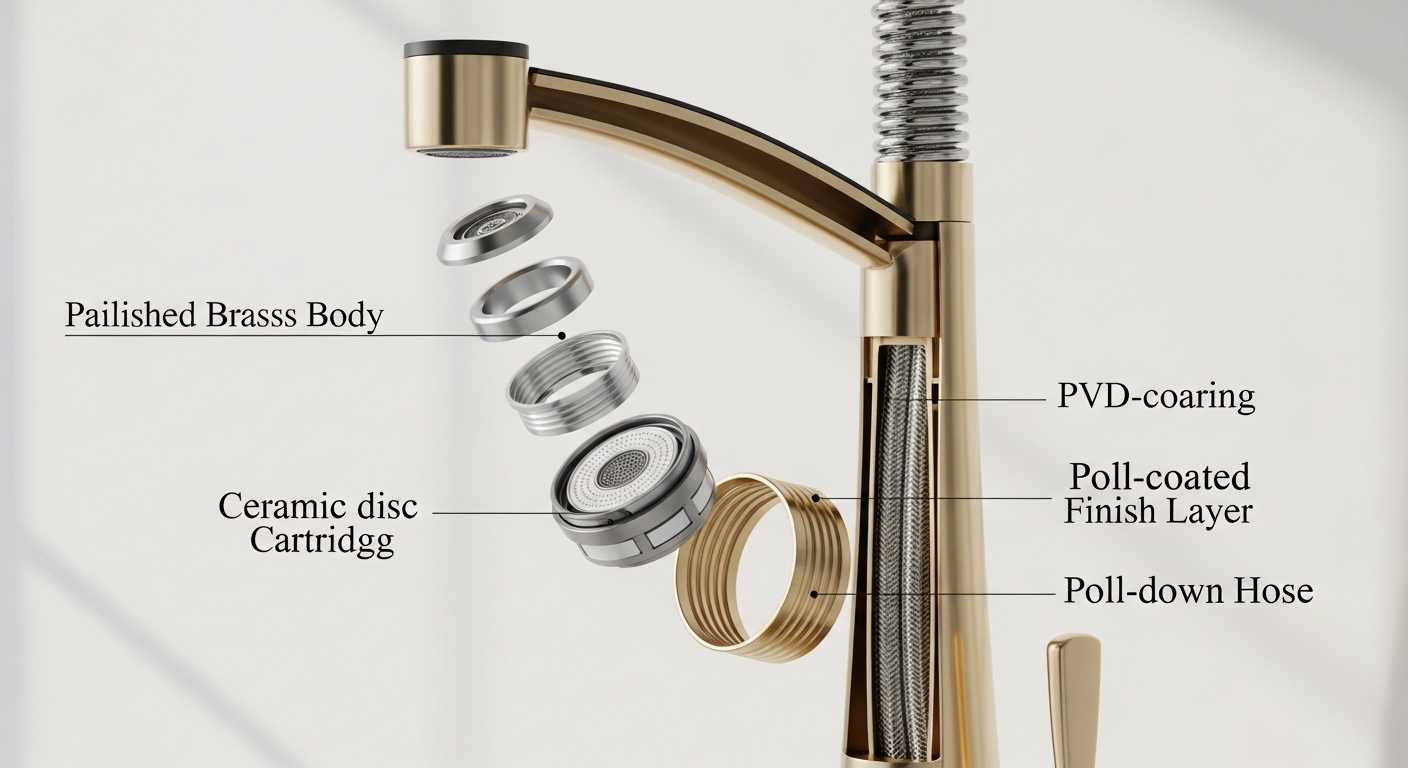
When shoppers ask about the best kitchen faucet quality, they almost never mean “which brand has the prettiest photo.” They mean: which faucet won’t leak in three years, won’t flake its finish, and won’t wobble loose over the sink. That’s a question about materials, cartridges, and construction — not marketing. This guide breaks down exactly what separates a faucet that lasts 15+ years from one you’ll be cursing by year two, with the specific specs to look for on the box or spec sheet.
I’ve installed, repaired, and torn apart hundreds of kitchen faucets, and the pattern is dead consistent: quality lives in a handful of components most buyers never think to check. Get those right and almost any body style — pull-down, pull-out, single-handle, bridge — will serve you well.
How can you tell if a kitchen faucet is actually good quality before you buy it?
You judge kitchen faucet quality by the parts you can’t see in the showroom: the valve body material, the cartridge, the finish process, and the hose. A good faucet feels heavy for its size, lists “solid brass” or “stainless steel” construction, uses a ceramic disc cartridge, and carries a lifetime warranty. A poor one is suspiciously light, says “metal” or “zinc alloy,” uses a rubber-seal or cheap plastic cartridge, and offers a 1–5 year warranty.
Here’s the honest truth most brands won’t print on the box: the finish and spout shape are the least important part of long-term quality. What kills faucets is the cartridge wearing out and the body corroding from the inside. So before you fall for a look, run down this checklist:
- Pick it up. Heft matters. A solid-brass single-handle faucet usually weighs 5–8 lbs. A hollow zinc one feels toy-like. Weight isn’t everything, but featherweight is a red flag.
- Read the body material. “Solid brass” or “SUS304 stainless steel” = good. “Metal,” “alloy,” or “zinc” = corrodes and cracks over time, especially where the threads meet water.
- Find the cartridge type. You want a ceramic disc cartridge, ideally from Sedal, KEROX, or a name-brand equivalent. Avoid ball valves and rubber-washer compression valves in a modern faucet.
- Check the finish label. “PVD” (physical vapor deposition) is bonded at the molecular level and won’t flake. “Electroplated” is cheaper and can peel.
- Inspect the hose. On pull-downs, a braided stainless-covered nylon hose beats bare PVC. Ask about the spray head weight and docking magnet, too.
Does the body material really matter — brass vs stainless vs zinc?
Yes, more than any other single factor. The body is what water sits inside 24/7, so its material determines whether the faucet corrodes from the inside out. Solid brass and SUS304 stainless steel are the two materials worth buying; zinc alloy is the one to avoid for the wetted body.
Brass has been the gold standard for a century because it resists corrosion, machines into precise threads, and takes a finish beautifully. The one caveat: cheaper “leaded” brass is being phased out for health reasons, so look for lead-free brass that meets NSF/ANSI 61 and 372 (the U.S. low-lead standard — under 0.25% weighted average lead). Stainless steel (specifically SUS304) is naturally lead-free, lighter, and very corrosion-resistant, which is why it’s popular for brushed/satin looks.
Zinc alloy (sometimes called “zamak”) is the problem child. It’s cheap and easy to cast, so budget faucets use it for the body and handles. The trouble is dezincification — over a few years, water leaches zinc out of the alloy, leaving the metal porous and brittle until it cracks or the threads strip. A faucet can look perfect on the outside while rotting internally. Zinc is fine for a decorative handle lever; it is not fine for the part holding pressurized water.
| Body Material | Corrosion Resistance | Typical Lifespan | Found In | Verdict |
|---|---|---|---|---|
| Solid brass (lead-free) | Excellent | 15–25+ years | Mid to high-end faucets | Best all-around |
| SUS304 stainless steel | Excellent | 15–20+ years | Brushed/satin finishes | Great, naturally lead-free |
| Zinc alloy (zamak) | Poor (dezincification) | 2–6 years | Budget/big-box specials | Avoid for the body |
| Plastic (ABS) | N/A (won’t corrode, but weak) | 3–7 years, brittle | Cheapest imports, spray heads | OK for spray head only |
This is exactly why seasoned installers keep warning people off the cheapest options — the savings evaporate the moment you’re paying a plumber to swap a corroded faucet you bought two years ago. Our friends in the trade put it bluntly in this piece on why you should never buy cheap bathroom fixtures — the internal materials are where corners get cut, and you don’t find out until it fails.
Which cartridge type lasts longest, and why does it matter so much?
The ceramic disc cartridge is the single most important quality component in a modern kitchen faucet — it’s the part that actually turns the water on, off, and mixes hot and cold. A quality ceramic disc cartridge is rated for 500,000 or more open/close cycles and can go 15–20 years without dripping. Ball valves and rubber compression washers wear far faster.
Here’s why ceramic wins: two polished ceramic discs slide against each other to open and close the flow. Ceramic is harder than the mineral grit in your water, so it doesn’t erode. That’s what stops the slow drip that eventually plagues cheaper valves. When people say a faucet “started dripping and I couldn’t fix it,” they almost always mean the cartridge — and on a quality faucet you can usually pop in a replacement cartridge for $15–30 instead of replacing the whole unit.
A few cartridge tips that signal real quality:
- Named cartridge brands. Sedal (Spanish), KEROX (Hungarian), and manufacturer-specific cartridges (Moen’s 1255, Delta’s DST, Kohler’s ceramic) are proven. A no-name cartridge is a gamble.
- Serviceability. The best faucets let you replace the cartridge in 10 minutes with an Allen key. If the cartridge is glued or the whole valve is sealed, walk away.
- Warranty coverage. Top brands ship you a free replacement cartridge for life. That’s a company betting on its own part — a strong quality signal.
If your current faucet already drips, don’t assume you need a whole new one. For many pull-downs and specialty faucets, a cartridge swap solves it — the same logic applies to filtered-water setups, as we cover in our guide to reverse osmosis faucet cartridge replacement.
Are expensive brand-name faucets actually worth it over a $60 big-box faucet?
Usually yes — but not always, and the reason is warranty and parts, not prestige. A $200–350 faucet from a reputable brand is worth it because you get a lifetime warranty, decades of replacement-part availability, and verified low-lead certification. A $60 unbranded faucet may work fine for a year, but when the cartridge fails, there are no parts, and you replace the whole thing.
Think about it as cost-per-year. A $280 quality faucet that lasts 18 years costs about $16/year. A $60 faucet replaced every 3 years — plus install labor each time — easily runs $40–80/year once you count a plumber. The “expensive” faucet is the cheap one over its lifetime. That said, you don’t need to buy the $600 designer model; the quality gains flatten out above roughly $300–400 for a residential kitchen. You’re paying for styling and smart features past that point, not durability.
Brand comparisons help here. If you’re weighing the big American names, our breakdowns of Delta vs Kohler sink faucets and whether Kraus is a good brand for faucets dig into how each stacks up on cartridges, finishes, and warranty support — the three things that actually differ between them.
Which finish holds up best in a real kitchen — and which ones show everything?
For durability, brushed/satin nickel and PVD stainless are the most forgiving finishes; matte black and polished chrome look great but show water spots and fingerprints fastest. What matters more than the color is how the finish is applied: PVD-coated finishes resist scratching and won’t tarnish, while cheap electroplated finishes can flake at the edges within a few years.
Kitchens are brutal on finishes — grease, acidic food splatter, hard-water minerals, and constant touching. Here’s how the common finishes really behave day to day:
- Brushed / satin nickel: The practical champion. Hides water spots and fingerprints, easy to wipe, timeless. Best default for most families.
- PVD stainless steel: Extremely durable, matches most appliances, resists scratches. Slightly cooler tone than nickel.
- Matte black: Gorgeous and on-trend, but shows hard-water scale and dried droplets clearly. Needs frequent wiping. Insist on PVD-grade black, not painted.
- Polished chrome: Cheapest to produce and very durable, but a fingerprint and water-spot magnet.
- Brushed gold / champagne bronze: Warm and popular; only worth it in a true PVD coating, or it’ll dull.
The finish-quality tell is a single acronym: PVD. Physical vapor deposition bonds the finish at a molecular level, so it resists corrosion and scratching for the life of the faucet. If a spec sheet doesn’t mention PVD and the finish is a fashion color, assume it’s electroplated and treat the warranty terms carefully.
What quality details should you check specifically on a pull-down faucet?
On a pull-down, quality shows up in the hose, the spray head, and the docking magnet. Look for a braided nylon hose with a stainless overbraid, a spray head that switches modes cleanly and doesn’t leak at the collar, and a strong magnetic dock that snaps the head back into place and holds it — not a weak clip that lets the head droop over time.
Pull-downs have more moving parts than a standard faucet, so there’s more to get wrong. A quality unit will have a smooth-retracting hose (a counterweight on the hose under the sink helps it dock), a spray head with a genuine ceramic or coated nozzle to resist scale, and toggle or button controls that click positively between stream and spray. If the spray head is lightweight plastic and the dock is a plastic ring, expect the head to sag within a year.
One quality feature people love but rarely check: flow rate and aerator design. U.S. faucets are capped at 1.8 GPM (some regions 1.5 GPM), and a good aerator gives you a strong, splash-free stream at that limit. Cheaper faucets feel weak because their aerator and internal passages are poorly designed — not because of the flow cap. If yours already feels weak, our walkthrough on removing the kitchen faucet flow restrictor explains the safe, legal way to check and clean it before blaming the faucet.
What standards, testing, and warranty should a quality faucet meet?
A genuinely high-quality kitchen faucet in North America should carry NSF/ANSI 61 and 372 certification (for safe, low-lead drinking water), meet ASME A112.18.1/CSA B125.1 for construction and performance, and come with a manufacturer’s limited lifetime warranty on the finish and mechanical parts. Those three lines on a spec sheet tell you more about quality than any product photo.
Here’s what each one actually protects you from:
- NSF/ANSI 61 & 372: Verifies wetted materials are safe and lead content is under the 0.25% weighted-average legal limit. Non-negotiable for a faucet you drink from.
- ASME A112.18.1 / CSA B125.1: The plumbing-fixture performance standard covering flow, pressure, and durability testing. Reputable brands test to this.
- Cycle testing: Quality cartridges are lab-tested to 500,000+ cycles. Some brands publish this; it’s a strong durability signal.
- Lifetime warranty: A company only offers lifetime coverage when it trusts its own parts. A 1–5 year warranty is a quiet admission the parts won’t last.
Standards also matter internationally — regulators keep tightening sanitaryware quality rules, as we noted when a new national sanitaryware standard took effect. The takeaway for you as a buyer is simple: certifications aren’t red tape, they’re free, third-party proof that a faucet was built and tested to a real bar.
FAQ
What is the most reliable kitchen faucet brand for quality?
There’s no single “best” brand, but Moen, Delta, Kohler, and Kraus consistently rank high because they combine ceramic disc cartridges, solid construction, lifetime warranties, and — critically — decades of replacement-part availability. The brand matters less than the spec sheet: a solid-brass body, named cartridge, PVD finish, and lifetime warranty from any reputable maker will outperform a fancy brand skimping on internals.
How long should a good quality kitchen faucet last?
A quality kitchen faucet with a solid brass or SUS304 stainless body and a ceramic disc cartridge should last 15–20 years, and often longer with basic care. The cartridge may need one inexpensive replacement in that span, which is normal maintenance, not failure. Budget zinc-alloy faucets typically last only 2–6 years before corrosion or cartridge wear forces a full replacement.
Is a heavier faucet always better quality?
Heavier usually means more solid brass or stainless, which is a good sign — but weight alone isn’t proof. Some makers add zinc to bump weight cheaply. Use heft as a first-pass filter, then confirm with the body material, cartridge type, and warranty. A genuinely light stainless faucet can still be excellent; a heavy zinc one can still be junk.
Are stainless steel or brass kitchen faucets better?
Both are excellent and will each last well over a decade. Solid brass is the traditional choice, machines to tighter tolerances, and takes finishes beautifully; SUS304 stainless is naturally lead-free, lighter, and pairs perfectly with stainless appliances. Choose based on the finish you want and your budget — for internal quality, they’re roughly equal, and both beat zinc easily.
Does a lifetime warranty really mean the faucet is high quality?
Largely, yes. A limited lifetime warranty means the manufacturer expects the faucet to last decades and will ship free replacement cartridges and parts if it doesn’t. Companies don’t offer that on parts they know will fail. Always read what’s covered — the best warranties cover both the finish and the mechanical/cartridge parts, and stay with you (or transfer to a new homeowner) for as long as you own the faucet.
Can I improve a good faucet’s lifespan with maintenance?
Absolutely. Wipe the finish dry after heavy use to prevent hard-water spots, clean or soak the aerator in vinegar every few months to clear mineral scale, and replace the cartridge at the first hint of a drip rather than letting it worsen. On pull-downs, keep the docking magnet and spray-head collar clean. These small habits easily add years to even a mid-priced quality faucet.
The bottom line on kitchen faucet quality
The best kitchen faucet quality isn’t a brand name or a price tag — it’s a specific combination of a lead-free solid-brass or stainless body, a ceramic disc cartridge, a PVD finish, a braided stainless hose, and a lifetime warranty backed by real certifications. Check those five things and you’ll never overpay for looks or get burned by a faucet that fails in year two. Spend where it counts — the internals — and almost any style you love will serve your kitchen for the next two decades.
About the author & wigafaucet: This guide was written by the wigafaucet product team, drawing on hands-on installation, teardown, and warranty-claim data across hundreds of kitchen and bath fixtures. wigafaucet (wigafaucet.com) specializes in faucets and bathroom fixtures, and we test every faucet we recommend against NSF/ANSI low-lead requirements, ASME/CSA performance standards, and real-world cartridge cycle durability before it earns a spot in our buyer’s guides. Our goal is simple: help you buy once and buy right.